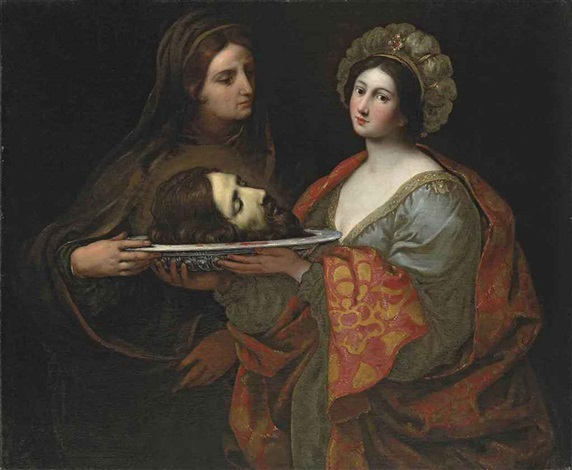

Scan of jacket front from War On Music (Canadian label) vinyl reissue of 2012
2026 marks the thirtieth anniversary of None So Vile: a seminal album in extreme metal by Canadian death metal band Cryptopsy which features an arresting photograph of a Baroque painting of The Daughter of Herodias holding the head of St John the Baptist on its cover. I’ve been interested in the painting for a long while, but started researching it in earnest early this year, thinking it might make a straightforward “this is who it’s by, this is when it’s from, this is what it means” post here. However, on delving into the surrounding literature, its story is far from simple. Instead, when unpacking my research, it’s somehow turned into a 10,000 word essay that explores how it may point towards a lost version by the Bolognese master Guido Reni.
So (despite my better judgement) this post will first look at the its surprisingly effective use on the cover of the seminal 1990s extreme metal release None So Vile, and where the specific painting hangs today. After sorting out who is holding the head (mother or daughter), it will take a dive into how the painting fits with the oeuvre of seventeenth-century Bolognese artists. These are Guido Reni (1575–1642), who clearly designed the original composition, and the taken-too-soon maestra Elisabetta Sirani (1638–65), generally considered as part of Guido’s school of painting and is currently the institutional attribution for this canvas. However Elisabetta was much, much more than a mere copyist and, I will argue, very unlikely to be responsible for this interesting variant painting that happened to be chosen for the album cover. When considered as a work from the workshop of Guido Reni, the particular painting used by Cryptopsy arguably attains a greater importance as reflecting the master’s original, ousting the currently accepted primary work in Rome which has a spotty critical history regarding its quality.
For the sake of completeness, I also look at the other compositions of the Daughter of Herodias receiving the Head of the Baptist that came out of Guido’s workshop, and incidentally, how Elisabetta’s father, Giovanni Andrea Sirani, may have reinterpreted them. In turn, these may have influenced his talented daughter in some of her own works-on-paper regarding the subject, that deserve more attention for their development of the character of the daughter of Herodias toward the modern conception of the independent Salome.
The post-Tridentine Council Seicento is not My Thing (at best, My Thing in Italy is the post-Fourth Lateran Council Trecento) so I heartily welcome any comments or corrections to this, or suggests to the bibliography. At the very least, I hope someone finds it interesting.
Contents
None So Vile and its cover art
“I do that rather well… don’t you think?“
3 July 1996, Montreal-based death metal band Cryptopsy released their second studio album, None So Vile. It is an album that still stands as an outstanding recording of the genre. The runtime of its eight songs barely over half an hour, it is a carefully-constructed edifice of sonic brutality. Amongst the tremolo-picking and rapid power-chord riffs, the major 4th interval − generally avoided in heavy metal when it’s not trying to be commercial − is frequently embraced, giving the harmonic palette an ironic dimension among the heaviness of the B-tuned guitars. The lyrics of Lord Worm (a.k.a. Dan Greening) also deliver typical extreme metal themes of the undead, serial killers and blasphemy, but with a twist of deadpan black humour.1 Guitarist Jon Levasseur’s lead breaks similarly sit astride moments of chaotic chromaticism and neoclassical harmonic sophistication. The track “Phobophile” with its catchy two-chord arpeggiated main riff, also sticks out because of its portentous piano introduction: the latter now invariably played on “tape” at Cryptopsy’s live shows, was originally written and recorded by bassist Eric Langlois.2 Langlois incorporated slaps and pops into his bass performances which were then unusual in death metal, particularly his short solo breaks in “Slit Your Guts” and “Orgiastic Disembowelment”.3 Ultimately it is held together by the inventive drum lines of Florent “Flo” Mounier: now the longest serving member who continues put out new Cryptopsy releases and take them on tour. Often alongside on the bill these days are much younger deathcore and slam acts, testament to how None So Vile remains a monolithic influence on extreme metal scenes across the globe.4
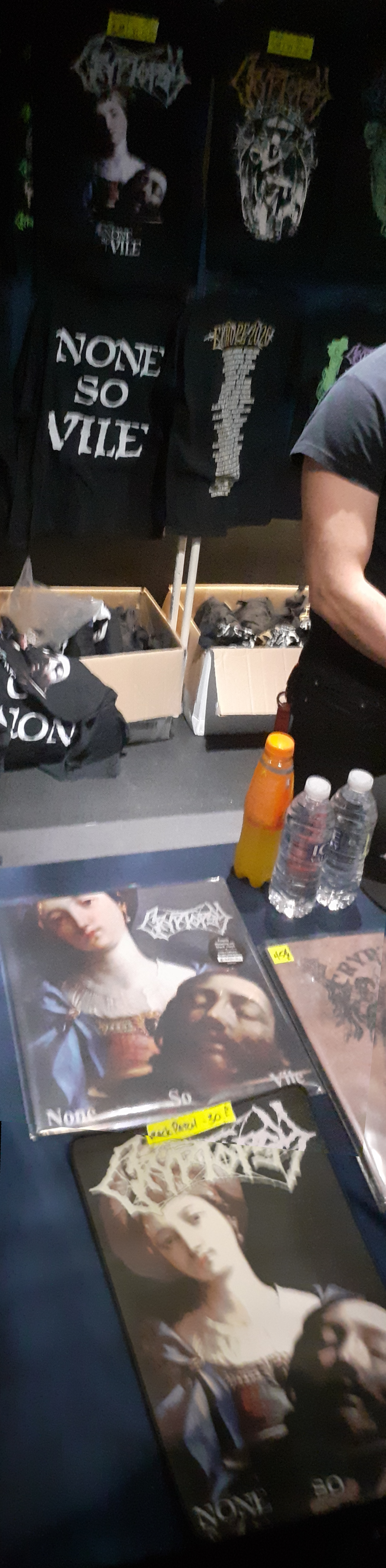
Club Academy, basement of the Steve Biko Building, Oxford Road, Manchester, 22 Jan. 2026.
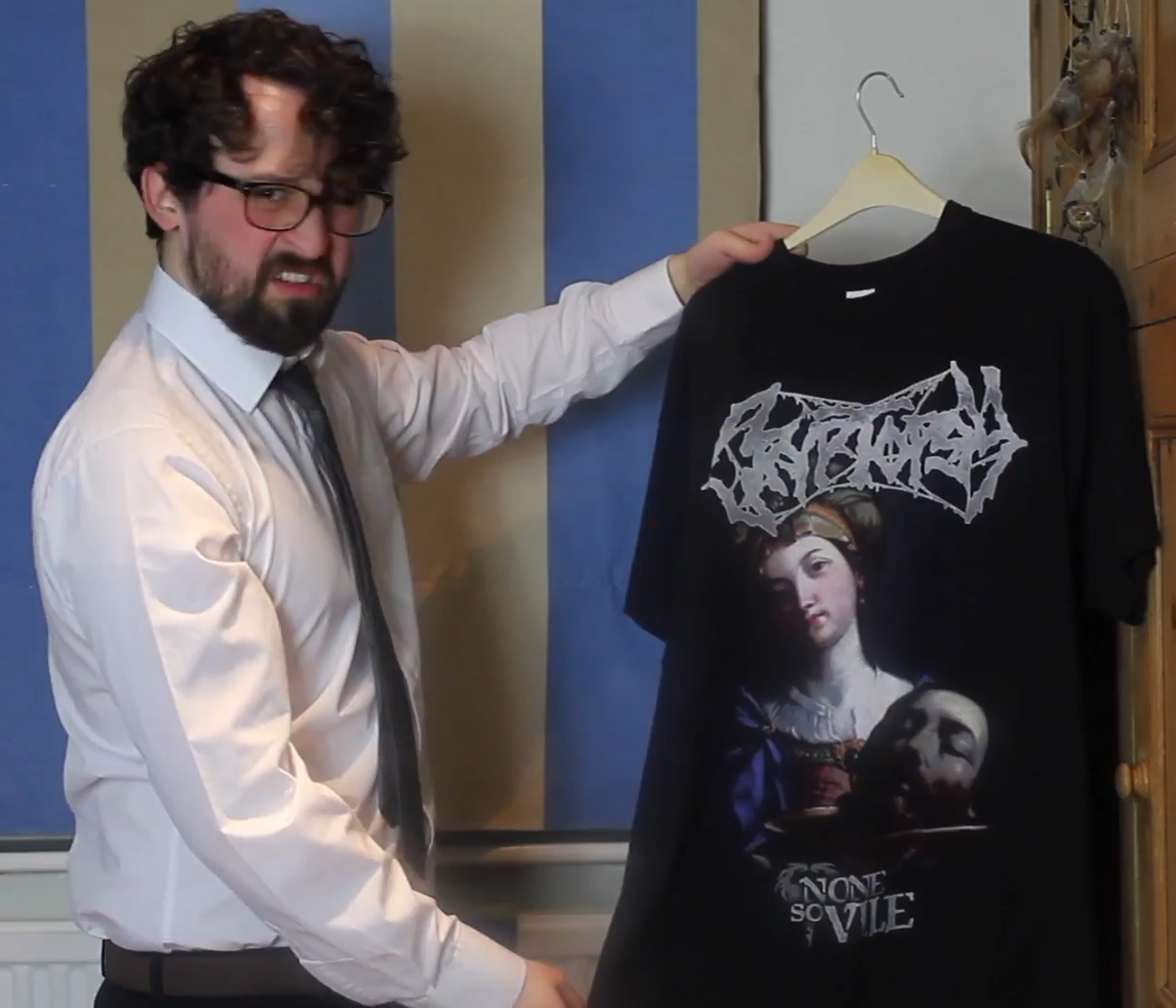
Still from from their skit around a 27-second long grindcore song: “The Phillip Schofield Chainsaw Massacre” (OFFICIAL VIDEO), posted Mar. 2019.
Anyway, that’s just me doing purple prose that will convince nobody who doesn’t already dabble in extreme metal as to the recording’s calibre leading up to the subject of my investigation: None So Vile‘s distinctive cover art. Instead of a commission of a new painting from a contemporary artist attached to the scene, such as the biological-horror landscape of Cryptopsy’s debut, Blasphemy Made Flesh,5 the cover of their sophomore is simply a flipped stock photograph of a Baroque painting of the daughter of Herodias holding the head of St John the Baptist on a platter, with the band logo in the upper right corner and album title in a simple serif font at the bottom, spaced across the width.
Yet remains a remarkably effective choice for an album cover three decades on. I went to a Cryptopsy headline gig in Manchester earlier this year (not the first time I’ve seen the band) which marked the 30th anniversary of None So Vile, and it was marvellous how many—including myself—chose to wear the proverbial “colours” of the 400-year-old Baroque painting to the show.6 The merch stand was also dominated by the image, as you can see above (Left). I know it’s an over-used word, but within a certain scene, this painted image from the Italian Baroque has become iconic: carrying vivid associations and meanings transgressing its original context.7
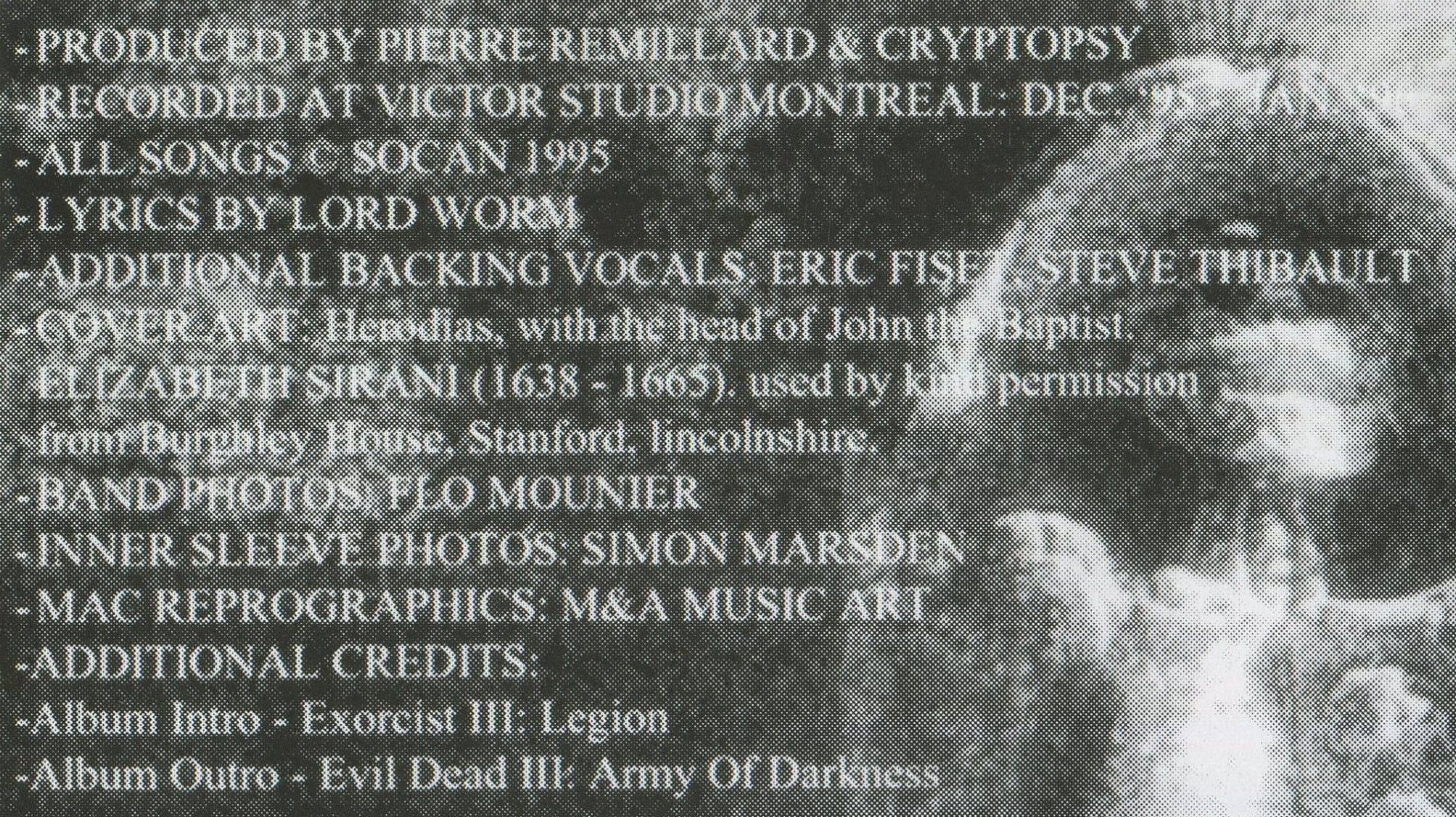
The cover art of None So Vile was chosen by drummer Flo Mounier,8 who called it “a beautiful painting that displays something brutal and horrifying, just like the music”.9 The precise source of the image was not left obscure by the band, for it was identified in the original liner notes (Right) as the version in Burghley House, assigned, as the institution’s own attribution, to Bolognese painter Elisabetta Sirani (rendered as “Elizabeth Sirani” which is fine, I suppose, as it’s the Anglicised version of a given Christian name: however the town is misspelled as “Stanford”).10 It seems most likely that Mounier encountered and licenced the image via the Bridgeman Art Library.11
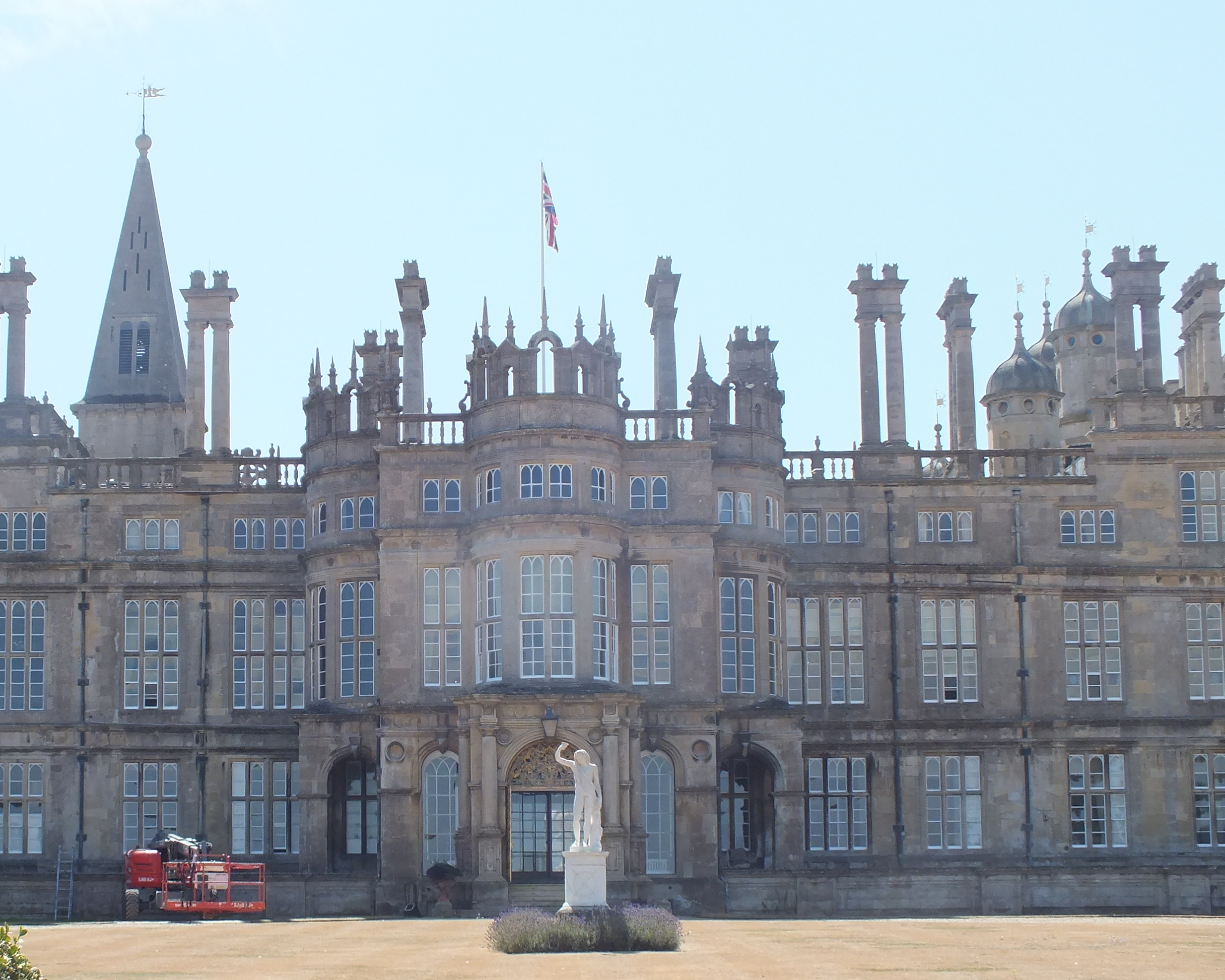
Before I wrote up my research regarding this painting, I had to visit Burghley House itself: perhaps the grandest surviving domestic building project in Elizabethan England, but certainly the only stately home that has a masonry spire on top of it (or obelisk, as unlike church belfry superstructures common to the area it is of square, rather than octagonal plan), sitting atop the courtyard-side frontispiece of its east range. I managed to arrange a visit around a business trip to the eastern counties in August 2026, when the ground was looking a little parched, to say the least.
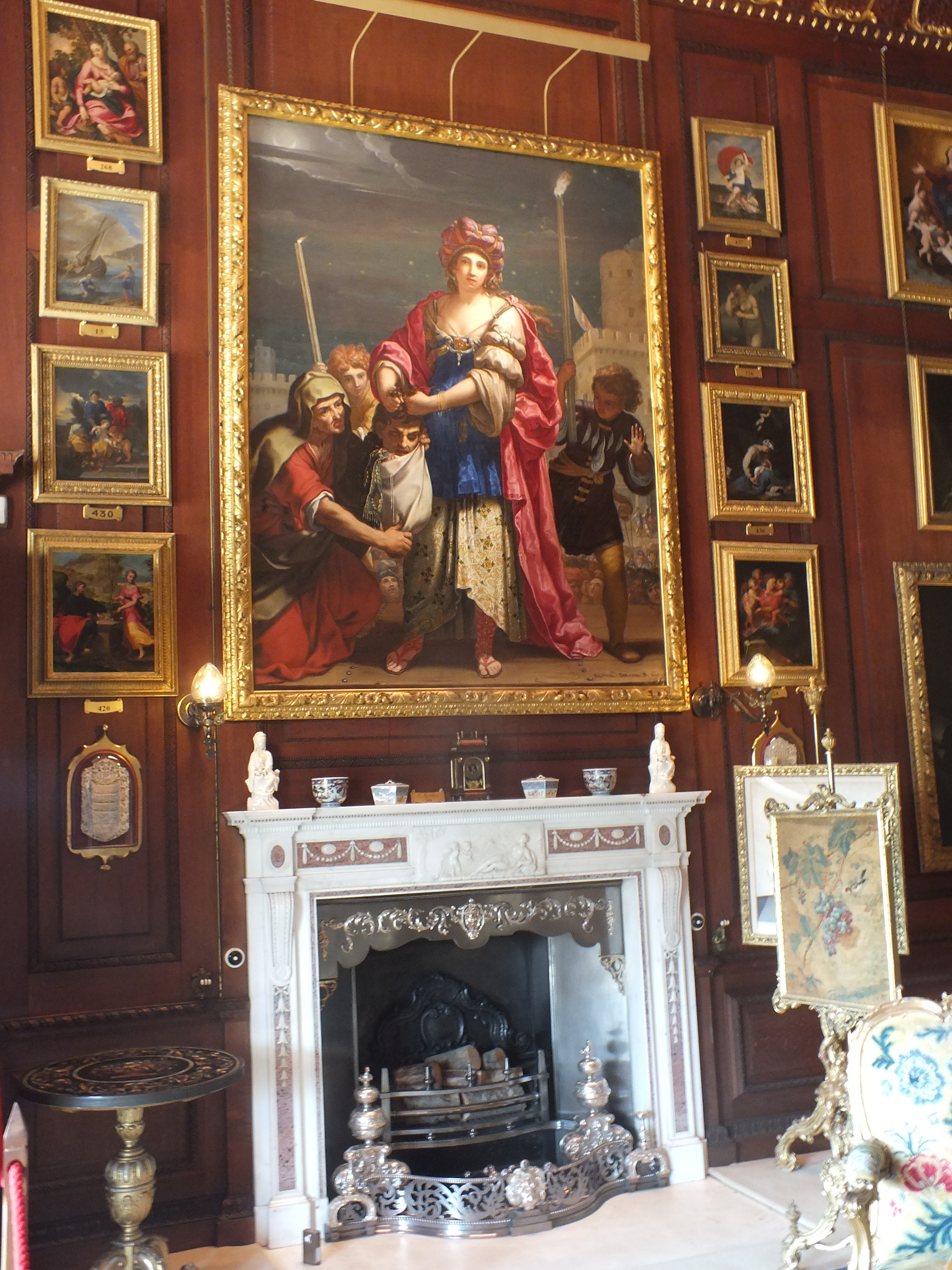
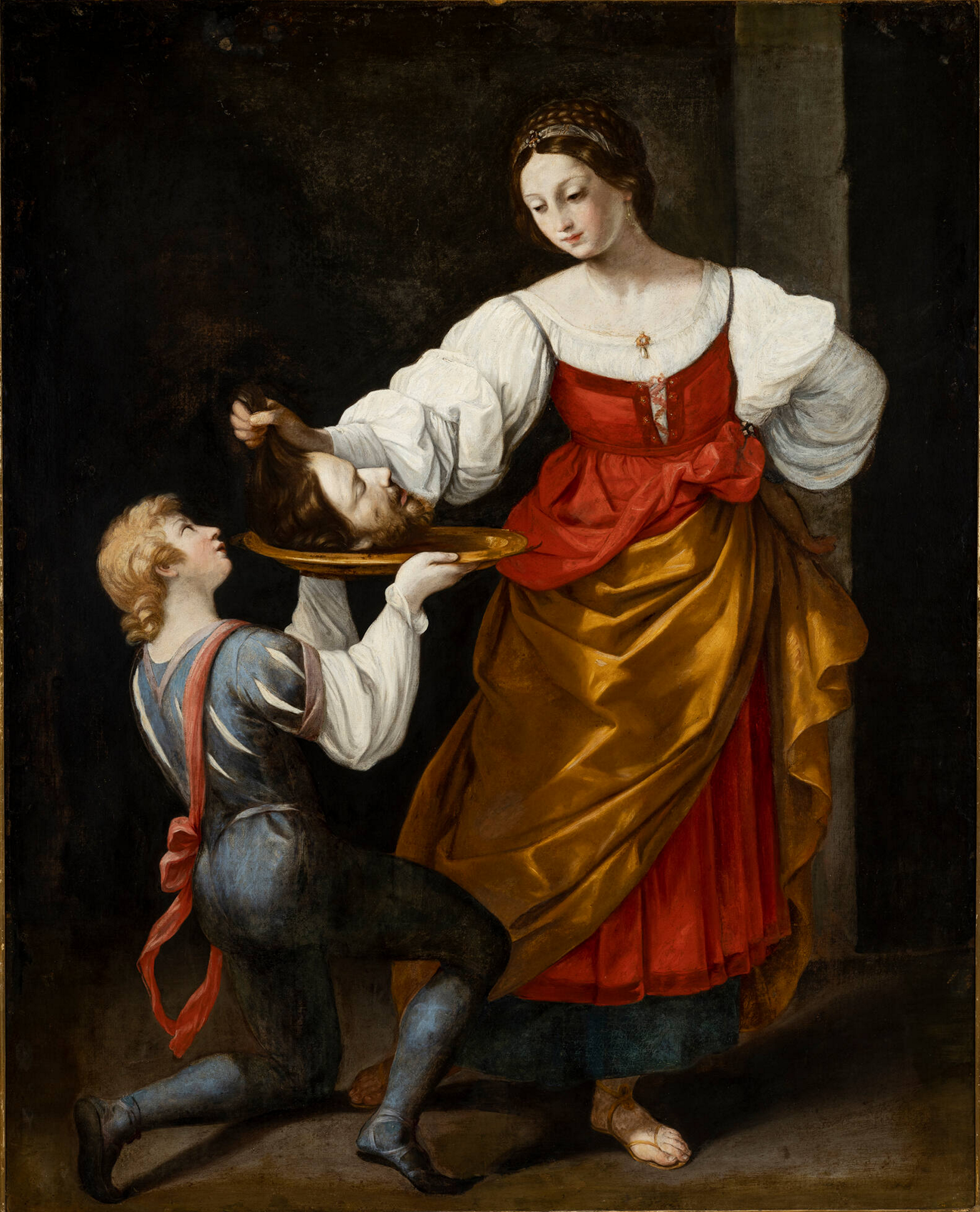
The Burghley House Daughter of Herodias with the Head of St John the Baptist
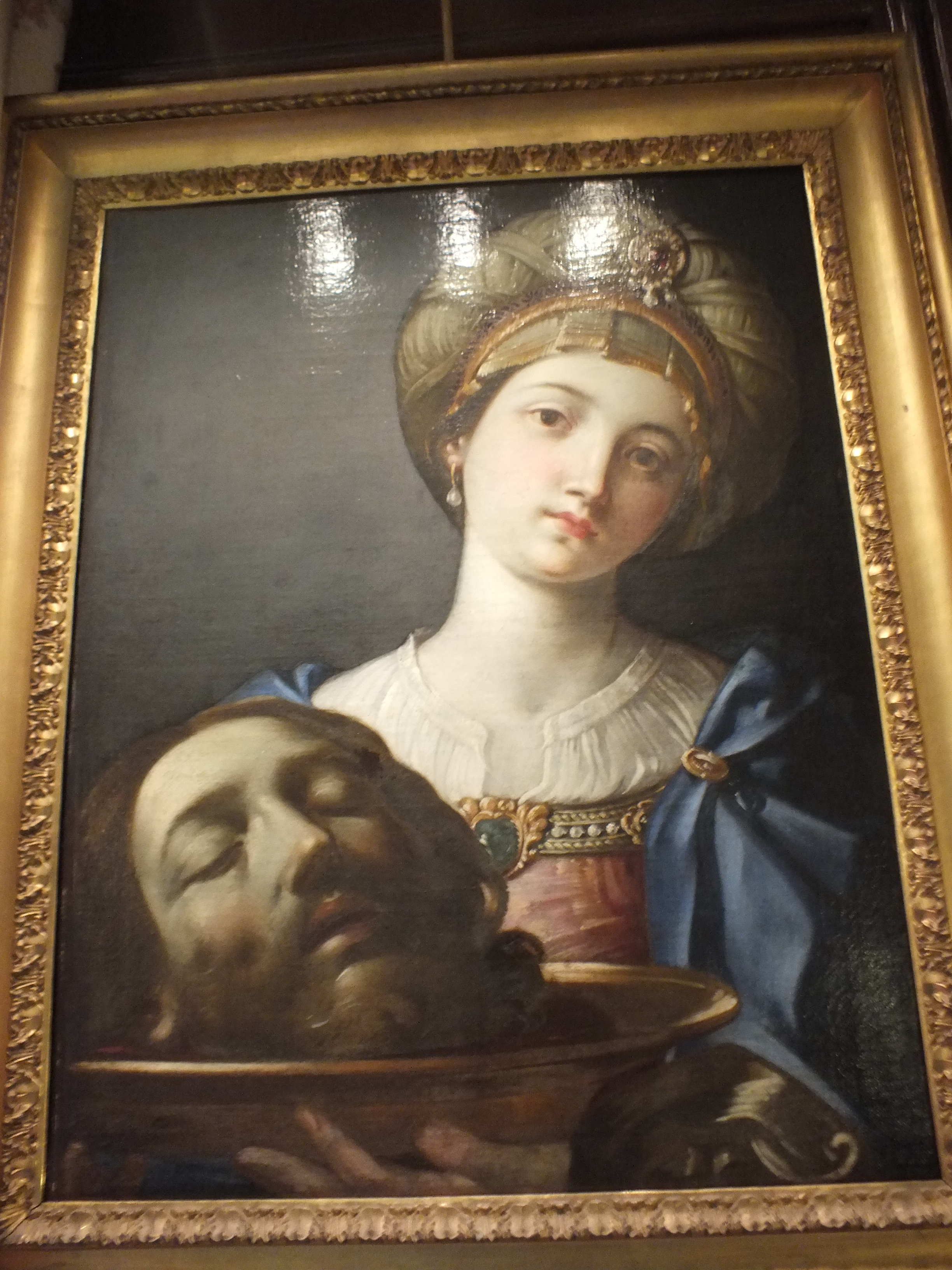
The oil on canvas painting reproduced on the cover of None So Vile hangs in the Brown Drawing Room in the north wing of Burghley House, part of the first-floor rooms open to the general public.12
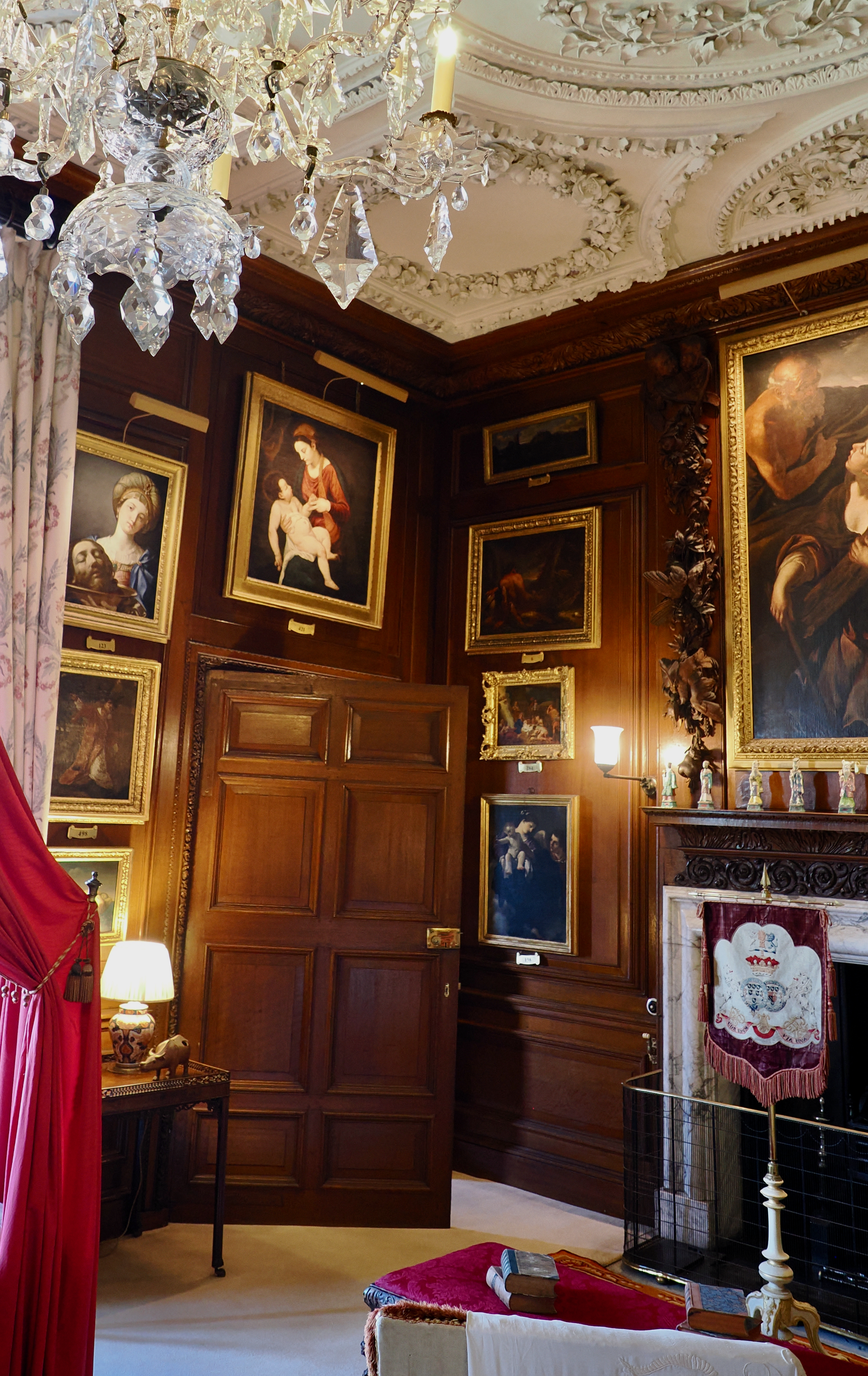
The door in the panelling leads into the closet formed in the quarter circles returns that flank the Bow Room hall to the right.
Taken 28 Jul. 2025 by Simon Wilkinson https://flic.kr/p/2rmac59
From my absolutely non-expert assessment of the canvas viewing it close-up within the frame it seems an even painting largely in good condition, I could observe no evidence that it has been cut down (which we will see why that is important shortly), although there would appear to be a lacuna/repair just above Baptist’s left eye in his hair, and abrasion to the area around the girl’s left eye and turban around that area, which is not so easily seen on reproductions.13
The canvas was acquired for Burghley House by Brownlow Cecil, 9th Earl of Exeter (1725–1793), apparently from the Colonna Palace in Rome on one of his grand tours to Italy, which continued the collecting of Italian artworks by his great-grandfather, John, the 5th Earl (1648–1700).14
The painting is listed as “Herodias” under the heading of the Brown Drawing Room in an 1815 catalogue of Burghley House, where it is given to Guido Reni,15 the premier painter in the Papal States city of Bologna, and indeed, arguably in the whole of Italy in the first half of the seventeenth century. In his lifetime, Guido was referred to as “divine”, a familiar but uncommon epithet for a painter, shared with his predecessors Perugino, Raphael and most famously Michelangelo.16
Herodias or Salome?
One “mystery” about the painting we can clear up very quickly is the identity of the person carrying the platter bearing the head of the Baptist, and the whole issue of Herodias vs. Salome.
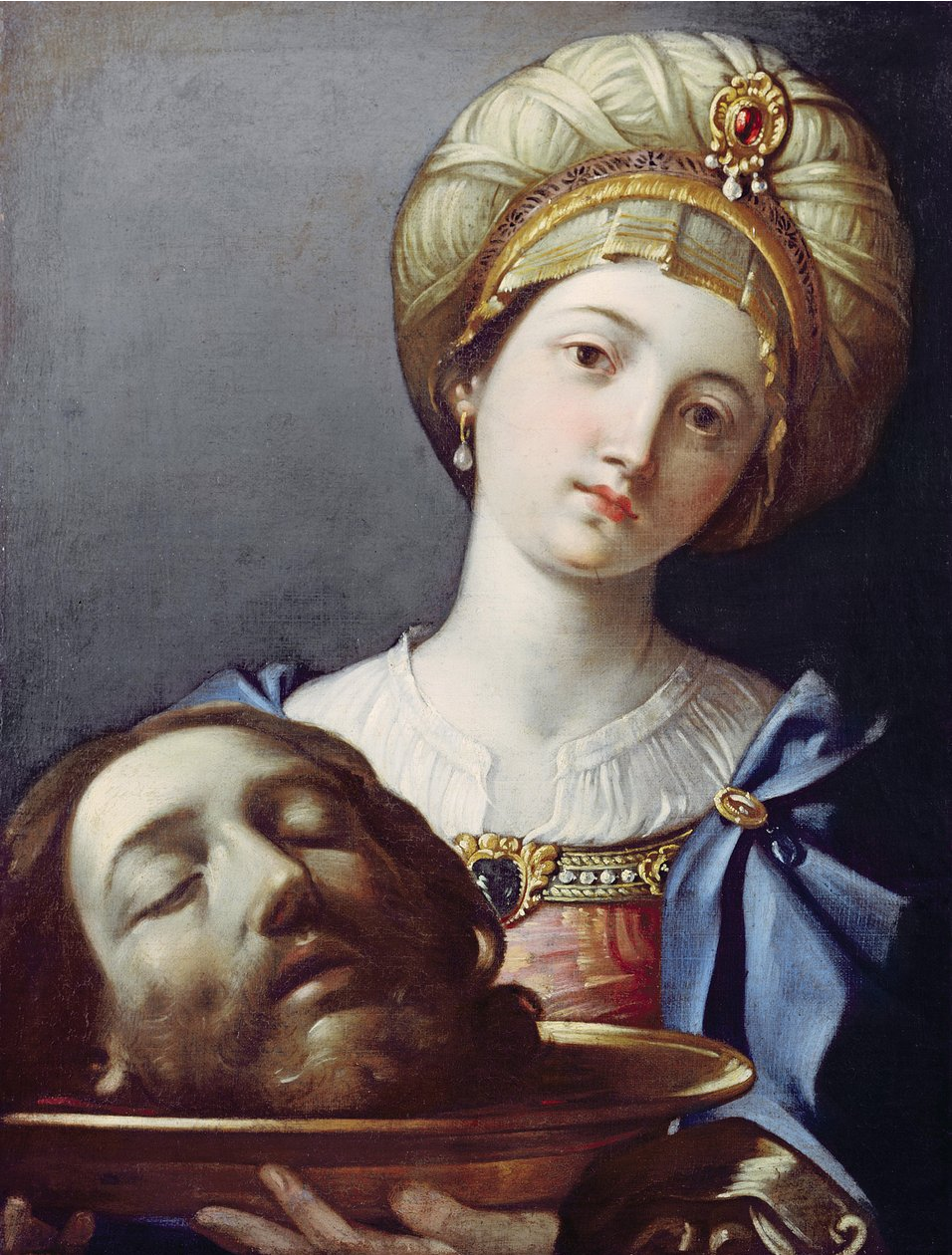
51 × 66 cm
Since the latter part of the nineteenth century, the girl who dances for Herod Antipas, tetrarch of Galilee and son of King Herod the Great (the latter, according to Gospel of Matthew, was the one who ordered the Massacre of the Innocents after the Magi did not return to him to reveal the location of the new-born Christ)17 has been generally referred to as Salome. This name, however, is not mentioned in the Gospels in reference to this individual: she is only referred to as the “daughter of Herodias” and subsequently in the narrative “the girl”.18 Herodias, Salome’s mother, as the Gospel of Mark tells us, had been formerly married to Herod Antipas’s brother Philip, which directly violated Jewish law.19
“Salome” as the name of Herod Antipas’ stepdaughter is sourced from the genealogy of Herod in the Antiquities of the Jews written by Flavian Josephus by the later first century AD, which has no mention of the involvement in the death of John the Baptist by the mother (here it is clarified that Herodias had divorced Herod Antipas’ paternal half-brother, Herod Philip and remarried while he was still alive) or daughter.20
Inventories of art objects before the later nineteenth century invariably refer to the stepdaughter by the name Herodias, following the long-held the assumption she was named after her mother.21 Creative explorations of the Biblical episode from the early nineteenth century, and the idea of “the Bible as literature” following Matthew Arnold, led to the increasing application of the name Salome to the daughter.22 Gustave Moreau made a series of erotically-charged, Orientalising works around the emerging character of Salome from the mid 1870s onward, famously given ekphrases in Joris-Karl Huysmans’ novel À Rebours of 1884.23 This climaxed with Oscar Wilde’s important play “Salomé“, first published in French in early 1893, published in English translation with the ukiyo-e inspired plates by Aubrey Beardsley the following year.24 Wilde’s own invention of “The Dance of the Seven Veils” and its subsequent setting in the 1905 one-act opera by Richard Strauss,25 crystalised Salome as, rendered by Huysmans:
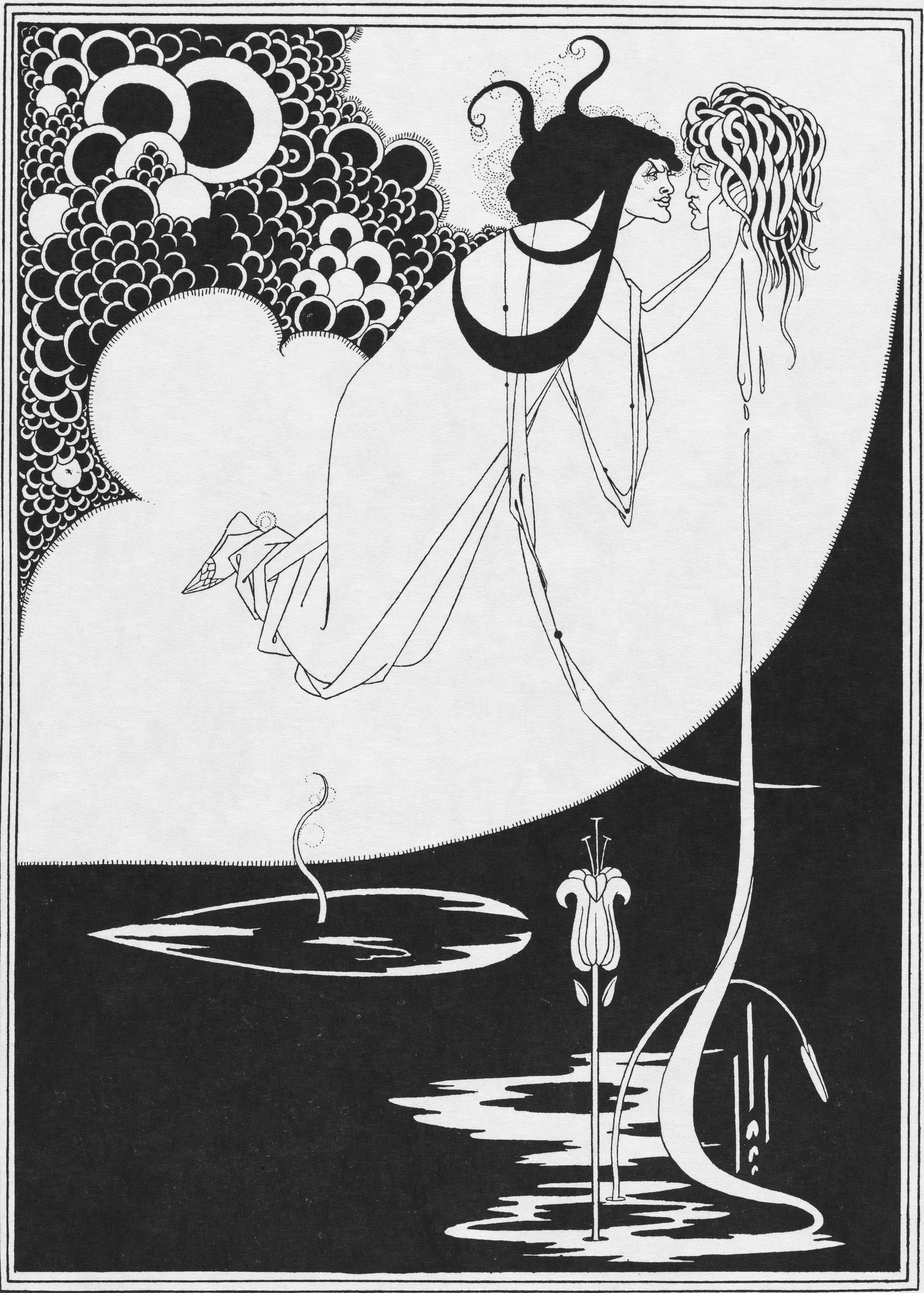
This impression, halftone print, and process prints from line blocks, published as portfolio by John Lane, 1907, Metropolitan Museum of Art, 63.693.2
22.5 × 16.2 cm (block)
“[…]in a sense, the symbolic deity of indestructible lust, the goddess of immortal Hysteria, of accursed Beauty, distinguished from all others by the catalepsy which stiffens her flesh and hardens her muscles; the monstrous Beast, indifferent, irresponsible, insensible, baneful, like the Helen of antiquity, fatal to all who approach her, all who behold her, all whom she touches”.26
This hyper-eroticised, monstrous (as her stepfather condemns her at the end of Wilde’s play, and then orders her own extra-judicial execution) version of Salome can be understood under the rabbinic process of midrash: a form of scriptural exegesis that fills in the gaps of the narrative to draw out the deeper meanings, from widely theological to deeply personal.27
I mention all this as, even for a largely secularised viewership, following the phenomenon of “Salomania” in the first decade of the twentieth century,28 the reception of the album cover is conditioned by this conception of the almost superhuman femme fatale Salome that has since fallen into cliché and occasionally kitsch.29 As important as this is for considering the modern viewer, when considering the original painting in its original context of sixteenth-century Counter-Reformation Italy, and grand tourists of the long eighteenth century, the connotations of the image that the painting presented were very different.
Therefore, I will be referring to the two figures by their strictly Biblical names. “Herodias” for the wife of Herod Antipas formerly married to his half-brother, (that which John the Baptist preached against as a violation of Jewish law and is implied to have angered her), and “the daughter of Herodias” for the tetrarch’s stepdaughter who danced for him, rather than Salome.30 It seems the best compromise between the original label of “Herodias” and forcing the subsequently-accepted name of “Salome” with all of its fin de siècle connotations onto it.
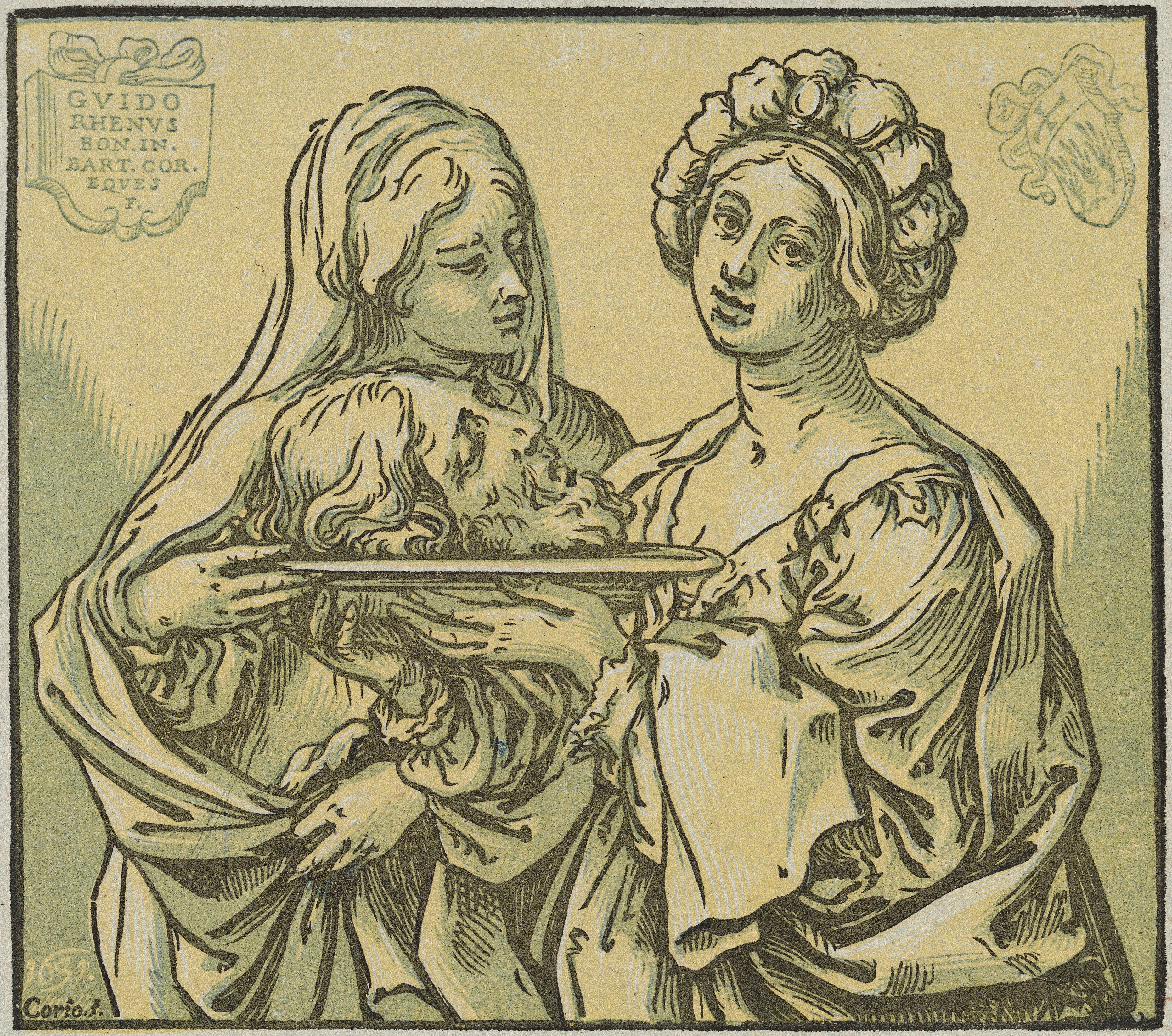
This impression National Gallery of Art, Washington D.C., 2004.67.3
16.7 × 19 cm (block)
Even though it is not in doubt, there is specific evidence that the Burghley House painting depicts the stepdaughter of Herod Antipas we generally today refer as Salome, rather than her mother. This is a woodcut print by Bartholomew Coriolano (Left), which includes an inscription identifying Guido Reni as the “inventor”, and dated 1631 in the bottom right.31
In this print we are shown the moment described in the Gospels of Matthew and Mark when daughter of Herodias, who has a turban bound and joined with a central brooch in a very similar way to the painting, brings the head of the Baptist to her mother. However, the Guido Reni original that this was made after, whether a drawing or a canvas, seemingly no longer exists.32
The Palazzo Corsini Daughter of Herodias and the prodigious oeuvre of Guido Reni (1575-1642)
The ultimate source for the Burghley House picture is widely assumed to be a much-copied canvas of the Daughter of Herodias holding the Head of St John the Baptist at three-quarters length generally attributed to the hand of Guido Reni which hangs in the Palazzo Corsini: one of the two venues that house the collection of the Galleria Nazionale d’Arte Antica in Rome.33 If you are familiar with the album cover, its palette may somewhat surprise you.
c. 1635.
136 × 98 cm
As well as the lower-key colours, all of her costume receives some illumination: there is no chiaroscuro here. This particular canvas had a degree of fame by the later eighteenth century, and it was very likely one of the 227 paintings from Italian collections, mostly Roman, that the draftsman Nicolaus Mosman (1727–87) made extremely fine copies of in black chalk on paper for Brownlow Cecil of Burghley House, 9th Earl Exeter.34 Therefore Brownlow certainly knew this canvas, and probably directly admired it, around the time he obtained its reduced copy that hangs at Burghley today.
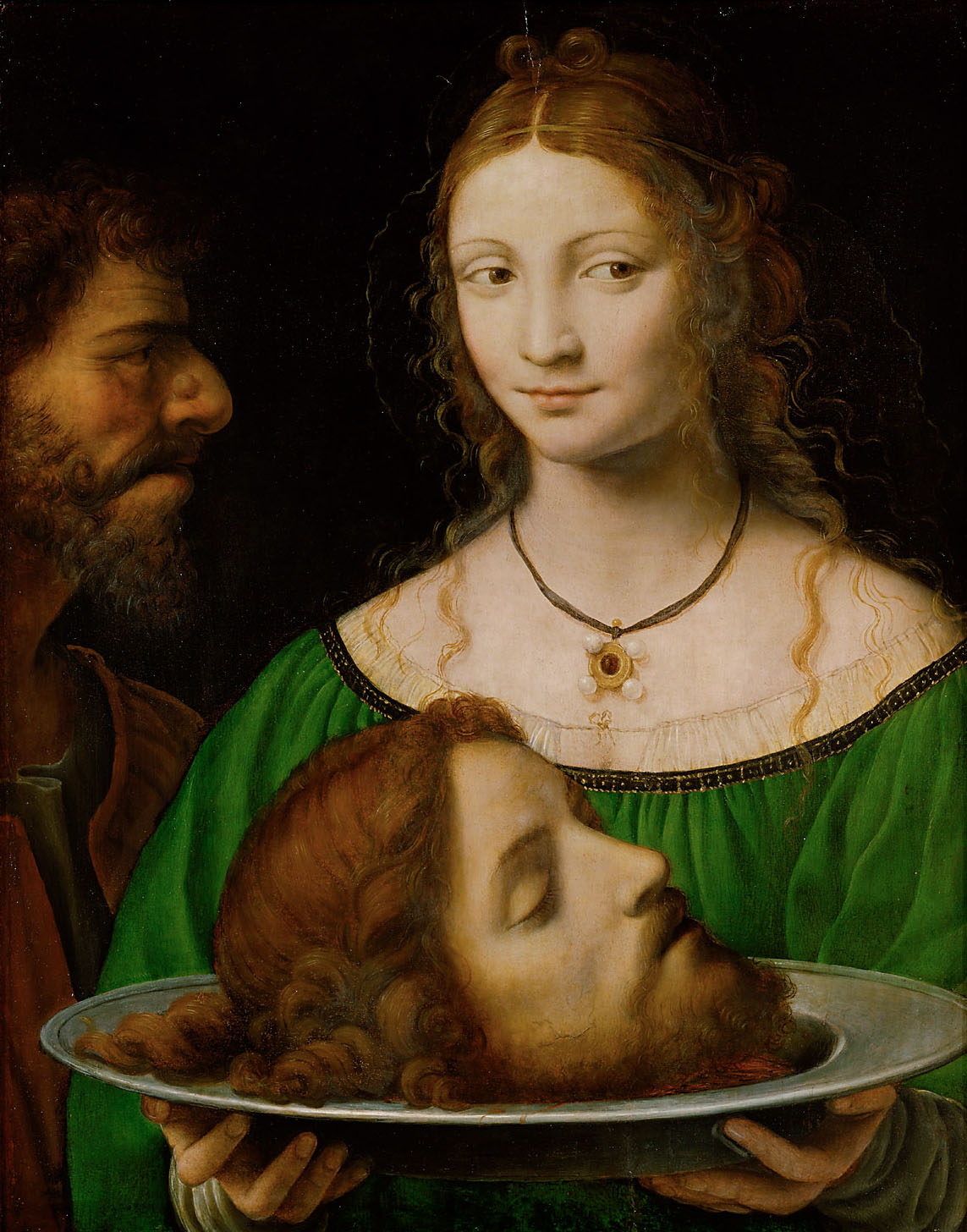
55.7 × 42.5 cm
Guido’s overall composition in the Corsini canvas was not novel: the subject of the daughter of Herodias bearing a platter with the head of the Baptist exploded in popularity in Lombardy at the beginning of the sixteenth century, particularly around its capital of Milan,35 often hypothesised as imitating a lost work by Leonardo da Vinci (1452–1519) who was resident in the ducal court there c. 1482–99.36 Ladislav Daniel draws particular attention to the version in Vienna by Milanese painter and accomplished Leonardo disciple Bernardino Luini (d. 1532), probably dating from the late 1520s, arguing that in general composition and specific details such as the hands, Guido must have known this particular work or a closely-related version.37 The implied internal psychology of the furtive sideways glance in Luini’s painting gives the young girl a spark of individuality, that identity that added the detail of the platter to her mother’s request for the head.38
Whether in Guido’s painting the daughter of Herodias is receiving the platter from the executioner, handing it to her mother, or some point in between, her passive gaze is the very opposite of feminine agency. It is extremely difficult to get much an indication what she, as a person thinks about the object she holds. If anything, she is asking you to do the contemplating. She is little more than a vessel, almost a reliquary for the head itself, in the manner of the medieval icon of the Johannesschüssel, the painting is not a narrative episode but an Andachtsbild that collapses many concepts for contemplation including John as the last of the prophets and the first of the martyrs.39 Another connotation carried by the inherited format is the conflation of the sacrifice of martyrdom with the consecrated host offered on a paten.40
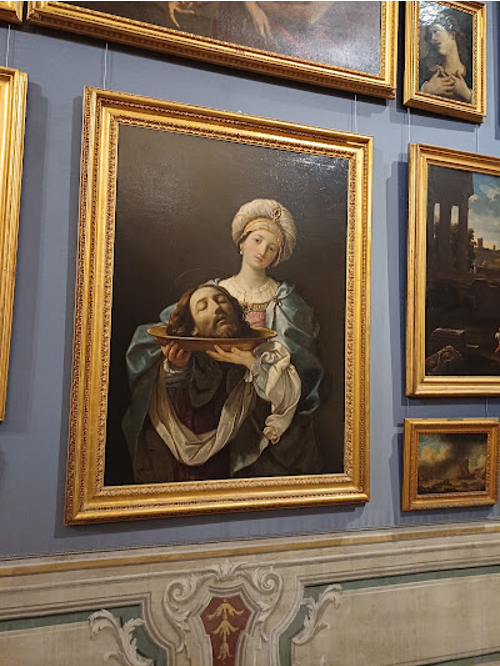
Photo uploaded by Eugenia Petruccelli to Google Maps, Sep. 2025
Rather than emotion or psychology, the most striking choice made in the overall composition by Guido Reni represented by the Corsini canvas is the spectacular costume of the girl: particularly the large, presumably padded, turban that she wears, adorned with an gilt brooch in the form of a leafed cartouche, containing a red gemstone with three hanging pearls.41 This turban, arguably anachronistic to first-century Galilee, both enforces her superior courtly status but also exoticises her as a foreign other to the contemporary viewer.42 Otherwise, she is dressed in white sleeves which are part of a neck-length undershirt, a pink dress with gilt threads which in its lower parts has a foiled brocade pattern, then over that a voluminous blue cloak (of a velvet weave?) joined by a brooch with a hanging pearl at her left shoulder. In a final flourish, an a off-white cloth beneath the gilt platter bearing the head of the Baptist is looped over her left arm, perhaps intended to evoke a maniple in Eucharistic vestments.
The Palazzo Corsini Daughter of Herodias is generally associated with, but not necessarily firmly dated by a purchase made for a dressing room of the Palazzo Barberini in Rome (now the other venue of the Galleria Nazionale d’Arte Antica along with the Palazzo Corsini) 13 December 1639 for “Un quadro con cornice dorata alto p. mi 6 et 4 1/2 con Erodiade mano di Guido Reni” [A painting with a gilded frame measuring 6 by 4 1/2 palmi of Herodias by the hand of Guido Reni] from or via a Monsignor Fausto for 170 scudi.43 The canvas comes up again in the same accounts next September as “quadro di p.mi 6 con mezza figura con Erodiade che viene da Guido” [painting of 6 palmi with a half figure of Herodias after that of Guido] when a painter Carlo Butelli is paid 10 scudi for receipt of a copy.44 170 silver scudi is a large, but not outlandish sum for an easel painting of a single figure (well two, if you count the decap) from the notoriously pricey Guido,45 but the 10 scudi is very much the going rate for a replica by a minor copyist.46 By comparison, a skilled stonemason in Rome at the time would earn around 85 scudi a year, although you ought to add 15-20% on top of that for their included food rations.47 The dimensions of 6 palmi (at 22.35 cm for the Early Modern Roman palmo romano,48 134.04 cm) fits the 136 cm-height canvas now in the Palazzo Corsini.
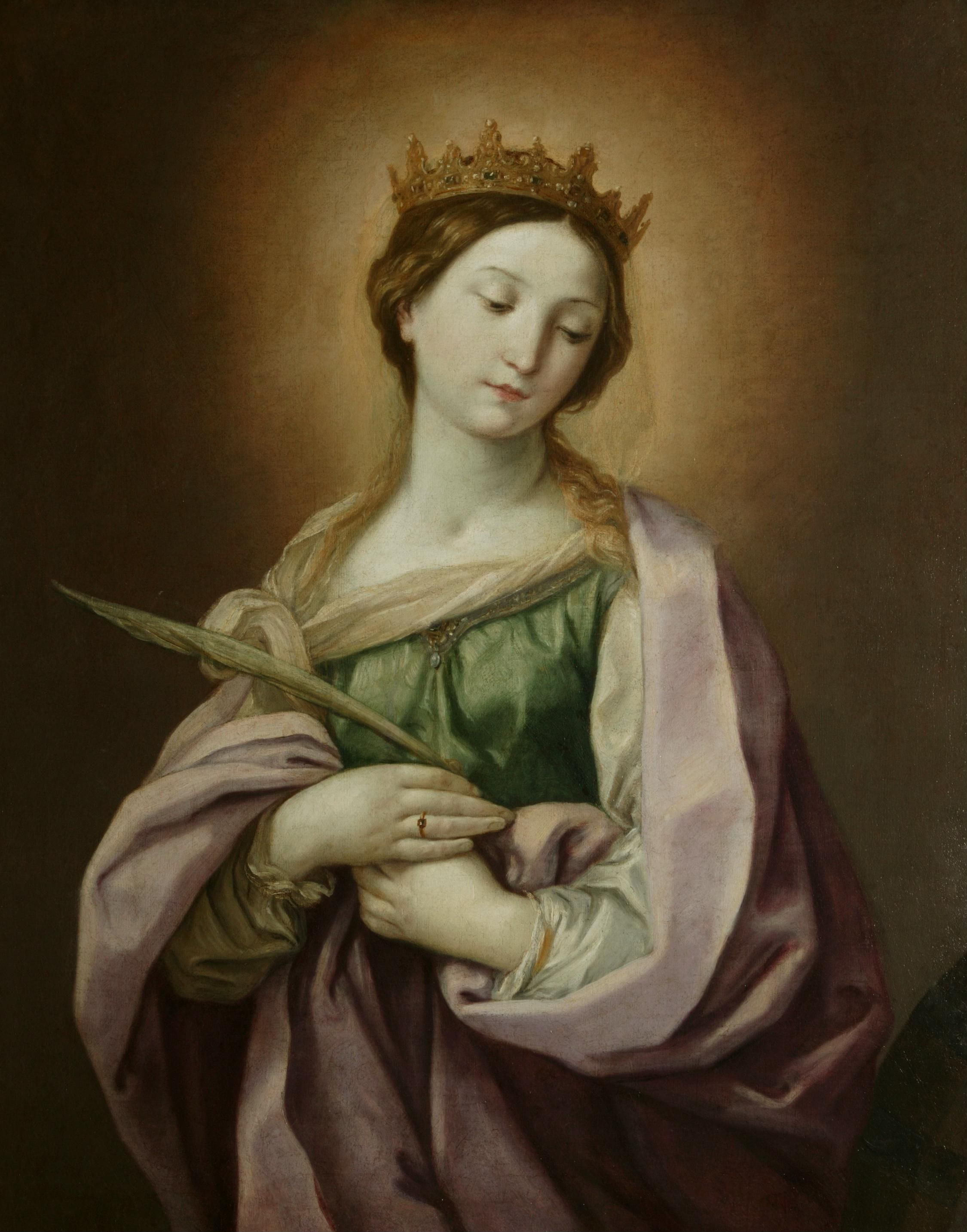
102 × 83.6 cm
Stylistically the Palazzo Corsini canvas matches Guido’s fully-developed light, delicate and sweet “ultima maniera” [final style] he used from around the mid 1630s before his death in 1642, thus fitting with its purchase from a third party in late 1639.49 Exemplary of Guido’s fully-fledged ultima maniera is a St Catherine that was in the Crozat collection where it was engraved by Nicholas Bazin (more on him below), brought to Britain by the Scottish collector Robert Strange in 1769 and purchased by Manchester City Galleries in 1974.50 Colours with low saturation, brightness high, utterly idealised: essentially about as far from Caravaggio as you can get.
However, that what’s in the Palazzo Corsini now was actually that documented Guido Daughter of Herodias obtained by the Barberini is something that deserves serious scrutiny. No transfer between the Palazzo Barberini and the Palazzo Corsini is recorded.51 The painting is not inventoried at the Corsini Palace until 1750 as “Erodiade di Guido Reni” when it is recorded as a work donated by Girolamo de Bardi (cardinal from 1743) to Pope Clement XII Corsini (d. 1740) coming from the Casa Bichi, all of which suggests a Tuscan provenance rather than a transfer within Rome.52
Beyond all the documentary problems, perhaps the biggest problem with the Palazzo Corsini painting as it being the Guido autograph original is that it has a very mixed reception in the literature. While there are some eighteenth- and nineteenth-century travel guides that singled the painting out with praise,53 and Luigi Antonio Lanzi (d. 1810) included it under “prodigi di Guido“,54 the German-speaking Swiss art historian Jacob Burckhardt called her depiction “Kalt und pomphaft” in 1869.55 In the catalogue to the landmark survey exhibition held in the Palazzo dell’Archiginnasio, Bologna in 1954 that intended to revive Guido Reni for the twentieth century, the Corsini canvas’s paintwork was described as “superbamente fusa in preziosità di toni e di luce” [“superbly blended in exquisite tones and lighting”], but Richard E. Spear, in his highly innovative biographical survey of Guido from 1997, cast doubt on its fully-autograph status, calling it “uncharacteristically heavy and pasty for a picture from the 1630s”.56
The Corsini painting, although I haven’t seen it myself (I know, I know, I should go to Rome) is very strange, as yes, it has the desaturated colours and painterly quality of Guido’s ultima maniera, but also it also looks a bit blown-out in its colour balance and clumpy in its brushwork. To make the point in a decidedly unscholarly manner, here is what it would look like if the Palazzo Corsini canvas was used as the album cover for a Canadian brutal death metal band in 1996 rather than the one at Burghley House.
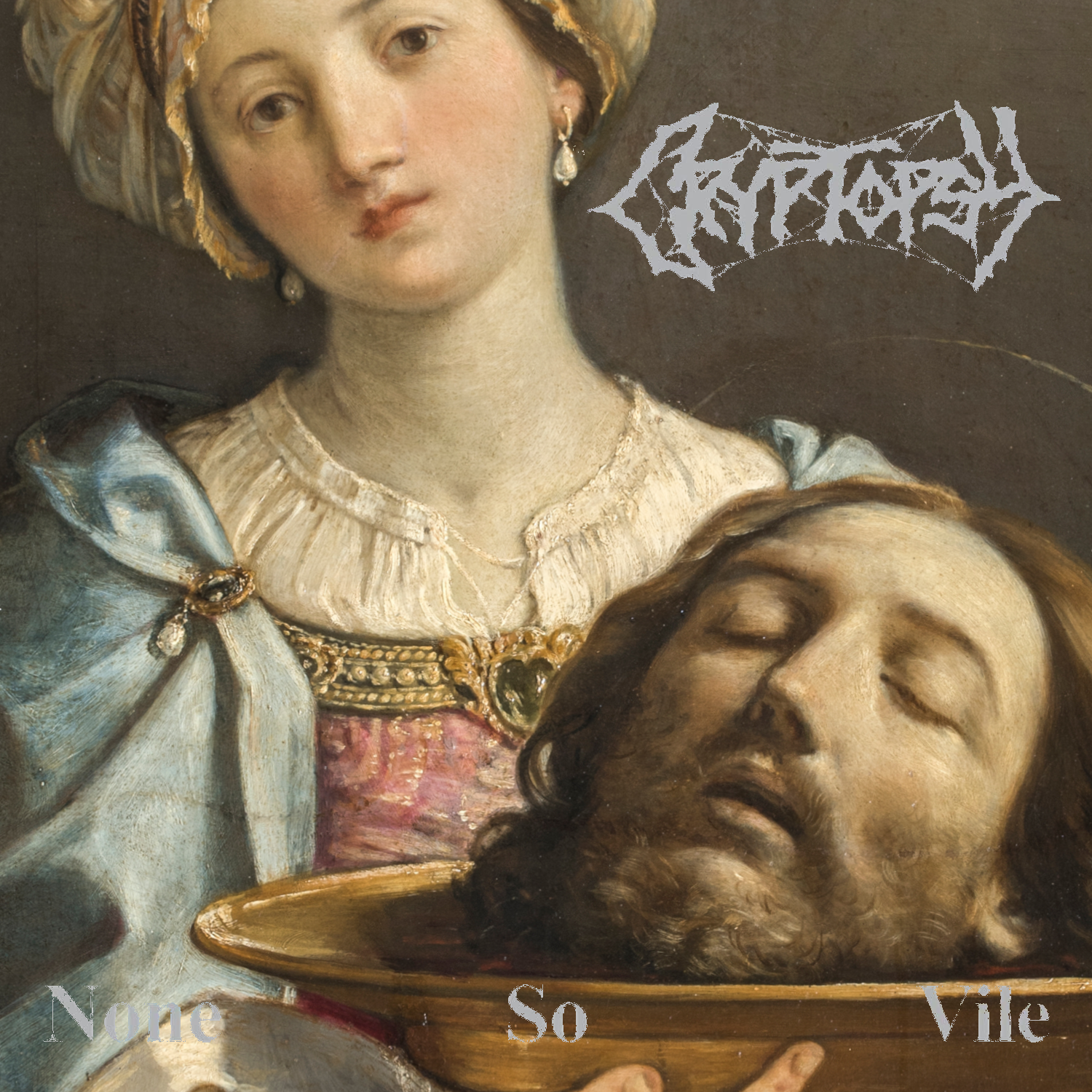
Kalt und pomphaft indeed. Burghley House No. 123 has an undeniable edge, at least to contemporary eyes, with its higher saturation and dramatic lighting that plays more into Roman chiaroscuro than what seems to be a weak essay of Guido’s low-key ultima maniera.
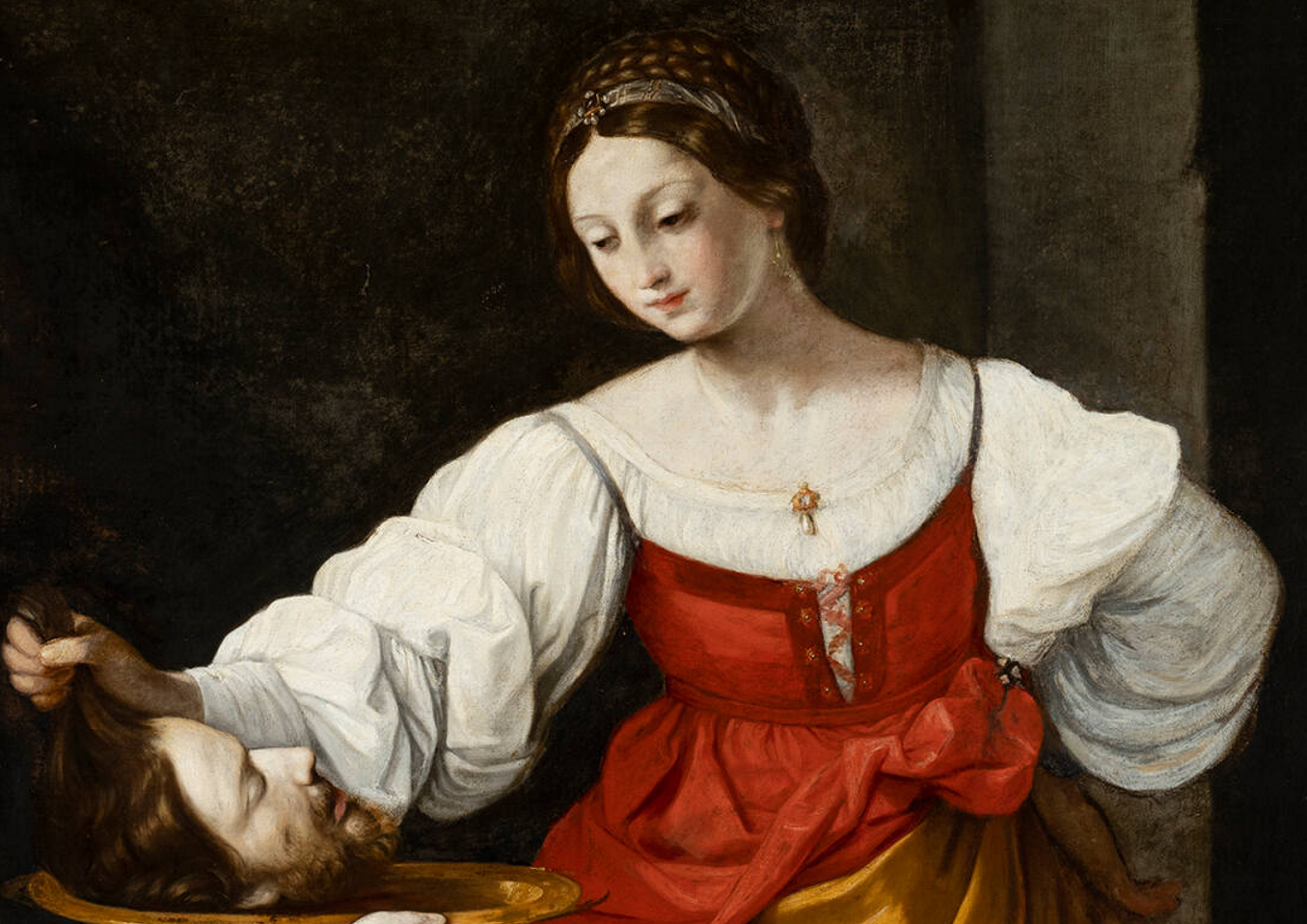
In contrast to the Palazzo Corsini version, whenever the Burghley House reduced copy of The Daughter of Herodias is mentioned in the art-historical literature, it is with high enthusiasm: Cesare Garboli referred to it as “una buona copia parziale” under his entry for the Corsini version,57 D. Stephen Pepper, likely following, included it as a “studio variant”.58 The Burghley painting ends across the girl’s hands under the platter, cutting the lavish interplay of the folds of the linen cloth, her cloak, shirt sleeves and brocaded dress, which increases the viewer’s focus on the psychological interplay of the two faces: one living, one dead. The bold crop of the Baptist’s hair and the girl’s hands to the left and bottom of the canvas respectively, could be considered an important artistic choice in itself.59 However, comparing the Burghley reduced copy to the full-size version (Right), we can see the darker shading on the cloak over her left shoulder anticipates the edge of the picture field on the right.60 Cutting the picture field at her hands also brings the composition closer to the Bernardo Luini picture that Daniel forwarded as a direct influence on Reni’s painting discussed above, along with other earlier treatments of the subject.
Owing to its exceptionally small size among the many versions of the composition, it seems circumspect to suggest that Burghley House No. 123 could have been the “Erodiade” mentioned as owned by Pier Maria Gentile (a Genoese patrician and clearly close to Guido Reni’s studio) in a letter he sent in 1639, described as “due mezze figure in un picciol quadro“.61
With the prototype alleged as weak, the traditional route is that we go on the hunt for another version of the painting that is judged good enough to qualify as Guido’s lost original autograph. There are a lot of versions of the composition normally ultimately associated with Palazzo Corsini Inv. 191 out there, mostly dating from the height of the Grand Tour from the mid eighteenth to the beginning of the nineteenth centuries. Enough to label it a plethora. UK public collections with what appear to be late replica (that is, from the mid eighteenth through to the nineteenth century) versions include The Ashmolean, Oxford; the Walker Art Gallery, Liverpool;62 Barrow-in-Furness Borough Council; The Ferens Art Gallery, Hull (by Benjamin West, 1763); Tabley House, Cheshire (held by the University of Manchester), Oxford City Council and Lamport Hall, Northamptonshire. A version that may be a important early replica, or even a Guido workshop product, is at the Penicuik Estate, Midlothian, which was inventoried in 1724, and by tradition was “brought by [the Earl of Calendar] to Scotland in the time of Charles I”, and although the canvas is clearly currently a bit of a mess, it clearly deserves further investigation because of its early provenance.63
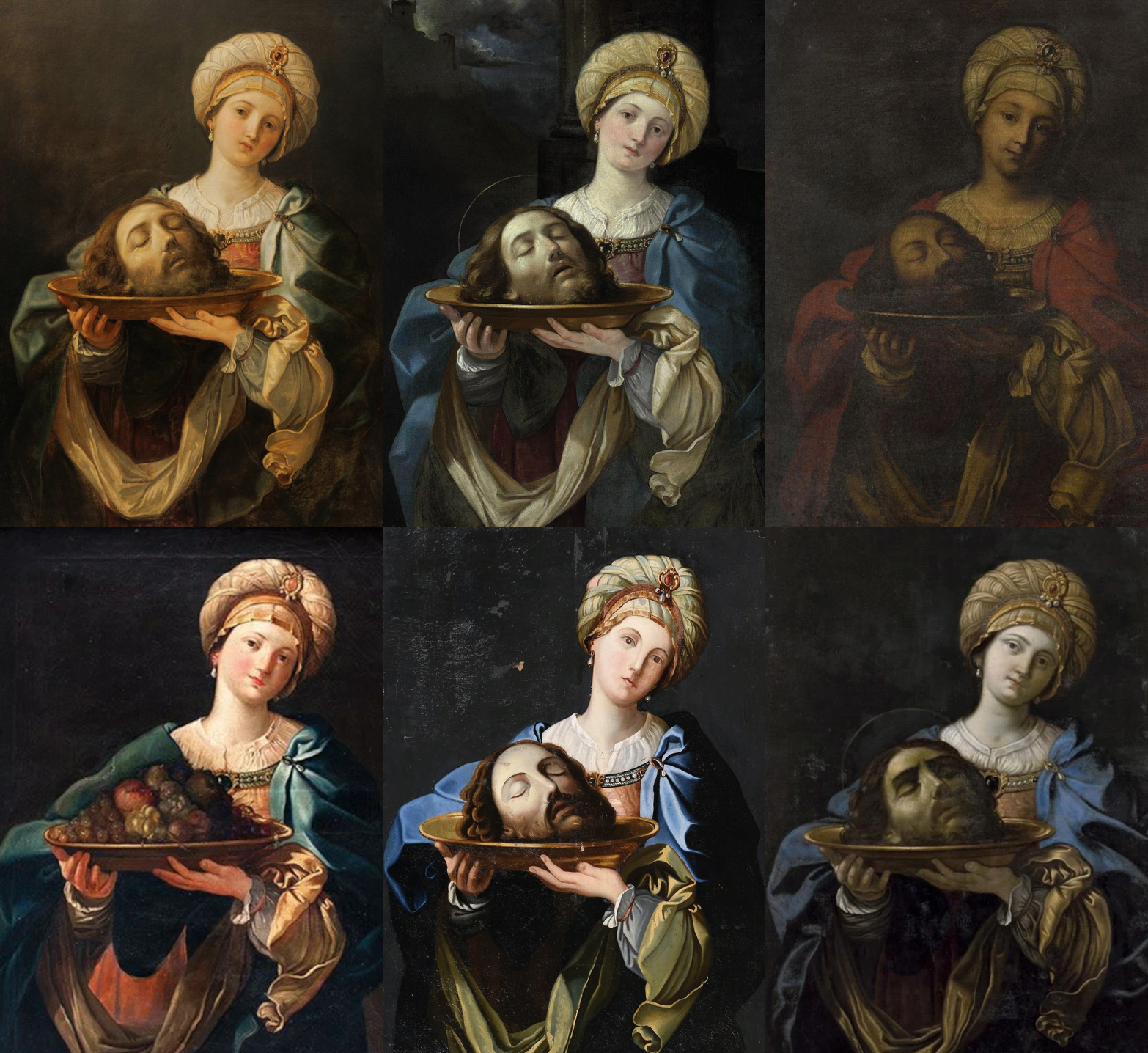
Further afield, the Academia in Madrid has a version signed and dated by court painter Mariano Salvador Maella, 1761 that was made as a graduation piece.64 Thomas Jefferson, yes, the third President of the United States of America 1801-9 (to be honest, it wasn’t nearly as important an office back then), while he was in Paris 1784-9 as Minister Plenipotentiary, bought a pretty good, probably early eighteenth-century replica of the Palazzo Corsini version at the sale of Louis Dupille de St-Severin, 12 Feb. 1785 (although seemingly under the impression that the composition was by Simon Vouet, a French contemporary of Guido who worked in Italy), that he hung in the top tier of the parlour at his house of Monticello, Virginia, where it remains today.65
Then there are all the ones that have appeared on the art market in the last decade or so. To the right is an animation of all the ones I’ve managed to gather from auction aggregator websites, usually with no freely-available data how much they sold for (or if they even sold at all). Some of them are very weird bowdlerisations, some clearly complete bobbins, some suspiciously good-looking that may have had some contact with Guido’s studio, circle, or followers after his death in 1642. I can say one of them sold for $35,000 as a studio of Guido Reni: why not have a guess at which one it might be! (answer in this footnote66)
However, there is one candidate out there that has been forwarded as the lost Guido prototype supplanting the Palazzo Corsini canvas, that is particularly intriguing for how it corresponds to the Burghley House version. It was back in 1992, on the 450th anniversary of Guido Reni’s death, that a small exhibition at the Sternberg Palace of the National Gallery Prague included a version of the three-quarters The Daughter of Herodias with the Head of St John the Baptist, hitherto unpublished, that was forwarded as Guido’s original version of the composition.67 It may look rather familiar.
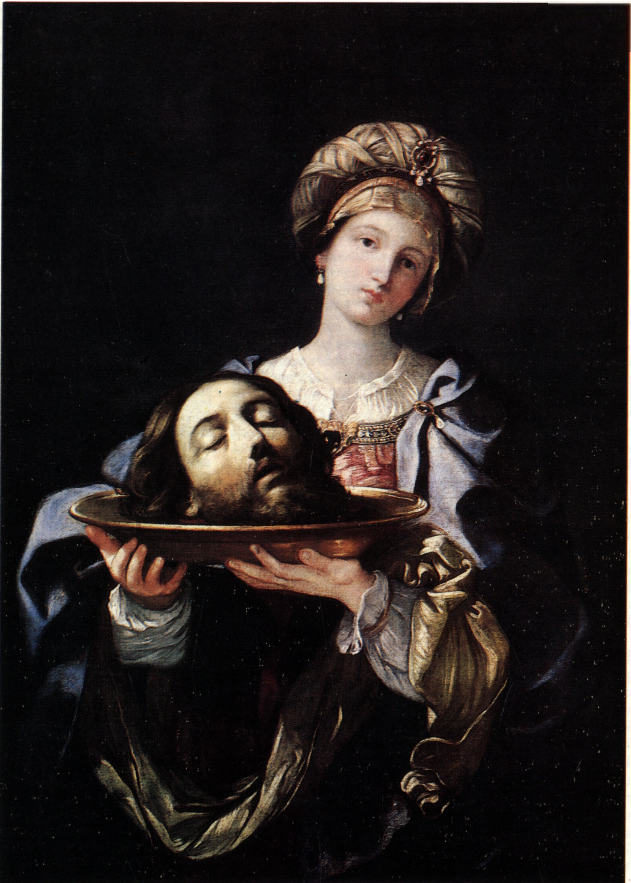
130 × 91.5 cm
This version of The Daughter of Herodias was first recorded in Geneva in the 1930s, before its purchase 6 June 1978 by the owner who lent it to the 1992 exhibition.68 In the accompanying catalogue, Ladislav Daniel (who was associated with the National Gallery in Prague 1981–2001, holding position of director 1993–4, and curator of sixteenth–eighteenth century Italian, French and Spanish painting 1985-2001) argued that the Palazzo Corsini Daughter of Herodias generally held as the Guido autograph original, is a later copy.69
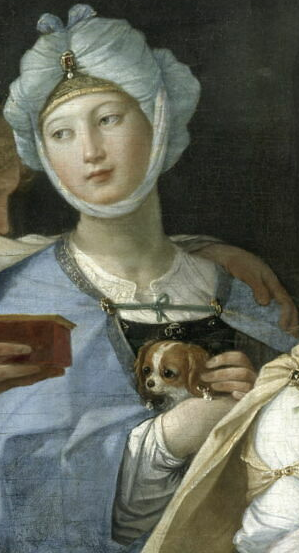
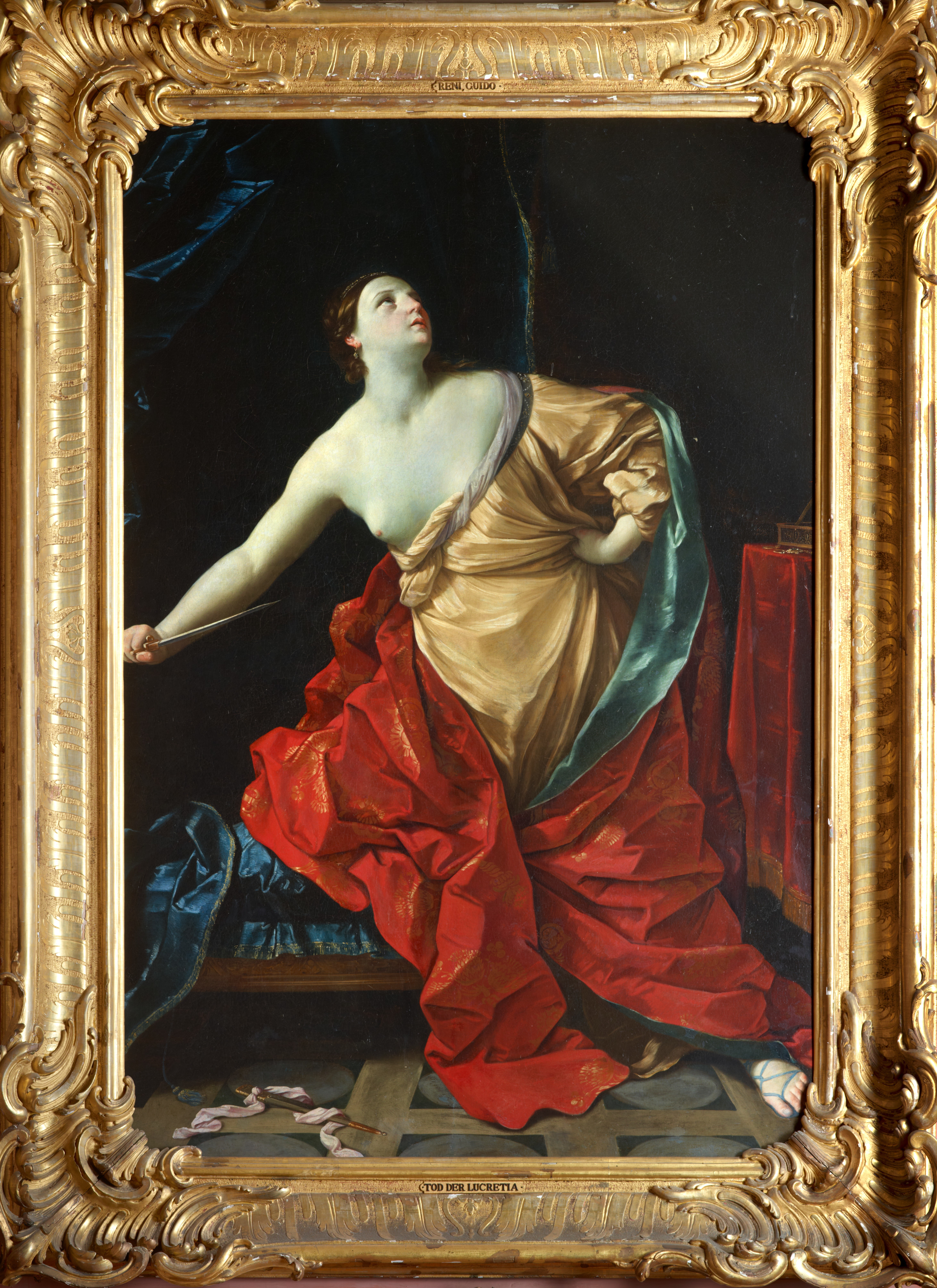
215 × 151 cm
Citing Guido accepted autograph works such as the Potsdam Lucretia of 1625-6 (Right) which has similar high-key colours and dramatic chiaroscuro,70 as well as a young lady of similar costume and manner in The Abduction of Helen completed between 1629 and 163171 (Left) and the decapitated head of the Baptist with chalk drawing of the head of Christ from 1620 (Royal Collection Trust, RL 5283) in its “volume and serenity”, Daniel placed the Geneva Daughter of Herodias in the second half of the 1620s.72 While the Geneva canvas has no better claim to be the “Erodiade mano di Guido Reni” acquired (in this case, it would definitely be second-hand) by the Barberini in 1639, Daniel clearly states he believes the Geneva painting can claim priority over the painting that now is widely appreciated as the Guido original in the Palazzo Corsini:
“The liberal and sure-handed style of brushwork reflected in the long strokes in the draperies, on the front brim of the dish and the head of St. John the Baptist, just as the finely executed minor touches shaping details of the jewelery, the turban and minor folds of the drapery, clearly attest to the priority of the Geneva work over the Roman painting which is a copy of the former.”73
There is also some documentary support for a pre-ultima maniera version of the Daughter of Herodias that the Geneva canvas may represent. A letter dated 15 Nov. 1670 from the painter Benedetto Gennari in Bologna to Antonio Ruffo, Sicilian nobleman and prolific art collector mentions “a painting of a half-length figure by the aforementioned artist [Guido Reni] depicting Herodias holding the head of St John the Baptist in a basin, it is executed in the finest taste and style of his work [miglior gusto e maniera ch’ei dipingesse] and is remarkably well-preserved considering its age”.74 To judge what he might mean by the stylistic assessment, what Guido’s contemporary and biographer Carlo Cesare Malvasia had to say in his Felsina Pittrice first published 1678 seems most relevant: although he has some positive remarks about the painter’s ultima maniera pleasing the learned, he is mostly baffled by the stylistic choices Guido took in his late career.75 Demonstrative of the critical status against the ultima maniera of around the turn of the following century is the oft-cited dialogue of Giovanni Pietro Cavazzoni Zanotti, “In Difesa di Guido Reni“, the existence of which demonstrates that a notion of Reni’s late works being viewed as “languid, washed-out and feeble” [languido, dilavato e fiacco] was widespread, even if Zanotti himself intends to rebut such notions.76 Of course, Gennari could have simply been aggrandising a potential sale that he hoped to earn commission on. However, it would be surprising if there were not numerable variants and copies around from the Guido workshop of the Palazzo Corsini-type Daughter of Herodias, as the sheer quantity his bottega produced of work in a Seicento context is particularly notable: 37 Lucretias and 23 Cleopatras counted in one recent assessment.77
The proposal of the Geneva canvas as a prototype Guido Reni studio product however, has not been widely accepted and has been hindered by the fact that it has thereafter, as far as I can tell, never been publicly exhibited since for anyone else to judge.78 The Burghley House reduced version is not directly mentioned by Daniel.79 However, its similarity in chiaroscuro conception and, as he puts it, the accentuation of “vanitas” due to the “dark, radiating colours” and the consensus in the Guido literature it is a good-quality studio product does somewhat strengthen his case.80 Among the plethora of copies above, Burghley House stands out because it is not a slavish imitation (excluding the silly ones that turn the Baptist’s head into flowers or jewels). As well as the bold crop, what also sets the reduced copy apart from every other iteration is the clasp of of the girl’s robe just below her left shoulder.
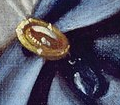
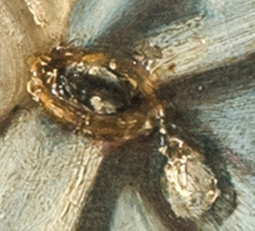
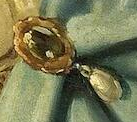
While all the other versions have a dark stone inside the gilt frame with a hanging pearl, the Burghley House is a vivid red with a hanging blue stone. This small change shows that the painter, along with the bold crop of the composition, was not making a slavish copy as a Grand Tour souvenir, but a variant work of art in its own right.
This impression Rijksmuseum, Amsterdam RP-P-OB-41.755
34.3 × 24.8 cm
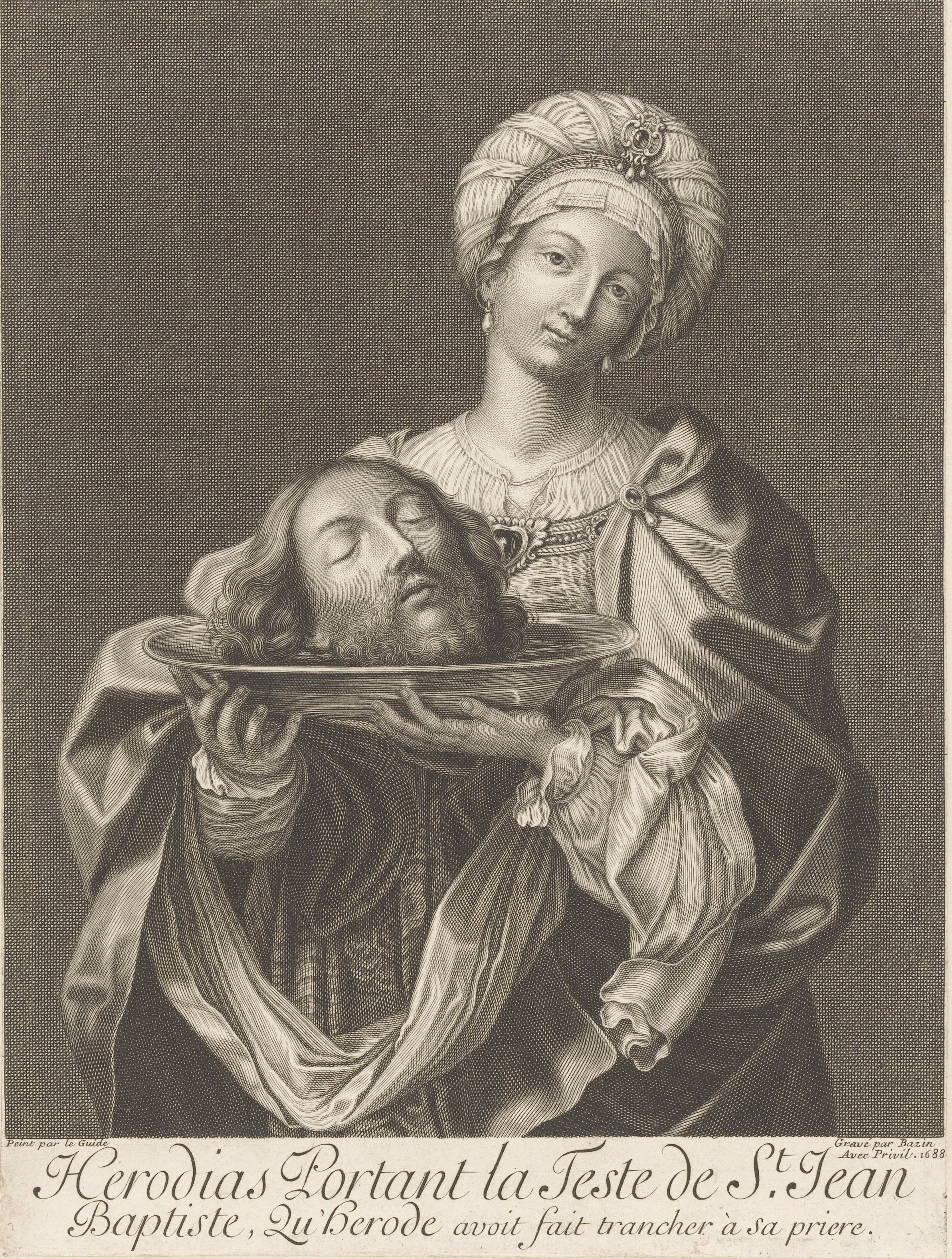
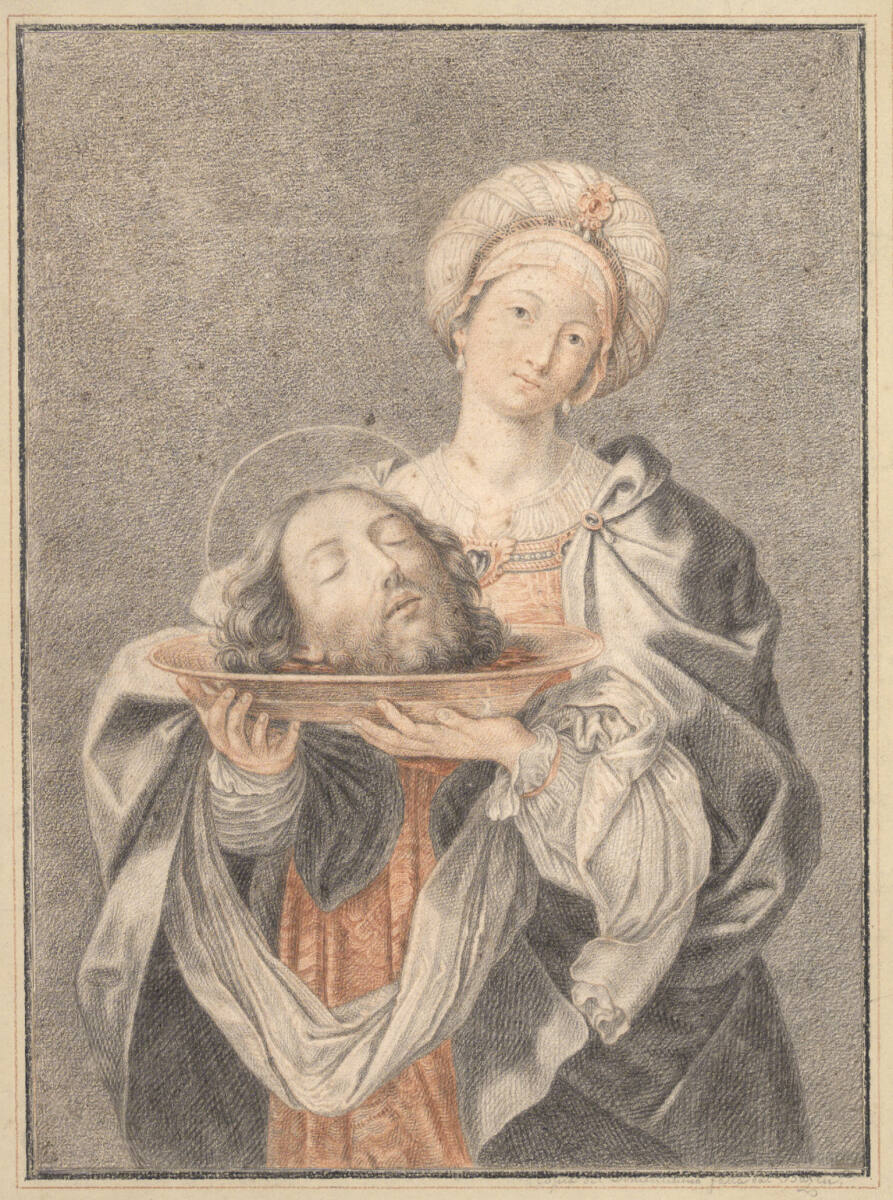
The first securely-dated witness to the Palazzo Corsini-type composition is dated 1688 by the Paris-based engraver Nicolas Bazin (Left), for which the original preparatory coloured drawing also survives (Right).81
Daniel considers the engraving as copied from Palazzo Corsini version, making 1688 as a terminus ante quem for that canvas’s creation (with the implication that the Palazzo Corsini version might not of come out of Guido Reni’s immediate circle or followers, which I think, for all its painterly shortcomings, is extremely unlikely).82 I am also not as certain it is based off the Palazzo Corsini canvas as, disregarding slight mismatches in the drapery (that you could explain as a lack of perfect fidelity), the biggest difference between this and the later widely-acknowledged prototype in Rome is the lack of a gilt hem below her left hand in the bottom centre of the picture when Bazin highlights the other yellow-keyed passages in his drawing with lightened use of red chalk. The brocade pattern on her dress in the lower centre is also much more prominent. Bazin importantly has the halo over the decapitated head in the sketch, which Burghley House No. 123 lacks, as does, seemingly, the Geneva version (although, like many of the copies out there, the photography/reproduction is too poor to confirm). It seems most likely that Bazin worked from a version of the painting that made it to France that was subsequently lost in the upheavals around the Revolution.83
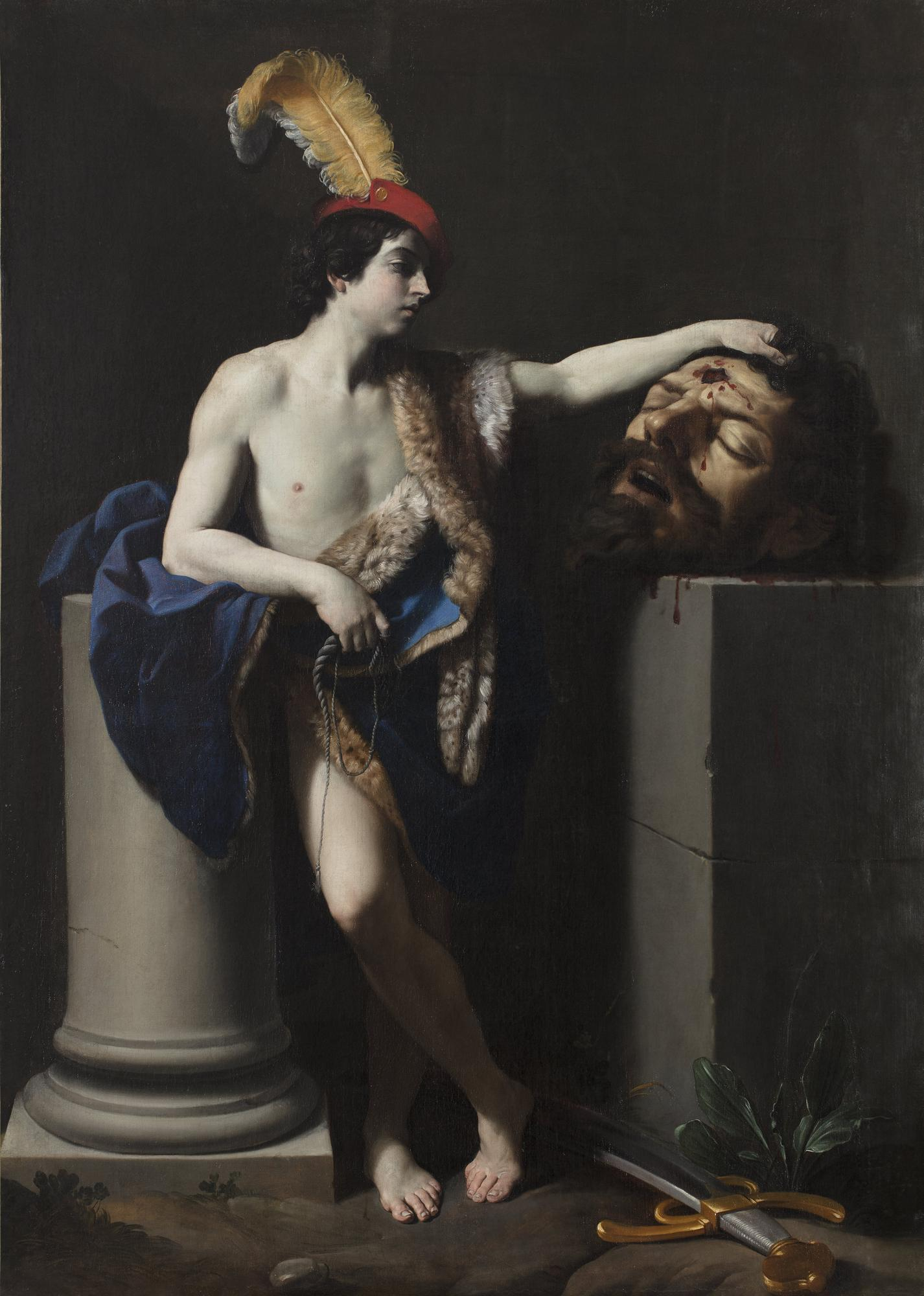
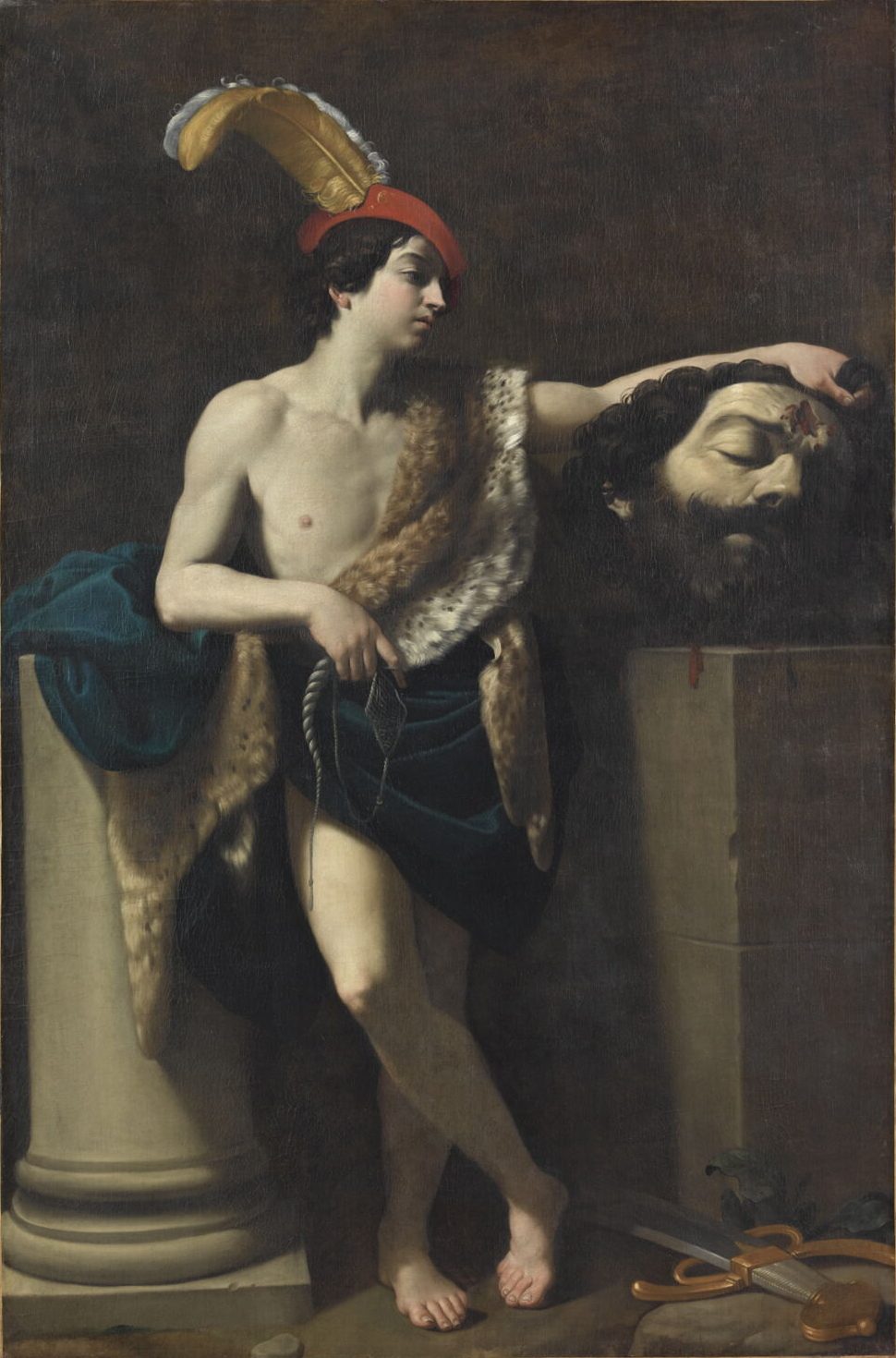
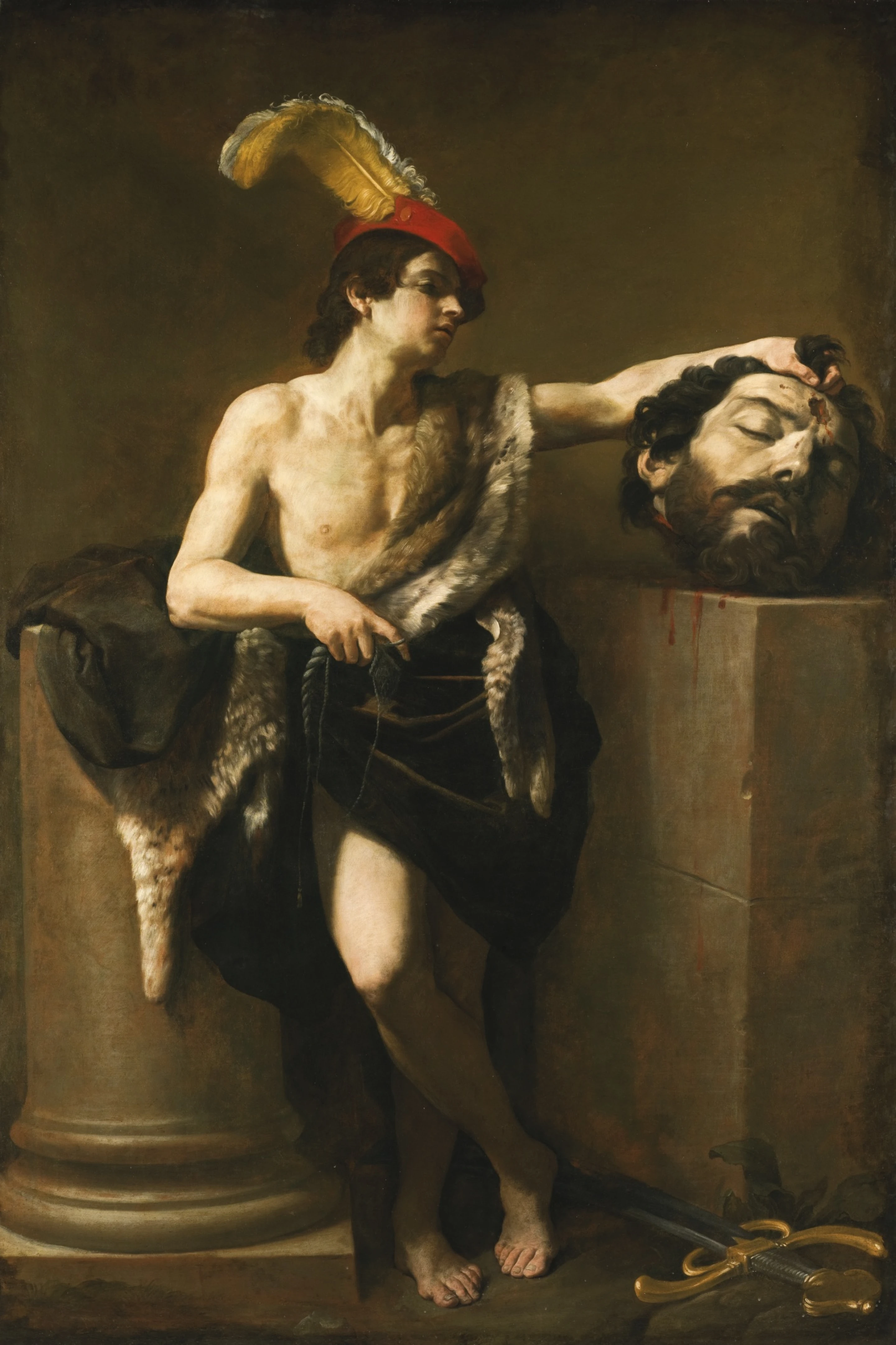
Amongst this traditional art-historian sport of chasing around in search of a fully-autograph lost prototype, we should entertain the possibility that there isn’t one and there never was one.84 However, that the composition was created by Guido in one stylistic period (the mid-to-late 1620s) and repeated years later when he had developed a different manner of colouration toward the end of his life is completely in line with the practice of repetition within his oeuvre.85 Another example of this is his David with the Head of Goliath, which has had undergone important re-evaluation in recent years.86 The relationship between “originals” and replicas regarding this particular subject in Guido’s corpus has always been provoked by this letter by Cardinal Bernardino Spada, patron-agent to Guido, written in 1631:
“[…] e fra I’altre havevo trovato un David, fatto nuovamente da Guido Reni, e venduto 200 ducatoni su I’andar del p.mo; ma secondo ch’ei dice, assai più bello; e con q.st’ occasione havevo imparato che, se bene il quadro del Theodosio Porta era stato ritoccato da Guido, ad ogni modo non era il vero originale, il q.le professa, che si trovi in Genova.“
“[…] including finding a David recently executed by Guido Reni which had been sold for 200 ducats more than the first one; but according to his own statement, it was far more beautiful; and at the same time I learned that, while the painting belonging to Theodosio Porta had been retouched by Guido, under no circumstances was it the true original which, it was said, was in Genoa.”87
c.1610-11
Failed to sell at Sotheby’s 1992, 2012.
?attrib. Simone Cantarini
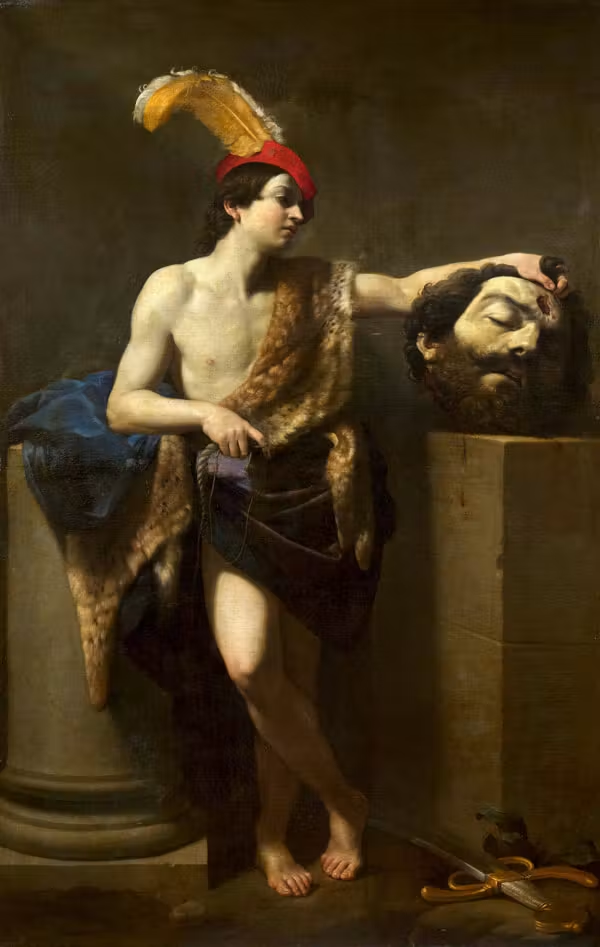
?c.1630-1
As his second version of David with the Head of Goliath was called by the artist himself “più bello” than one thought to hang in the Louvre, its identity has been much sought. Above are two candidates for “del primo/vero originale” and two for the “fatto nuovamente/più bello“, one of which has flopped twice trying to make a profit on the art market and the other in contrast that did spectacularly well just a year ago.88 The identity of the specific David canvases aside, the statement it is important evidence how Guido reused his older compositions throughout his career, with the belief his newer manners of colourisation and modelling made them superior works of art.
Up until now I have been exclusively discussing Guido Reni, who is beyond any reasonable doubt the inventor of this composition of The Daughter of Herodias with the Head of St John the Baptist. However, the Burghley House canvas is currently attributed to Elisabetta Sirani, something which I cannot dismiss out of hand. Indeed, there are some interpretations that have a gendered take on the painting that imply the importance of a female artist in its creation.89 However, I will now put forward that it is completely at odds for what Elisabetta’s oeuvre is known for: original organisations of pictorial rhetoric from first-hand engagement with visual and textual sources rather than slavish copying of existing compositions, and complex depictions of spiritually-upstanding examples of female agency.
The invenzione of Elisabetta Sirani (1638–65) and her own depictions of Herodias with her daughter
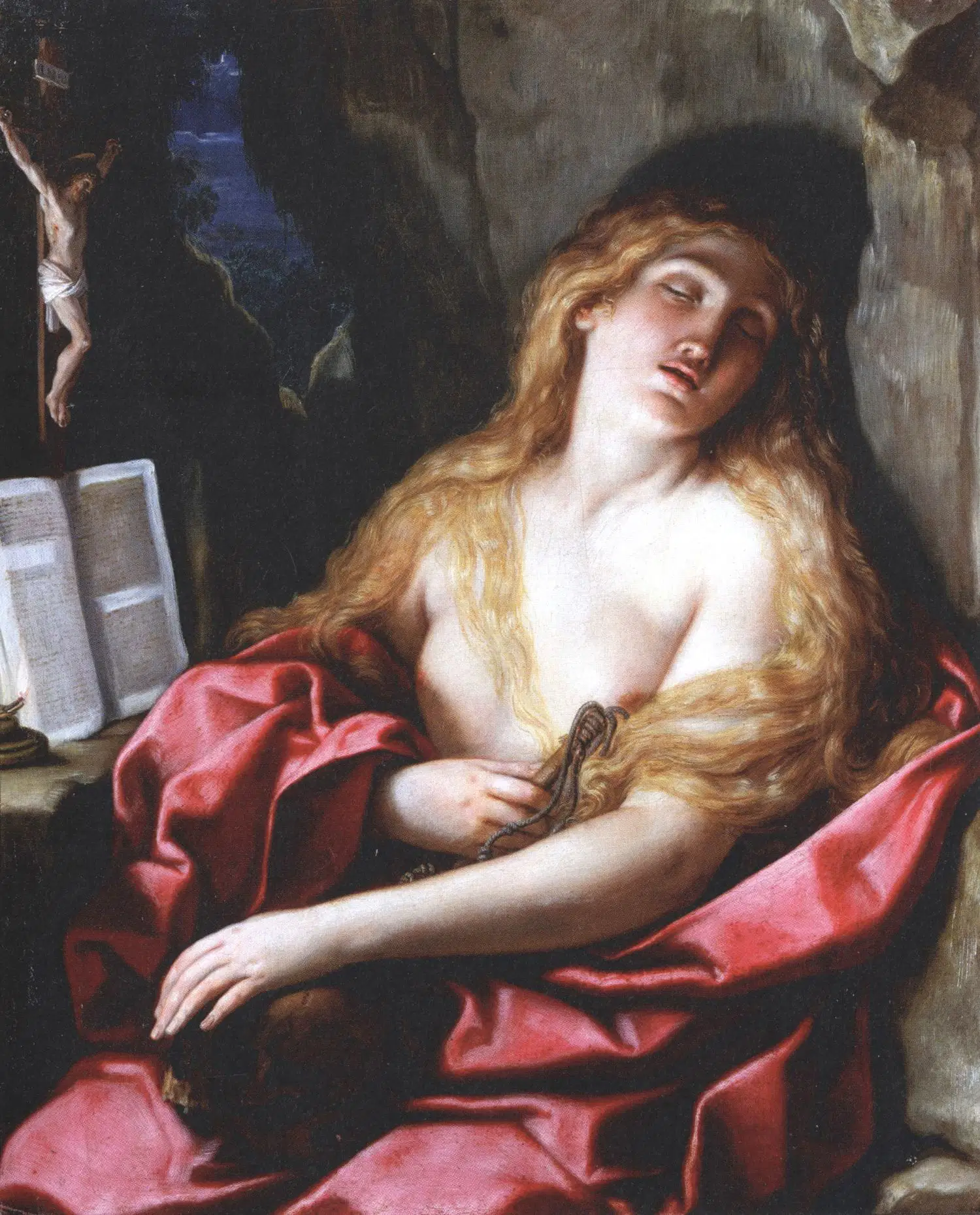
113.5 × 94 cm.
Elisabetta Sirani lived and worked her entire life as a painter in the walls of the city of Bologna, which has the oldest university in Europe, and by her lifetime was incorporated into the Papal States as its second city after Rome. She achieved high acclaim from her patrons and fellow artists before her death 28 August 1665 at the tragically young age of 27. Her father was Giovanni Andrea Sirani (1610-70), who was the closest collaborator of Guido Reni towards the end of his career, his only leading assistant to remain working under the master through to his death in 1642.90 Giovanni Andrea probably entered into Guido’s studio in the early-to-mid 1630s, when he was in his early twenties.91 After his master’s death, he finished off many of the blocked-out canvases that remained in stock92 and subsequently established his own bottega.93
When Guido Reni died, Elisabetta was only four years old, but Guido became a formative influence on her work: her half-length Penitent Magdalene, painted 1663 for Marchese Ferdinando Barbazza, is said by Spear to absorb the spirits of Guido’s similar compositions of suicidal women from antiquity, but with an eroticism foreign to Guido occasionally found in Elisabetta’s religious works.94 However, even when she relied mainly on Renian models especially in the first part of career, she is never thought to have made a slavish copy of a Guido composition by modern scholars working on her oeuvre.95 Even in her early commissions, she was always adding her own details to Renian prototypes. A good example is her 1658 Madonna Lactans, recorded in her work diary painted for a Padre Bovio of the Bologna parish church of St Gregory, often compared to the Guido version of the subject now in Raleigh, NC, but with a tight swaddling, that foreshadows Christ’s entombment, paralleled with her c.1657-8 print of The Flight into Egypt.96
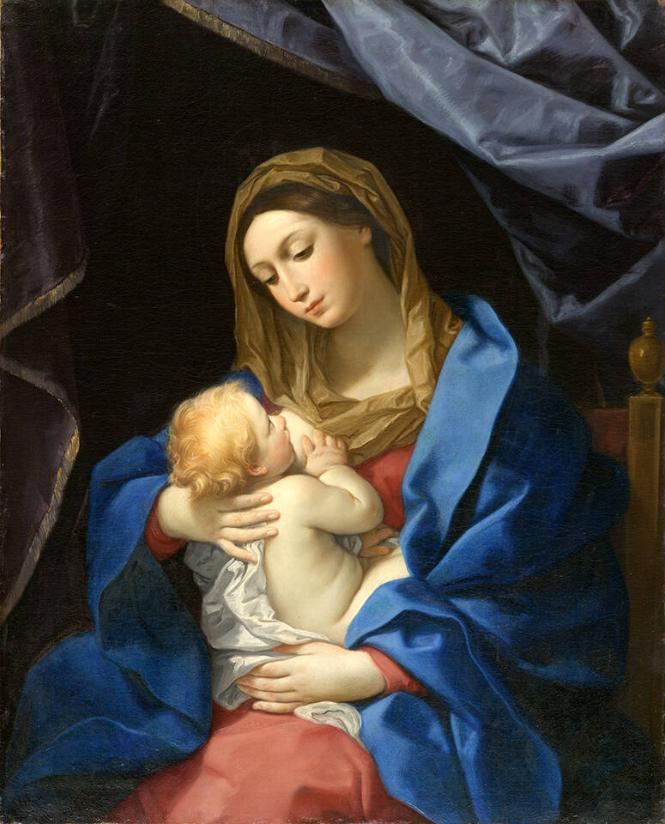
114.3 × 91.4 cm
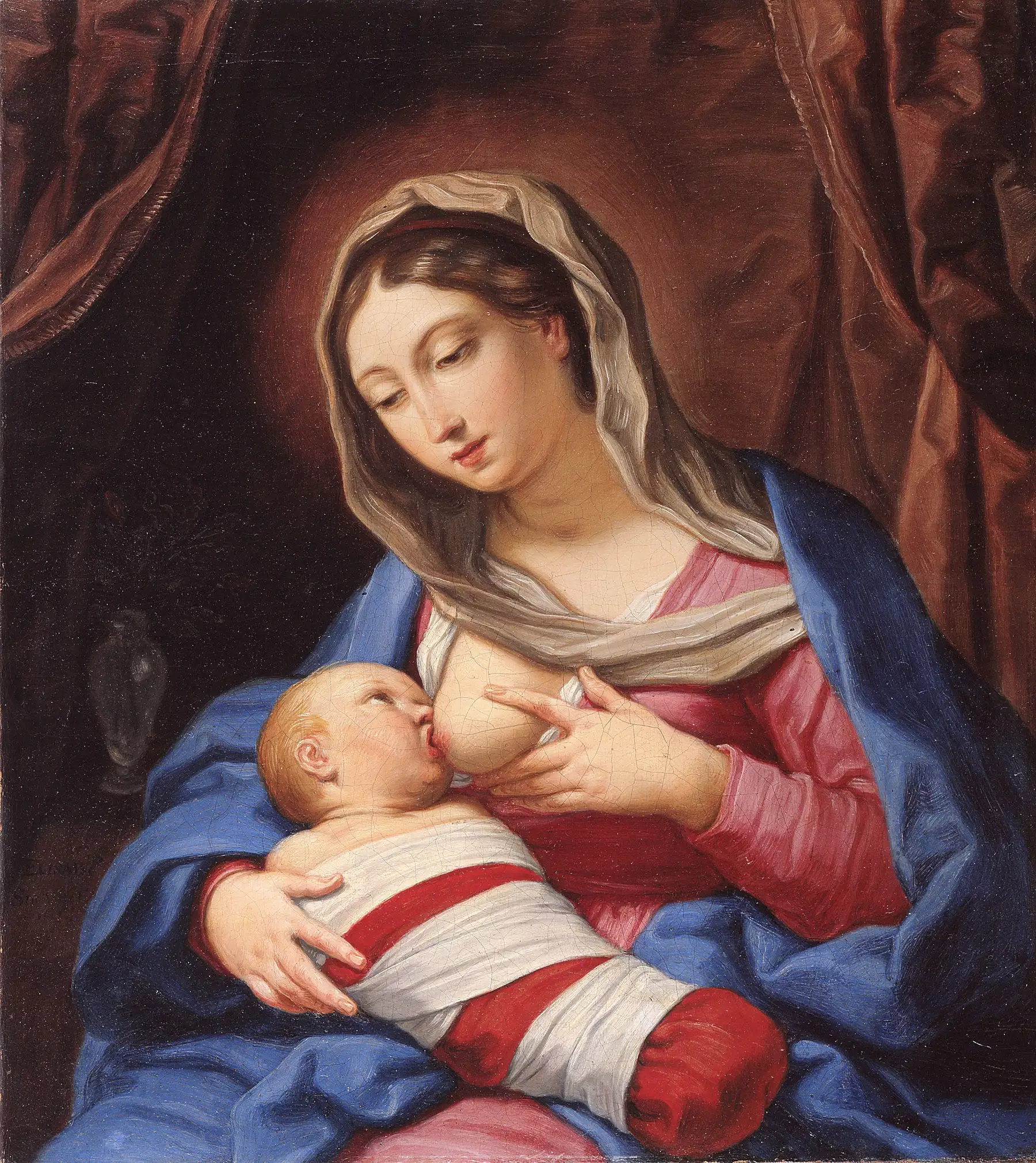
76 × 68 cm
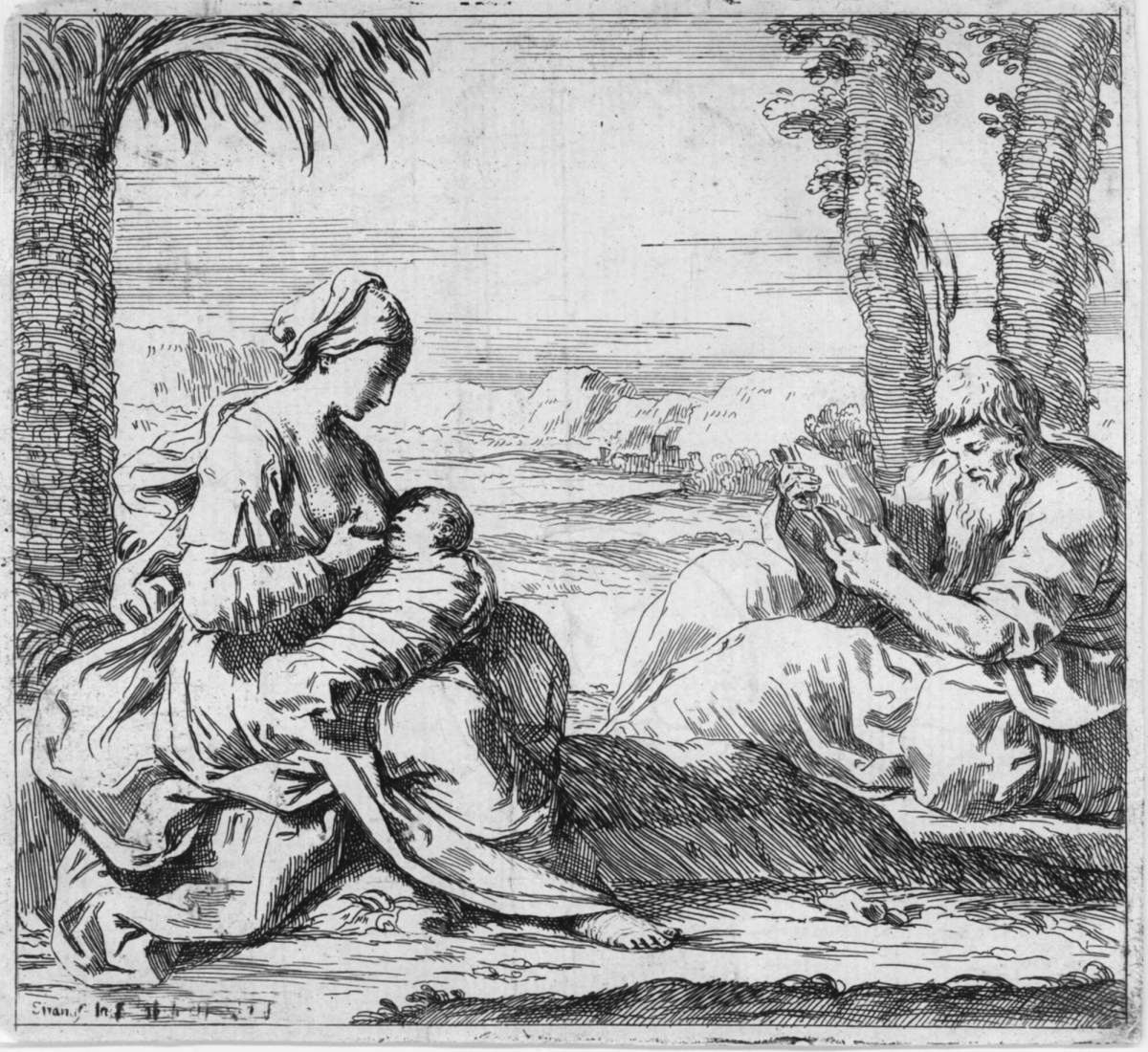
16.2 × 17.7 cm (Image)
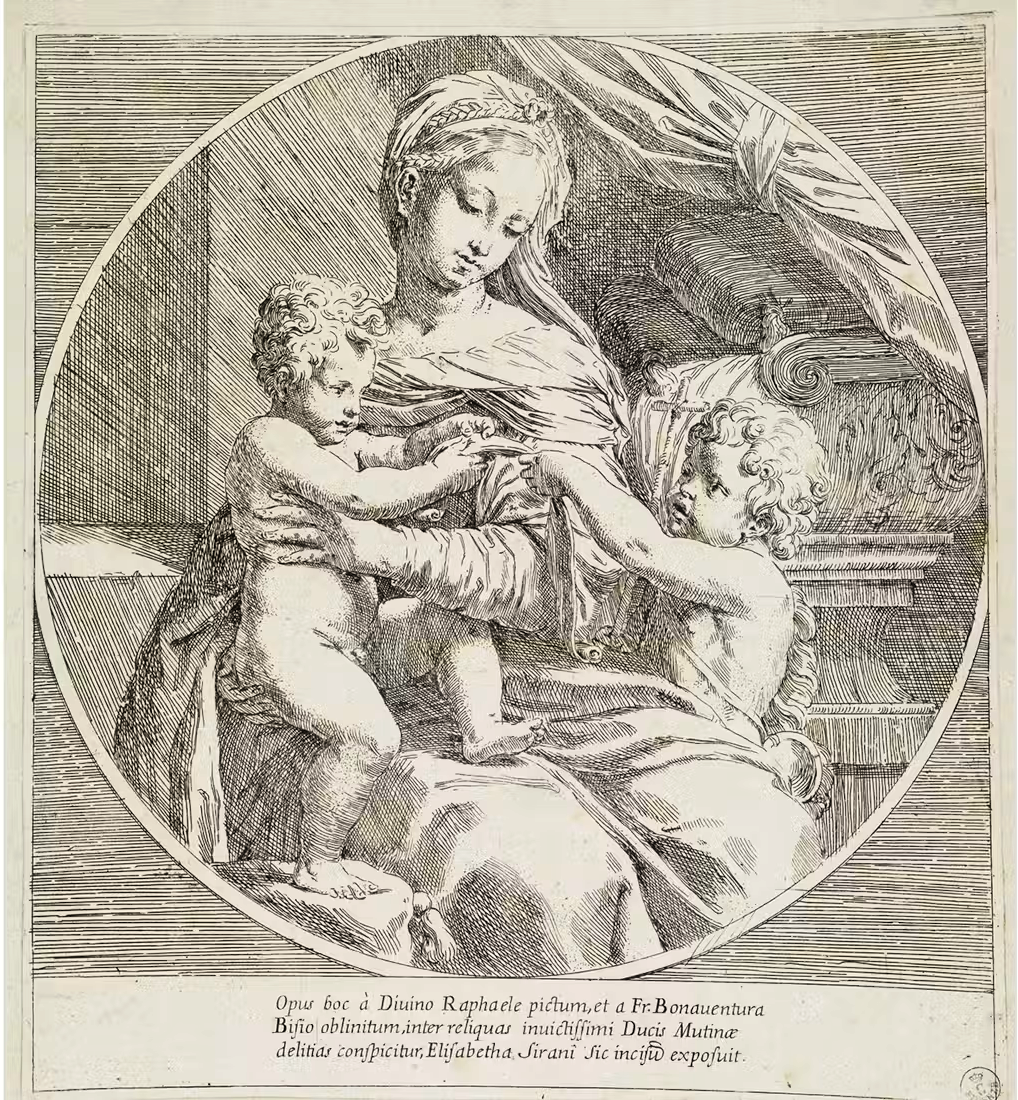
This impression: Uffizi, Florence: Cabinet of Drawings and Prints, inv. 106338 st. sc
With prints such as her two versions of The Flight into Egypt, Elisabetta was one of the first female peintres-gravures, although she probably only made ten engravings in her lifetime, only one was not of her own invention.98 It was also of specific circumstance, ultimately a of a tondo then thought to be a Raphael autograph that had recently entered in the collection of the Duke of Modena.99 But importantly, in the Latin inscription below, stating clearly that is dependent on a drawing of the tondo by the artist-agent who had obtained it, Padre Bonaventura Bisi: meant as thanks for having introduced her work to the Medici in 1658, and promoting herself in what Adelina Modesti describes a “Holy Trinity of the classical tradition”.100 It is generally thought of as Elisabetta’s finest-quality engraving and with its wide range of shading and tonal through careful hatching, testament to her skill as an etcher.101
Elisabetta’s first big commission as a painter came in February 1657, a large canvas of the Baptism of Christ for the church of San Girolamo della Certosa (part of a Carthusian monastery: after the Napoleonic suppressions, it became a municipal cemetery) as part of a cycle of the Life of Christ, along with six other mostly local painters, including her father, which had been inaugurated 1644.102
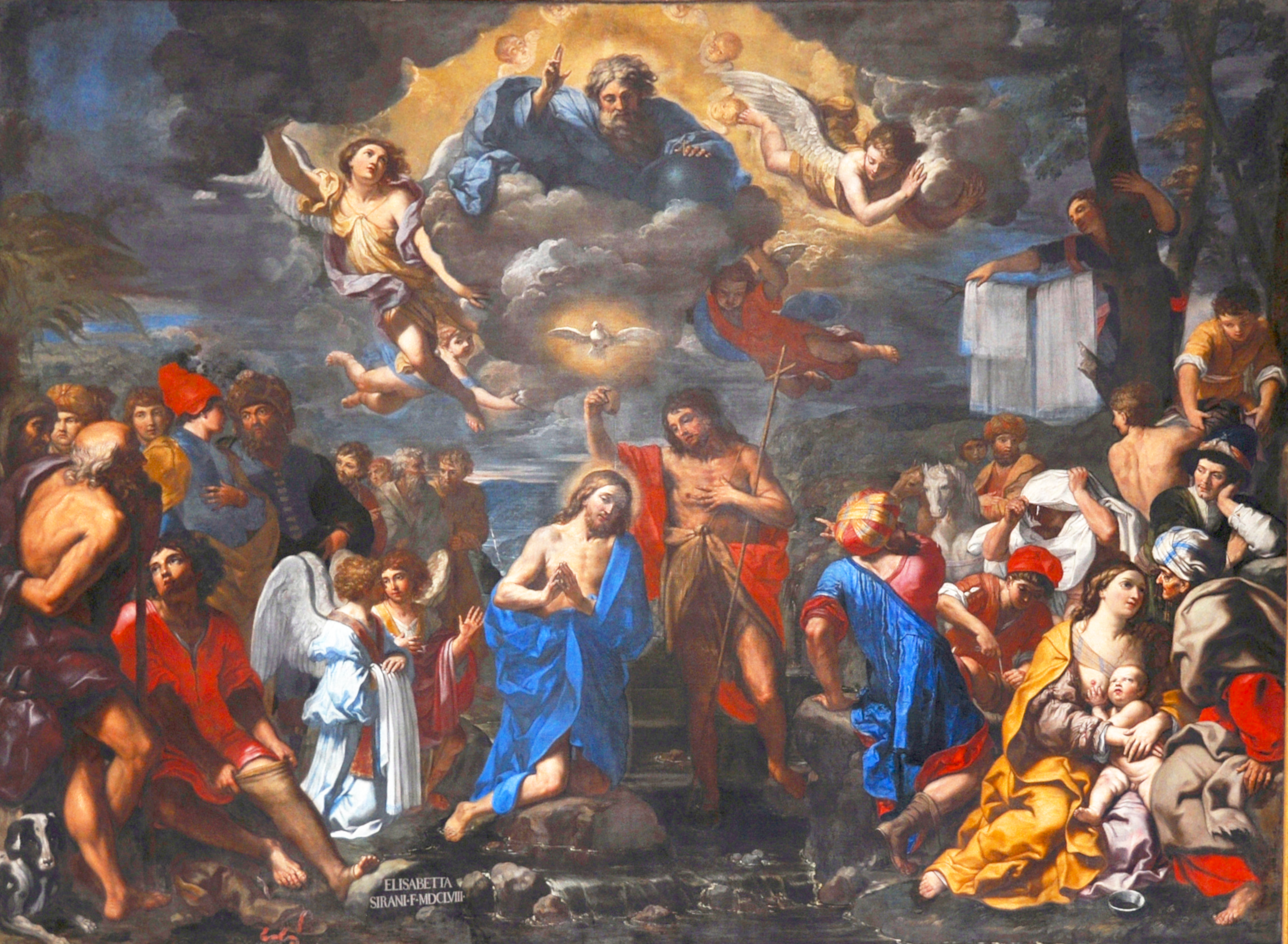
400 × 500 cm.
Transformed version of this photograph as none of the images online are wholly suitable (neither is this, to be honest, but it is better than the alternatives)
Seemingly mostly completed within her twentieth year, Elisabetta’s monumental Baptism canvas is a hugely distinctive achievement both in its disegno and colore.103 Its 33 life-size figures often draw on poses from Old Masters such as Leonardo, Michelangelo and the Carracci.104 The distinctive colour palette dominated by muted blues, pinks, and tans characterises the swirling masses of surrounding figures,105 with a powerful central pyramid formed by the ultramarine robes of Christ, the gesturing figure to His right, and God the Father in the apex.106
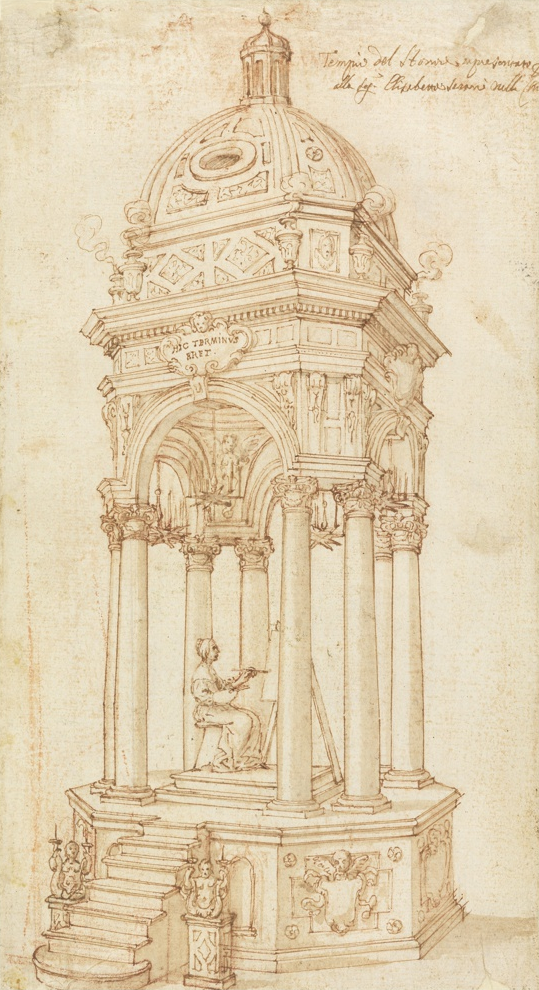
29.9 x 16.3 cm
Elisabetta continued to work closely with her father and was, as well as her own works, was commissioned to copy and produce variants of his work in a collaborative workshop environment.107 Then, around 1662, Giovanni Andrea became so afflicted by his arthritic gout that Elisabetta assumed control of the family workshop, as she subsequently was referred to as maestra.108 We have an insight, although far from comprehensive, into her oeuvre from a diary that she kept recording commissions from 1655 onward, that was transcribed in full by the Bolognese art historian Carlo Cesare Malvasia in the Felsina Pittrice.109 Her death 28 August 1665 was initially litigated by her distraught father as a poisoning by a family maidservant, but autopsies concluded Elisabetta died of natural causes and the charges were dropped.110
She was accorded a public civic funeral by the citizens of Bologna of which the showpiece was a enormous catafalque modelled on a Baroque high-altar baldachin set up in the nave of Bologna’s Dominican church.111 Drawings and prints show it to be a miniature temple−of timber, but painted to look like stone and marble−with inscriptions extolling her virtues and featuring a life-size effigy of her in the act of painting on the dais, and a pair of sirens punning on her family name flanking the steps up (Right).112 Elisabetta was interred in San Domenico’s Chapel of the Rosary, the family chapel of her godfather Saul Guidotti, incidentally also the burial place of Guido Reni two decades earlier.113
Despite her curtailed career,114 Elisabetta displayed a enormous talent for invenzione from an early age, creating novel, effective figural compositions within the formal constraints of the Baroque style, often working with patrons to create compositions of obscure subject matter, particularly of heroic women from ancient history.115
Bohn succinctly describes that Elisabetta:
“unconventionally interpreted [heroic] women not as eroticized subjects presented to the male gaze but as exceptional females who had transcended the conventional limits of their gender in possessing the masculine-identified virtue of fortitude.”116
Burghley House No. 304.
236.5 × 183 cm
Burghley House has a stunning example of such work of Elisabetta: her Judith Triumphant with the Head of Holofernes, signed and dated 1658, that by itself Burghley House is worth the visit to see.117 Elisabetta does not dwell on the grisly moment of the Jewish widow decapitating the Assyrian general Holofernes in his tent like many other painters like Caravaggio and Artemisia Gentileschi, but the moral and political implications of Judith’s triumph as a femme forte.118 Although Judith adopted the guise of a seductive woman as a mask of femininity, her spiritual virtue remains intact as she readies to lift up the general’s severed head high above her own for the gathered crowd.119 Again, the rich ultramarine-blue dress forms a mesmerising central element as in Elisabetta’s Baptism of Christ for the Certosa.120
Painted a year later for the same patron (the banker-merchant Andrea Cattalani) as a pendant to the Judith Triumphant, was the unusual subject from Plutarch of Timoclea of Thebes Throws the Captain of Alexander the Great into the Well, which similarly depicts the active moral agent of femme forte rather than femme fatale.121 With no visible emotion, Timoclea, victim of sexual violence by the Thracian military officer, after fooling him into thinking there is treasure at the bottom of a well, tips him over into its depths to his death (with the coincidence that his tumbling making him look like an anti-clockwise swastika being chucked in the bin).
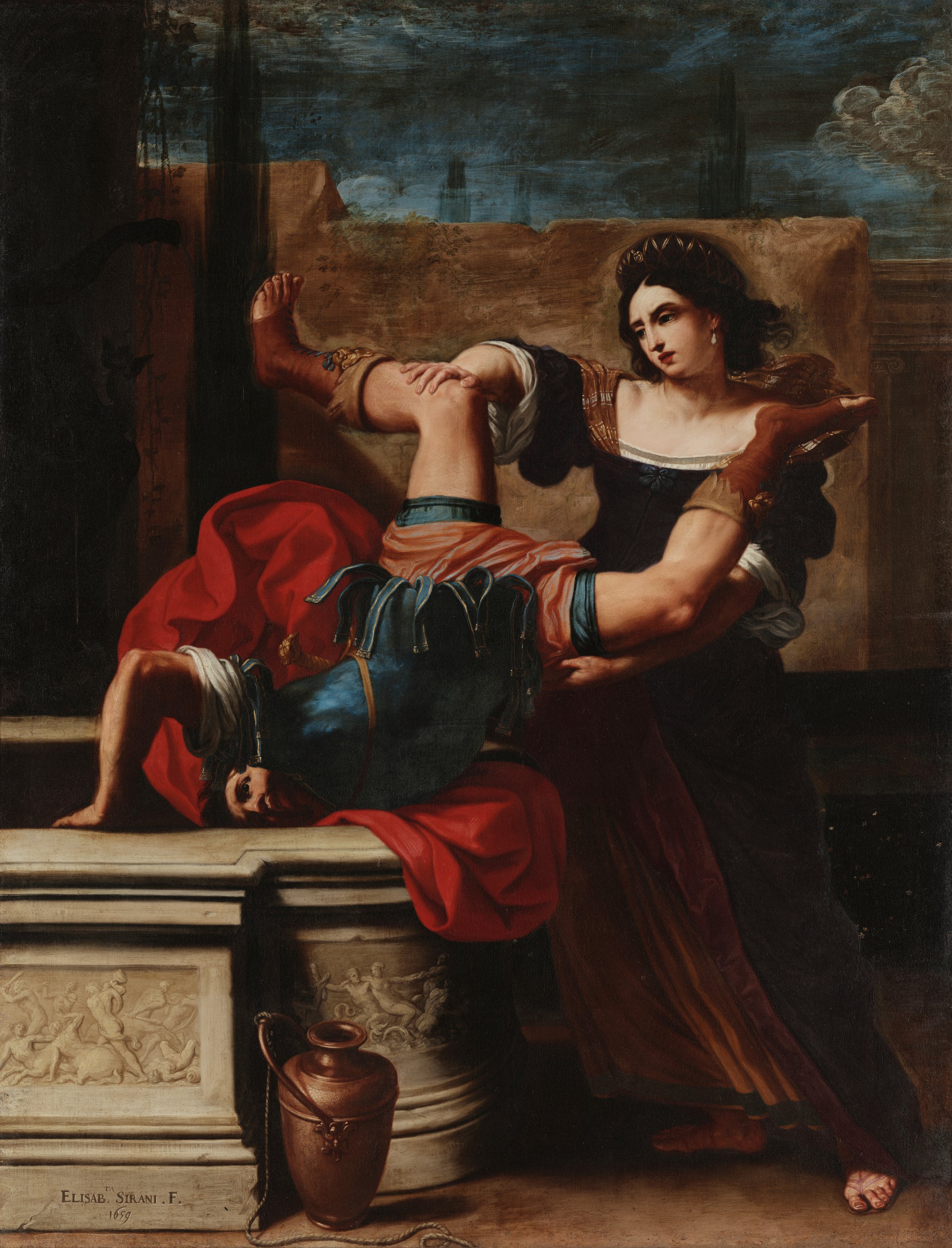
Museo e Real Bosco di Capodimonte, Naples, inv. Q633.
228 × 174.5 cm
In a contrast to Elisabetta that could hardly be greater, Guido Reni was a man who, in his life, was abnormally misogynist even for the seventeenth century: wanting no woman in his house after the death of his mother in 1630, and completely flipping his lid when he once found a lady’s blouse in his laundry.122 This did reflect in his art, particularly his approach to male and female bodies, as Spear puts it: “the former as tactile, empowered presences, the latter as elastic, impotent abstractions”.123 That is not to say Guido could not successfully stage dramatic paintings with women actors, just that he would do so with a very different conception to the Sirani, especially Elisabetta. Spear characterises Guido’s copious oeuvre of the suicides of Lucretia and Cleopatra as women-as-object in a voyeuristic spectacle of “passive female bodies sapped of sexual power and therefore legendary female control”.124
It could be assumed, unlike heroines who benefitted their civic community such as Judith and stood up to a rapist like Timoclea, that it is difficult to put a virtuous slant on the daughter of Herodias, who, at best, is a neutral party in the execution of the Baptist, arguably complicit.125 But, Elisabetta did put her own slant on “anti-heroines” too, as well as showing Cleopatra, also Deliah, Iole and Circe by highlighting their power and intelligence.126 And indeed, she did do the same with the daughter of Herodias: just not in a painting.
Elisabetta produced two interconnected works on paper depicting the martyrdom of St John the Baptist. Although they have been widely published on regarding her workshop practice, the clever interpretation of the subject matter seems to have been rather neglected. Both innovatively recast the daughter of Herodias as sympathetic figure, fully aware of the magnitude of the events unfolding around her rather than a passive part of narrative or as a vessel in a contemplative Andachtsbild. Elisabetta made a print of the subject dated 1657, and a wash sketch that is argued both as a preparatory drawing for the print and conversely as a derivative work after it.
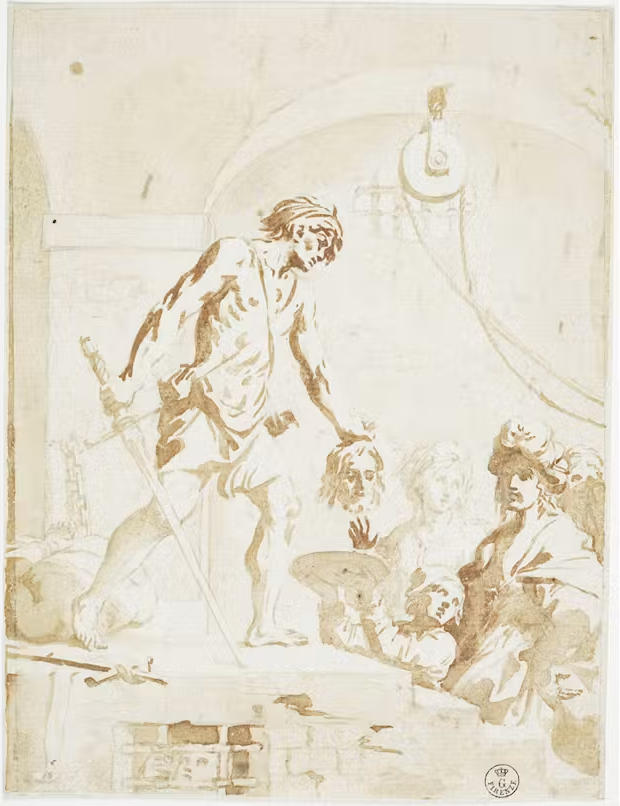
Florence, Uffizi Galleries, Cabinet of Drawings and Prints, inv. 6300 F
19.6 × 14.9 cm
The ink sketch (Left) is held by the Uffizi, as it was sent to Florence by Ferdinando Cospi (a keen patron-agent for the Sirani in Bologna) to Prince Leopoldo de’ Medici in 1662, presumably as a gift from Elisabetta herself. Modesti states explicitly that she believes that the wash was made around five years after the print due to Cospi’s letter regarding the delivery making it clear the drawings have been newly made.127 Bohn however maintains the sketch to be preparatory for the print as part of Elisabetta’s workshop practice.128 Regardless of the order of creation of the two works, they are a pair of images that, fitting to Elisabetta’s artistic character, recast the Biblical scene imaginatively: an early attempt at redeeming the daughter of Herodias as a young woman with her own thoughts, rather than a cog with no agency in the gears of sacred history.
The Florence sketch composition is dominated by the figure of the executioner on a raised platform above us and the rest of the cast, presenting the precursor’s head in the direction of who wanted it in revenge, for preaching against her marriage to Herod Antipas. That lady, Herodias herself, in a voluminous turban, is cast in half shadow, stoically looking forward. Recessing in lighter wash passages, a pageboy and then her own daughter (in a tighter turban possibly directly referencing Guido’s Palazzo Corsini type) looks to her as if expecting her to show any emotion for the enormity of the deed. The background is a sweep of a masonry arch with a pulley suspended from its soffit, the rope making a counter-arc in the composition.
Elisabetta’s addition of the pulley in her set for the execution is an intriguing detail, as it adds a grim, almost industrial dimension to the scene of extra-judicial killing. A pulley can also be seen in the prison architecture in other decapitations of the Baptist by Italian painters, at least two I’ve found. It’s a diversion, yes, but one too interesting to relegate to the footnotes.
First, part of a Baptist cycle on a series of panels by Quattrocento Sienese painter Giovanni di Paolo made c. 1454, where it is seemingly an observed detail on the outer part of the jail in a conservative mode of depicting architecture that is indebted to Sienese masters of the second quarter of the previous century, particularly the Lorenzetti brothers and Simone Martini.129
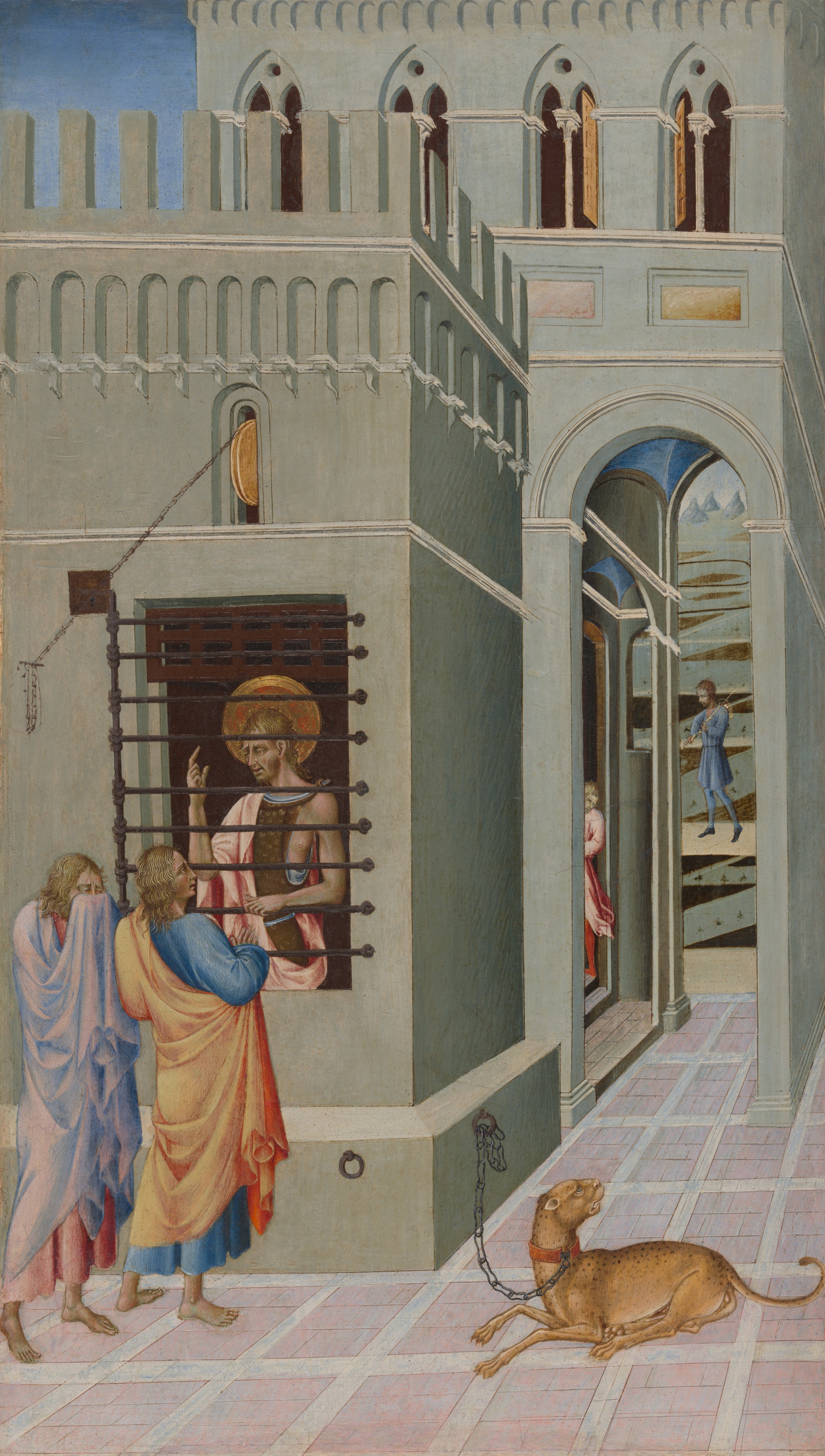
68.3 × 40 cm
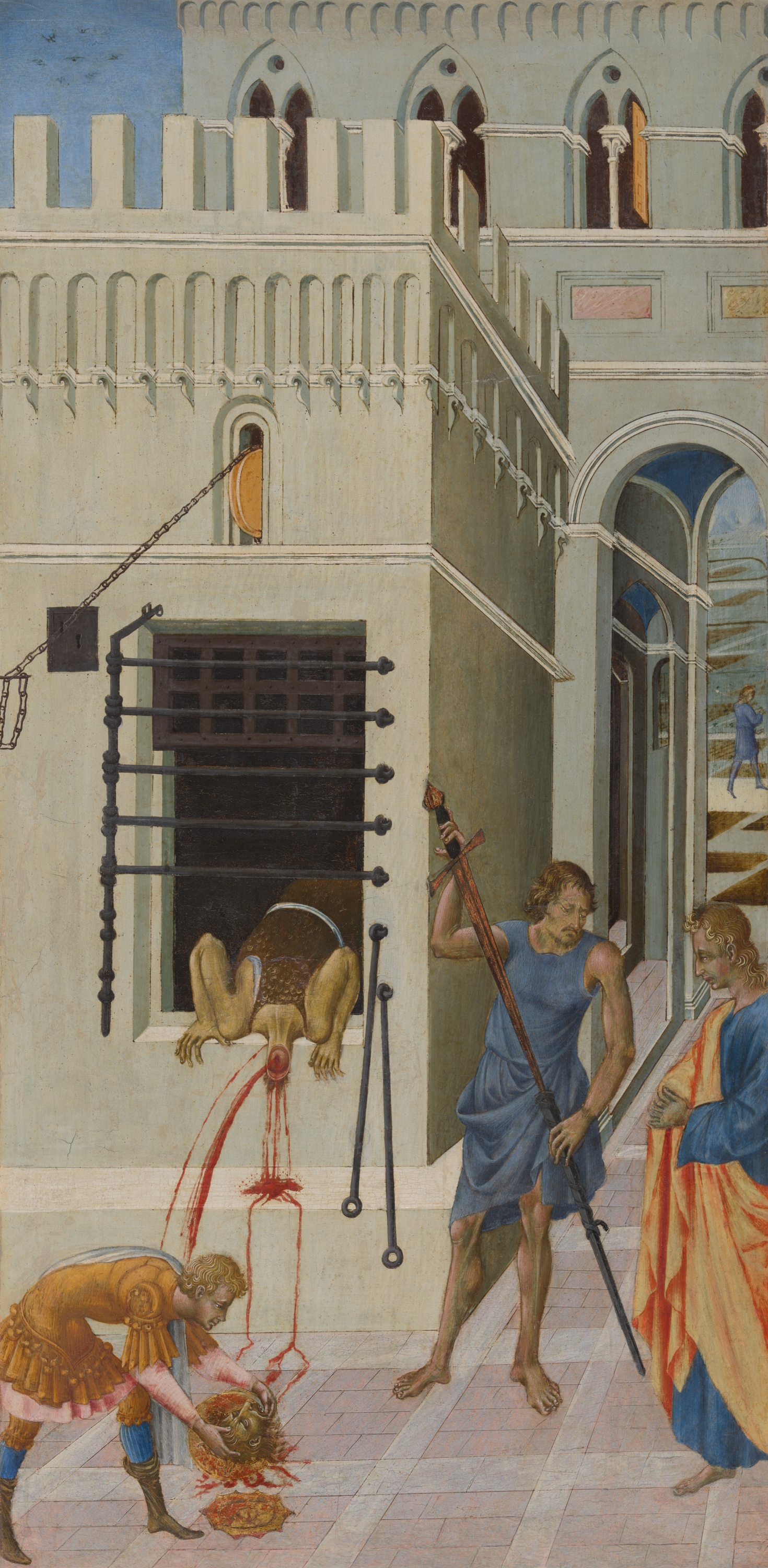
68.6 × 39.1 cm
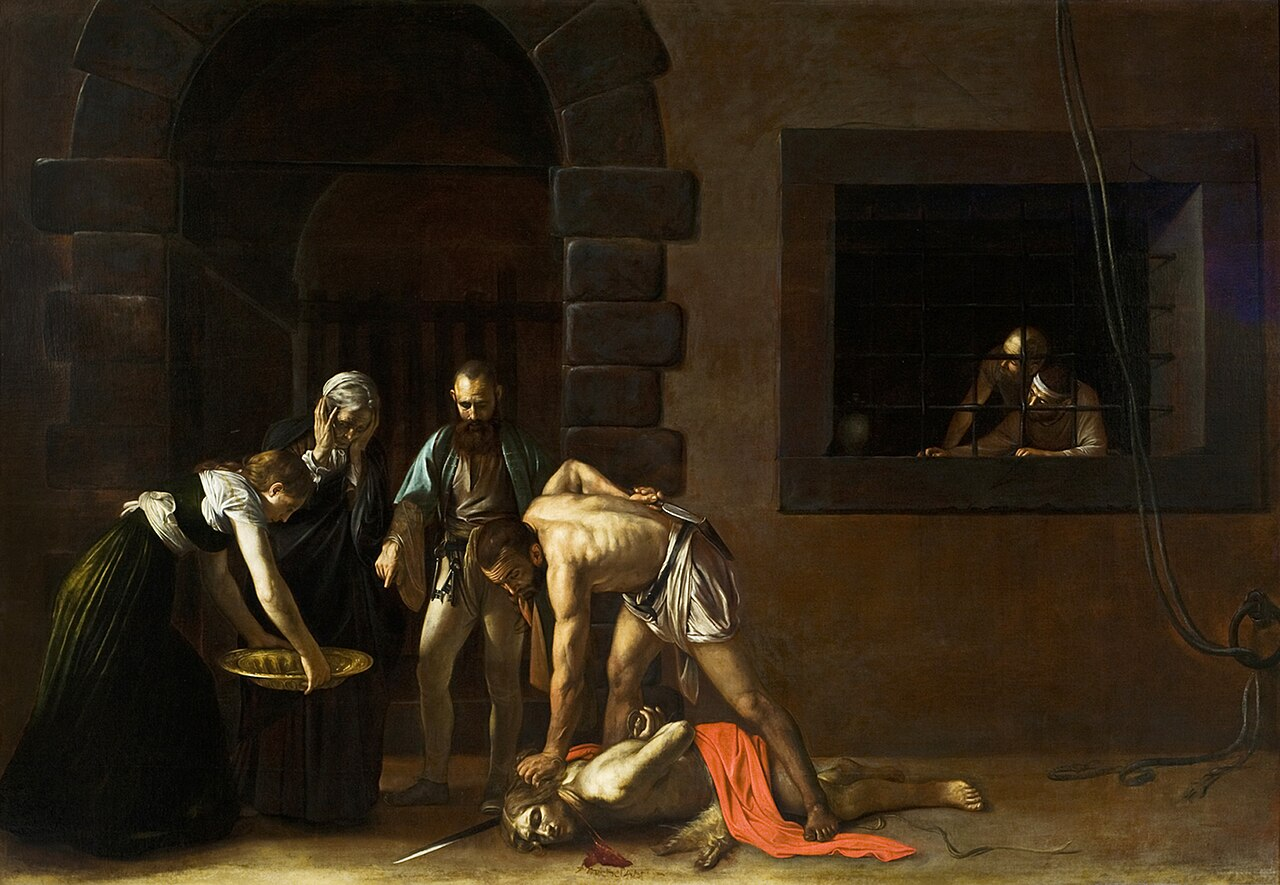
370 cm × 520 cm
Second, Caravaggio’s famous altarpiece painted during his brief period as a knight of the Order of St John on their island of Malta (1608) after his flight from Rome in the wake of the incident in 1606 when he killed a man in a duel. Like the Elisabetta wash drawing, the right side of the composition has a doubled-over rope which is presumably suspended by a pulley off the top right of the canvas, which serves as a temporal dimension in the drama, in that it is implied the Baptist was bound here by via an iron hoop embedded in the prison wall before he was pulled over for his execution.130 It’s also notable here how like Giovanni di Paolo a century and half before and Elisabetta five decades later, Caravaggio uses the jamb of a semi-circular masonry arch to accentuate the executioner: here the jamb dressings running right down his restraining left arm as he pulls out a knife to finish the nasty business of hacking off the precursor’s head that the onlookers are quite keen to get finished as quickly as possible.131
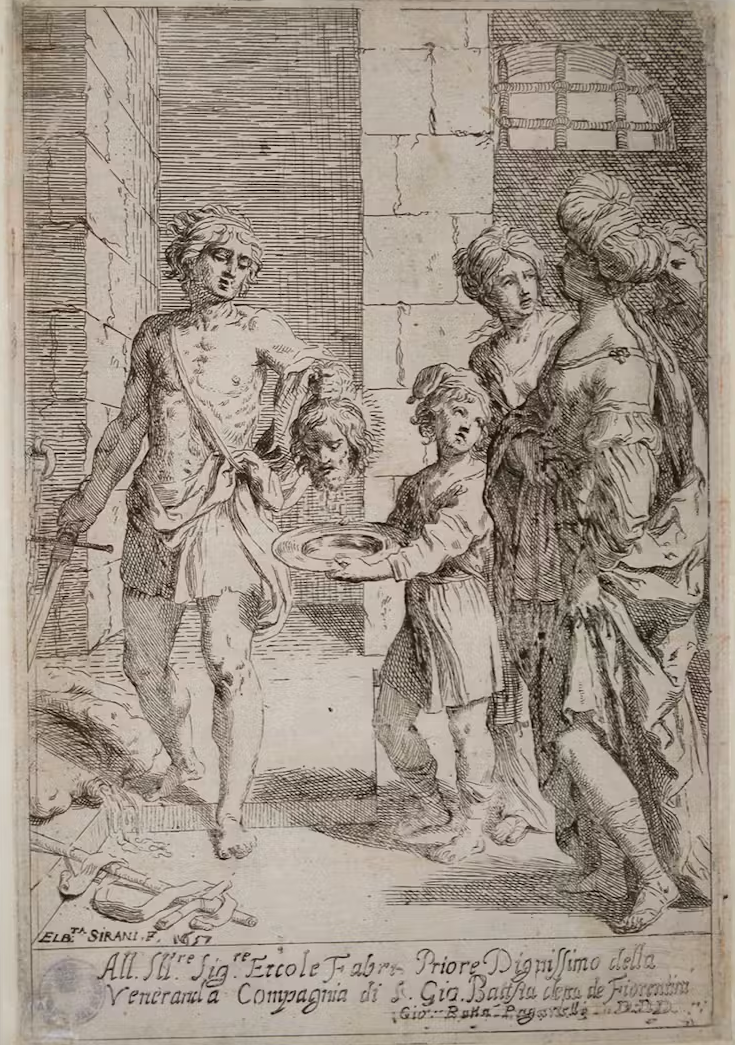
This impression National Art Gallery of Bologna – Cabinet of Drawings and Prints, inv. 2074
21.2 × 14 cm (block)
Elisabetta’s print of the subject of the Baptist’s Beheading (Right) is signed and dated 1657,132 with a subtitle (often sliced off on surviving impressions) saying it was made for Giovanni Paganelli and dedicated to the Prior of the Compagnia S. Giovanni Decollato (Confraternity of St John Beheaded), a man named Ercole Fabri: member of a Bolognese senatorial family who were patrons of the Sirani.133 In Elisabetta’s print, the emphasis is brought away from the grand architectural stage and framing (except a cross-barred lunette that sets the architectural iconography of a prison) towards a much tighter focus on the psychology of the actors. The executioner is drastically brought down and now presented frontally, descending from a mere step above the assembled party.
Herodias, the tetrarch’s wife, her face totally in shadow under her pompously padded turban, is implored by her distraught daughter, dressed in a tighter turban, to stop as she grabs her mother’s right hand. But her mother is unmoved as she strides towards her vengeful prize: accentuated by the purposeful and expressive detail of her left hand in the process of pulling up her dress above her sandals: presumably to avoid it being soaked in the river of blood that gushes towards her from the precursor’s decapitated cadaver.134
The order of the two compositions seems incidental to their individual creativity: the print is suited to close contemplation of the drama, intended to provoke discussion; while the far more monumental wash drawing, with its the analogue for the Host placed almost on the central axis towards the bottom of the picture, would make an effective Counter-Reformation altarpiece accentuating the sacrifice of the Eucharist akin to that of Caravaggio on Malta.135 Both of them also deserve greater attention for their narrative invention. To bring up again the concept of midrash: Elisabetta foreshadows Oscar Wilde and the Symbolists by engaging in midrash on the episode of the Beheading of the Baptist (although, characteristically for Elisabetta, with none of their eroticism): an imaginative recasting of scripture, dramatising a message by informing us of the actors’ thoughts.136 As well as its intrinsic meaning, it expresses its value in the life of the reader: here, a newly-emerging female artist in mid-Seicento Bologna.137 It is not I think, too much to conjecture that the nineteen-year-old Elisabetta who made this plate may be projecting anxieties on the Daughter of Herodias about embarking on her career, and following those before her in seizing the prize of fame.
Thus, within the impressive oeuvre of Elisabetta she produced within her short life, Burghley House No. 123, being both a slavish replica of part of Guido Reni composition and a biblical woman displayed with zero emotion or psychological agency, looks an unlikely fit into the sort of works she was known for and commissioned to make by her patrons.
Other Guido Reni Daughter of Herodias compositions recast by the Sirani
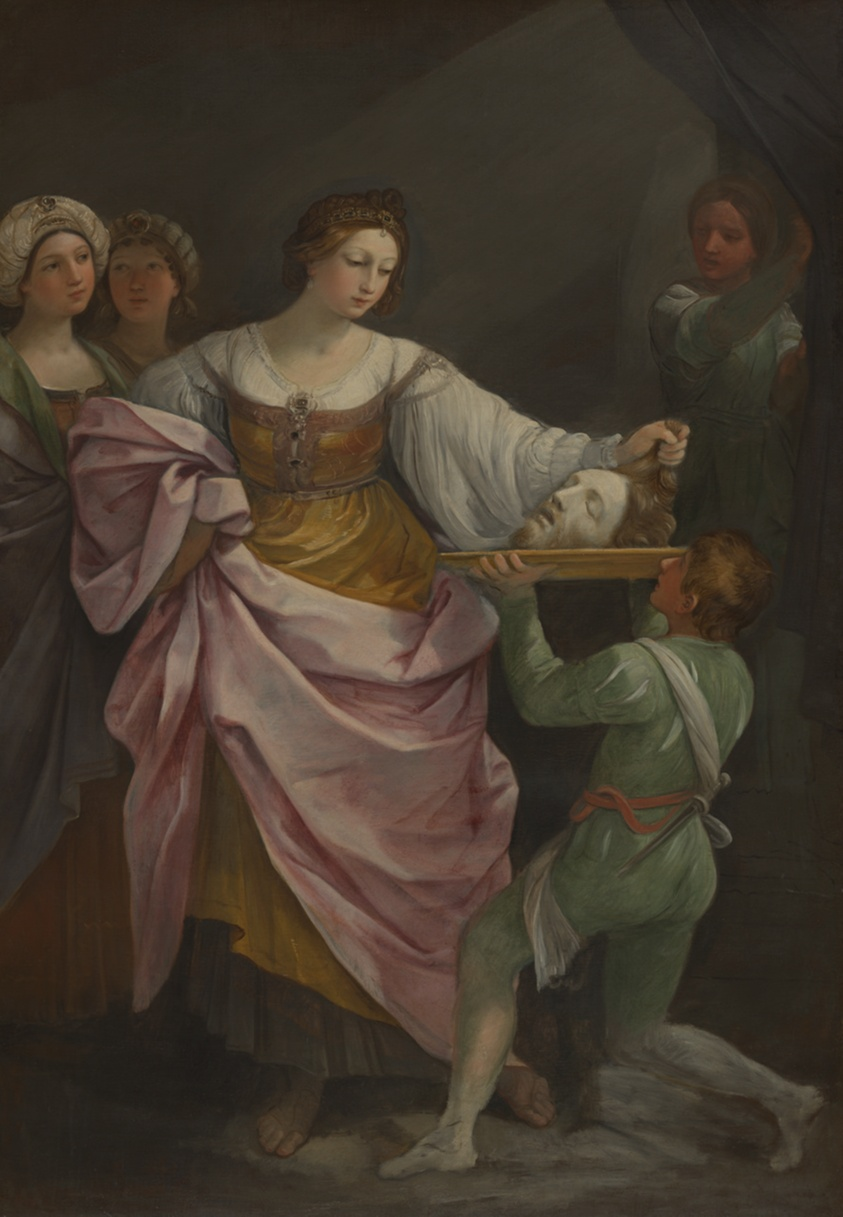
248 × 172 cm
There are two other Guido Reni paintings of the daughter of Herodias with the head of the Baptist that are associated with the Sirani that will be addressed in a final section. Partly because they are separate compositions that could be confused with the Palazzo-Corsini type in documentary references to paintings of “Herodias” by Guido Reni, but also fluctuating psychological interpretations of the subject bridging between the late output of Guido Reni and the works of the subsequent Sirani bottega.
The first, with its overall fairly unusual intermediary character of a young servant boy presenting the platter bearing the Baptist’s head, almost certainly must have been a direct influence upon Elisabetta’s works on paper above. The widely-acknowledged autograph of this composition is the canvas now in Chicago that, although unfinished, is exemplary of Guido’s ultima maniera (as it appears to have left the studio without Giovanni Andrea Sirani needing to retouch it).138
The full-length daughter of Herodias here has uncovered hair, in contrast to her handmaidens, who have tight turbans akin to the Palazzo Corsini three-quarters type. It was in the Palazzo Colonna in Rome from a very early date, as mentioned by Malvasia, so presumably commissioned by them.139 Jérome Richard in 1766 published a description of a “Hérodiade, grand tableau du Guide” in the Colonna Palace and recognises its unfinished appearance.140 The painting was in England for much of the nineteenth century, by 1812 it had been bought by the Earl of Darnley and was in Cobham Hall, Kent. Gustav Waagen inevitably saw it and judged it as “insipid” and “weak in modelling”, but nevertheless attributed it to Guido.141 A paper delivered July 1876 to Kent Archaeological Society in the long gallery of Cobham Hall itself gave it to Elisabetta Sirani, comparing it to a similar painting owned by Lord Yarborough.142 The higher degree of finish on the latter canvas long meant it was held to be the Guido original until Federico Zeri’s reassessment in 1960.143
190.5 × 152.4 cm
Lord Yarborough’s painting also made its way across the Atlantic Ocean in the twentieth century, and now hangs in the John and Mable Ringling Museum of Art, Sarasota, Florida. It is clearly a reduced variant copy of the unfinished Colonna canvas, omitting the turbaned handmaidens and the shocked figure pulling back the curtain, and flipping the figural composition and reimagining the costumes as a high-key composition more akin to the Carracci. After being thoroughly excoriated by Zeri in 1960 (who also observes the magnitude of its repainting),144 it is now widely understood as created after Guido Reni’s death in 1642 solely by Giovanni Andrea Sirani due to the sweet expressions and elegant postures that exaggerate Guido’s ultima maniera, along with the rather boneless hands.145 In the Sarasota painting, the daughter’s cloak is also wrapped around her waist rather than the outer arm of her contrapposto stance, with her dress billowing over, giving a less aristocratic manner to her character from the probable Palazzo Colonna Guido original now in Chicago.
There is a marked change to psychology between the two works. The Chicago painting, which indeed seems to be Guido’s original autograph, has an entirely noncommittal exchange, where both the heads of the daughter of Herodias and the Baptist are tilted three quarters towards the viewer. Like The Daughter of Herodias now in the Palazzo Corsini, it’s hard to read that she cares about the head, which is now cold and drained of blood. Her handmaidens coyly exchange glances like it’s going to serve a decent bit of gossip at best. As Ela Nuțu puts it, this is the girl strictly of the biblical text: “an unnamed girl whose unshaped, vacant self—what Jacques Lacan would call her manque-à-être—allows her mother to project her powers and manipulate her Other flesh”.146

In the Sarastota version, even though it’s clearly an inferior painting in its quality (and a bit of a repainted wreck with some clearly very weak passages as a result), it is notable as well as the horizontal flip and the removal of the three attendants, that the daughter of Herodias is wrenching the precursor’s hair like a joystick to look directly into his closed eyes. Did the original painter intend a subtle smirk, acknowledging the mirror between her life and his death, and perhaps that there is a realisation of the game that her mother has played her in as a pawn? I don’t think we’re quite full Wilde here in that she wants to kiss the head like it’s the Song of Songs, but even in the subtle tension in her extended arm, I am sure you will agree, overall it is a very different encounter.
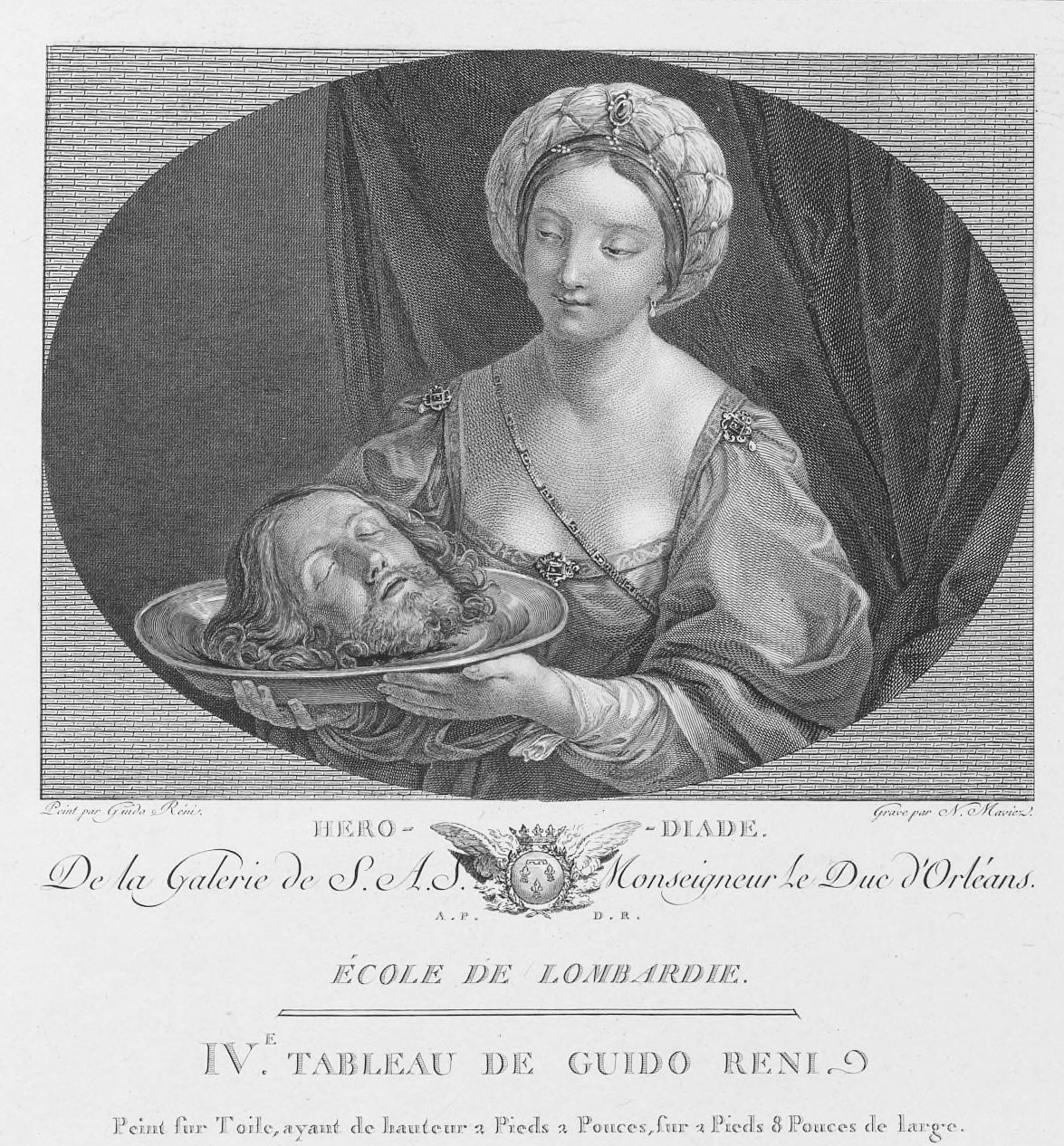
From Jacques Couché and Louis-Abel de Bonfons, 1786
Another Guido Reni Daughter of Herodias with the Head of the Baptist composition associated with the Sirani but complicatedly exists (or existed) in a number of versions is a half-length similar to the Palazzo Corsini type, but in a landscape orientation, generally with the picture field and intended framing feigned within an elongated oval.147 The generally assumed original of this type is only pictorially recorded by an engraving when it was in the collection of the Duke of Orleans in 1786 (Right), the composition flipped horizontally due to the process of printmaking that can be seen in all the accompanying images in the series.148
This canvas is sometimes taken as first catalogued in the collection of Cardinal Mazarin − chief minister of Kings Louis XIII and XIV − at his death in 1661: as an oval painting with its height [hault] recorded as 2 pieds 7 pouces – 83.92 cm).149 However, when the Herodiade “ovale” was in the Duke’s collection by 1727, as recorded on the print, it was documented as 2 pieds 2 pouces by 2 pieds 8 pouces – 70.43 x 86.67 cm).150 While the longest dimension being one pouce (2.709 cm) different could be overlooked, that the Mazarin inventory explicitly gives it as the vertical dimension of the oval [hault, height instead of large, width] is not so easy to handwave away as a minor inconsistency or mistake in the listing, and that the Mazarin collection was another, portrait-orientated, composition, such as the Palazzo Colonna type looked at immediately above. Although the location of the Duke’s oval today, if it even survives, is unclear: however it has been argued to have been sold at least four times in England between 1829 and 1911.151 In the 1911 sale, it was listed as Elisabetta Sirani, with dimensions very similar to those in Duc d’Orléans collection (26 ½ x 34 inches: 67.31 x 86.36 cm).152 Another version, with a striped sleeve, formerly from the Cholmondeley Collection at Condover Hall (Shropshire) appears to have come up for auction in London in 1970, but its location is also unknown.153
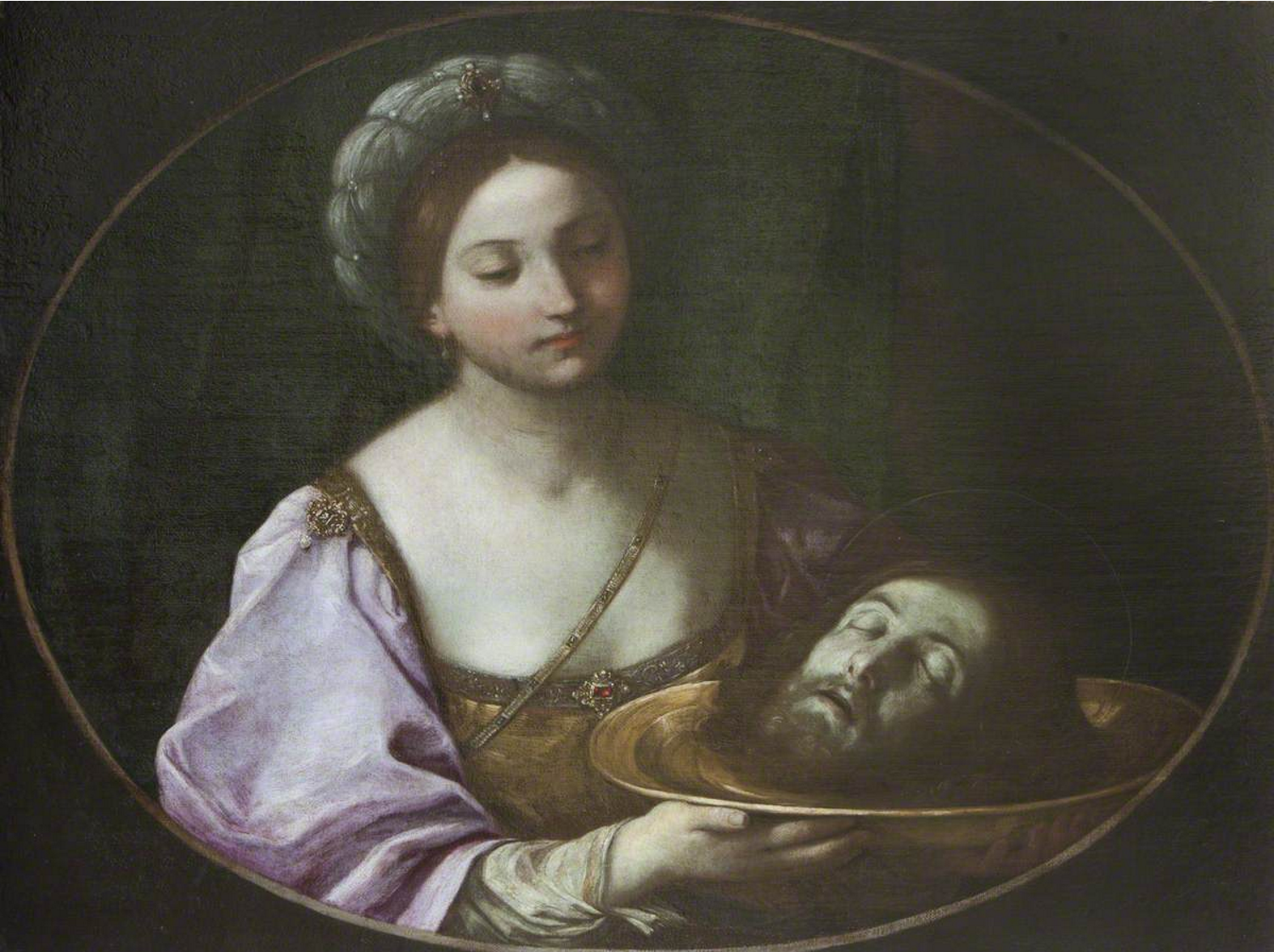
68.5 × 83.8 cm
It would seem that the best version of the wide oval composition of The Daughter of Herodias with the Head of the Baptist in a public collection is at Belton House, just north of Grantham (Lincolnshire) acquired by Sir John Brownlow, 5th Baronet (1690-1754). The painting was purchased by the National Trust at auction in 2005 to keep it at the Belton Estate, which they have held since 1984.154 The dimensions are similar to the Duc d’Orléans oval but it cannot be identified as it since this version was inventoried May 1738, well before the dispersal of the Duke’s collection after the Revolution.155
Taking the Duc d’Orléans print and the Belton House painting together: the daughter of Herodias looks passively at the cold head of the precursor (which quite frankly, seems somewhat smaller than her own). Her costume is similar to the Palazzo Corsini type: a cloak with brooches over the shoulders, but her turban with frontal brooch is rather modest in comparison with less sense of the exotic: only the jewelled shoulder chain adds interest. We can’t see the undershirt on her bust, but we can see its sleeves on her lower arms, with the linen cloth under the platter which, as in the Corsini composition, is knotted around her right arm. The drapery of a curtain in the background is paralleled by the Palazzo Colonna full-length in Chicago. Together with the tonality being very close to Guido’s low-key ultima maniera from the late 1630s, this suggests this composition in an oval is derivative of both the Corsini three-quarters and Colonna full-length compositions, thus it is comfortable to tentatively assign this composition as something that came out of the dissolution of his master’s bottega after 1642 that Giovanni Andrea Sirani made sellable.156 How close a witness the Belton House canvas is to that version is an open question.157 There are later copies of this horizontal-format Herodias with the Head of the Baptist in public collections, some of which have pointers towards other versions going around in English collections in the nineteenth/early twentieth century.158
Conclusion
As much as I can conclude after what is mostly a desk-based assessment (I should get myself to Rome, I know), it appears most likely that Burghley House No. 123—used as the cover art of brutal death metal album recorded in the Quebec metropolis three decades ago—with its well-judged tight crop of an existing Guido Reni composition was made by one of the pupils in Guido’s studio before the master transitioned to his sweeter ultima maniera in the 1630s. Recent research has shown the 1620s was when Guido really started began to focus upon single-figure subjects akin to the three-quarters length Daughter of Herodias that could be replicated by his students to meet the demand of his growing market due to his increased fame and reputation.159 Who precisely painted it is likely beyond the limits of historical investigation: contemporary sources report no fewer than eighty worked at Guido’s bottega in Bologna, and that he may have had over two hundred pupils in his career, although these figures are judged to be rather excessive.160
It is not impossible that the Burghley Daughter of Herodias is from the hand of the breakout young talent of Elisabetta Sirani. As we have seen, despite beginning her career in 1654 at the age of sixteen, twelve years after the death of Guido Reni, is still considered part of Guido’s scuola in her artistic development.161 However, the rigid allegiance to a Guido prototype and the lack of any accentuation of female agency, as well as a palette of colours and dramatic chiaroscuro mode that is alien to her established oeuvre of works make it seem highly unlikely. Also, while good quality, Burghley House No. 123 is not the most finely-finished of canvases and does not compare well to Elisabetta’s autograph achievements from the late 1650s when she was in her late teens/early twenties, such as can be observed on the Burghley House Judith Triumphant with the Head of Holofernes, No. 304, painted when she was twenty years old.
Pending a true connoisseur of Elisabetta’s brush, or those of her own scuola, to put the record straight (although I do think the amount of international scholars who must have been to Burghley to see her superlative canvas of Judith, No. 304 and not regarded No. 123 says much by itself), I would argue that it does Maestra Sirani and her talents of invenzione a disservice to give this canvas to her. Instead it seems more likely Burghley No. 123 came out of Guido’s studio or circle in the late 1620s, around the time the first version of the composition was painted, pre-dating the version that currently hangs in the Palazzo Corsini, Rome. This instead makes it even more interesting as witness to the autograph prototype, which, as argued by Ladislav Daniel in 1992, perhaps hangs in somewhere in Geneva. Certainly further research could be done by looking closer at the other copies that have been across the art market. Even if they are copies after, rather than connected to the Guido studio or its followers, they could give firmer evidence for the existence of a version earlier than the Palazzo Corsini canvas, before the latter achieved renown as a go-to canvas to copy, seemingly in the mid to late eighteenth century.
Amongst this discussion between the high art of oil paint on canvas of subjects from the scriptures, especially from a classical idealist like Guido Reni, and low art of distorted guitars playing chromatic riffs with some absolute madman doing guttural growls over the top, it seems only apt to end on the poem by Giambattista Marino, published 1620, regarding Guido Reni’s canvas of The Massacre of the Innocents now in the Pinacoteca Nazionale di Bologna.162 Especially that final couplet.
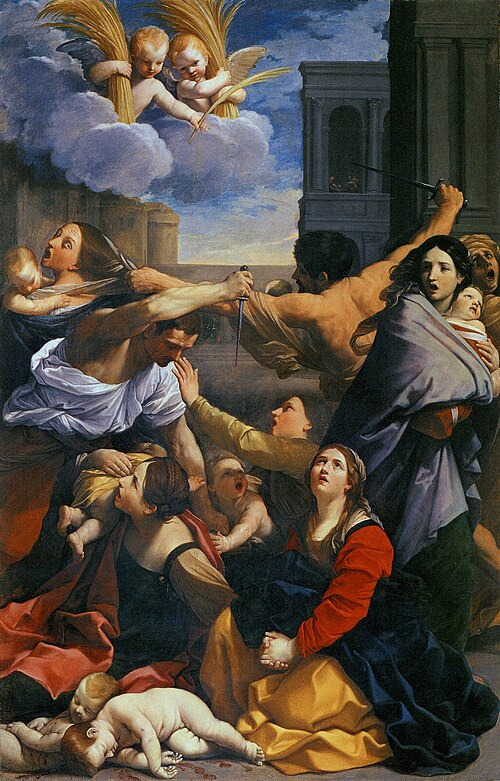
Pinacoteca Nazionale di Bologna, inv. 439
268 cm × 170 cm
Che fai GUIDO? che fai?
La man, che forme angeliche dipinge;
Tratta or opre sanguigne?
Non vedi tu, che mentre il sanguinoso
stuol de’ fanciulli ravivando vai
nova morte gli dài?
O ne la crudeltate anco pietoso
Fabro gentil, ben sai
ch’ancor Tragico caso è caro oggetto
E che spesso l’horror va col diletto.163
What are you doing, GUIDO? what are you doing?
The hand that paints angelic forms
Now treats of bloody deeds?
Do you not see that while you are revivifying
the bloody throng of infants
you are giving them new death?
O compassionate even in cruelty,
gentle artificer, well you know
that a tragic event is also a precious object,
and that often horror goes with delight.164
Footnotes
- The main career of Dan Greening, Lord Worm is, (in)famously, teaching the more precise points of English as a foreign language, particularly to Québécois: “I work with a language center. I get contracts and I go to these student’s workplaces by schedule as opposed to a classroom. Someone […] gives me a call and says: “we have a bank president that’s only at a certain level of expertise with English and needs more for whatever reason.””
“Pardon, Please: The Deciblog Interview With Lord Worm”, Decibel Magazine, 25 Aug. 2014. Link|Archive
Earlier confirmation of this day job, which was always rumoured online, can be found from an interview shortly before he rejoined the band to record Once Was Not (2005): “LORD WORM: Martin [Lacroix] came in and was handed tours on a silver platter, did the live album and that was it. He is gone because he was not fluent in English. Although I was hired to give him English lessons which I did for nine months – I am an English teacher – and was helping him with the lyrics, he did not last”, “Interview with Lord Worm”, Metallian, 20 Aug. 2004 Link|Archive ↩︎ - “MC – By the way, who wrote the piano intro for [Phobophile]?
LW – Eric Langlois, bass man, sitting right over there (points to a semi-comatose Canadian bass player)”
Matt Cinatl, “Cryptopsy interview with Lord Worm”, The Metal Institute, 11 Feb. 2009 Link|Archive
“I remember it took awhile for Eric [Langlois] to get a take like he wanted it, for his piano intro to ‘Phobophile’. We were all pretty tired, at that point. So was Pierre [Rémillard, producer/engineer], who felt that the best way to motivate us was to mime descending a circular staircase. You know how, when you’re really tired, stupidity seems even funnier? It was like that”, “LORD WORM – One So Vile…” BraveWords, 22 Jul. 2011 Link|Archive ↩︎ - Also, Atheist from Sarasota, FL, originally active 1987-94, who have plenty of this, partly due to the gone-too-soon bassist Roger Patterson (1968–91) on their debut Piece of Time (1989), but subsequently by Tony Choy (1971–) who stepped in to play Patterson’s authored parts on “Unquestionable Presence” (1991) and then remained with the band to help compose Elements (1993). Choy also played on Dutch death metal band Pestilence’s Testimony of the Ancients (1991) which is also an important early “progressive” work in the genre. ↩︎
- On genre labels, Cryptopsy are now generally referred to under the umbrella of “technical death metal”, or “tech death”, although in 1996 they were referred to as “brutal death metal”, “Flo Mounier interview”, Master of Brutality (Netherlands Fanzine) 9 (1998). ↩︎
- Credited to “Dragon Design, München” in the original CD booklet, who was Michael Schindler (1963–2016), an artist based in Bavaria: https://www.metal-archives.com/artists/Michael_Schindler/67173.
Yes, it does look a bit like Sepultura’s Arise (1991, Michael Whelan) mashed up with Iron Maiden’s Seventh Son of a Seventh Son (1988, Derek Riggs). ↩︎ - “Cryptopsy setlist”, Club Academy, University of Manchester Students’ Union, 22 Jan. 2026. Though I must say, it was slightly disappointing that they did not play the entirety of None So Vile (their setlist always leans very heavily into it anyway), omitting “Lichmistress” and “Dead and Dripping”. There was also the odd decision (apparently made at all venues, at least in the UK) that the backline used by the opening acts they’d brought over from North America (Corpse Pile, Houston, TX; Inferi, Nashville, TN and 200 Stab Wounds, Cleveland, OH) was removed, and they played their set exclusively through the venue PA, which quite honestly, did not sound good at all (poor sound quality mentioned by Ethan Craddock, “Cryptopsy Celebrate 30 Years of None So Vile in Manchester” Ramzine 27 Jan. 2026)
And for everyone who says it’s a faux-pas to wear the t-shirt of the band you’re going to see: get lost! I hardly ever do it but the bands like it. ↩︎ - “Iconic” is an adjective, in this particular sense only recorded from the mid-20thc, that the usage of which is often accused as overused in recent years, e.g. “In later use frequently somewhat hyperbolical, in contexts without general or wide cultural resonance, and passing into a weakened sense of ‘a (relatively) significant, famous, or well-known person, thing, etc.’.” Oxford English Dictionary, “iconic (adj.), sense 3,” Jun. 2026.
Martin Kemp provides in the introduction to his collection of eleven “iconic images”, prefaced with an obvious reluctance, a definition of an iconic image as: “one that has achieved wholly exceptional levels of widespread recognizability and has come to carry a rich series of varied associations for very large numbers of people across time and cultures, such that it has to a greater or lesser degree transgressed the parameters of its initial making, function, context and meaning”, Martin Kemp, Christ to Coke: How Image Becomes Icon (Oxford UP, 2012), p.3. In Kemp’s definition, the ultimate part of “transgression” is fulfilled by the use of a Baroque devotional painting re-interpreted via its use on a death metal album cover, but not of the levels of universality across “times and cultures”. None So Vile is an extremely niche release, never coming close to charting in terms of units shifted in any market that can count toward the criterion of “very large numbers of people” but I think there are problems with declaring that any image can truly gain that a pan-cultural status, at least without a chauvinism for the supremacy of the “West” as a global omni-culture. And if we disregard the pan-cultural criterion, why can an image not be iconic within a subculture?
Kemp’s criteria of “transgression” is arguably contradictory to the classical meaning of icon (εἰκον) as “likeness”, and subsequently the classification of “icon” as a sign that denotes the signified via resemblance in Peircean semiotics, see e.g. Nicole Everaert-Desmedt, “Peirce’s semiotics”, An Introduction to Applied Semiotics: Tools for Text and Image Analysis, Louis Hébert (Routledge, 2019), pp.241-9, esp. p.244.
Sorry if this is a bit of a pretentious footnote, I genuinely think it is interesting when “iconic” is appropriate. ↩︎ - “The one who came up with the idea for the cover picture was Flo, because he’s really good with art; he studied in communications and marketing and stuff like that, and he came up with that and we looked at that and it all clicked right away.”, “Blasphemous, Vile and Now Supreme: CoC chats with Jon Levasseur of Cryptopsy”, Chronicles of Chaos 13 Apr. 1998|Archive ↩︎
- Flo Mounier interview, Master of Brutality 9 (1998), op. cit.
Lord Worm went on record to deny that there is deeper meaning between the use of the painting and his lyrics.
“Are the album title and the cover art connected in any way? Do they have a deeper meaning?
No, they’re not connected at all! Just like the actual title, “NONE SO VILE,” doesn’t have any particular connection to the lyrics. There’s no special, deeper meaning in anything we do. That only hinders the creative process.”
(translated from German: presumably the interview was conducted in English).
“Jon Levasseur and Lord Worm Interview”, Hypnosis (Germany Fanzine) 5, 1997, p.36.
Should add that, the album title is within the lyrics to the opening track, “Crown of Horns”, albeit one line in the mid-section over a chromatic ascending riff which is the closest to a bridge the song has (the 3/4 hymn-like tremolo-picked instrumental break that follows reappears to back the guitar solo). ↩︎ - None So Vile was originally released by Swedish label Wrong Again Records after serious disputes with the German label Invasion Records who released their debut Blasphemy Made Flesh. The band’s dissatisfaction with Invasion is mentioned in Hypnosis 5, p.35.
In 1997 Cryptopsy joined the Netherlandish Displeased Records and None So Vile was reissued with them in 2000, which is where this scan originates from: I have not been able to source a copy of the booklet from the original Swedish pressing. The 2012 War On Music vinyl release resets the credits on the back of the jacket, but still misspells the location of Burghley House as “Stanford”.
“Stamford” and “Stanford” are essentially interchangeable as meaning “stony crossing place”, the spelling with an “n” still being used in the 18thc, see Francis Peck (ed.), Academia tertia Anglicana; or, the antiquarian annals of Stanford in Lincoln, Rutland, and Northampton shires (James Bettenham, 1727). Still, you know they’re thinking of the university in the San Francisco Bay Area. ↩︎ - Photograph catalogued as BH26516|Archive ↩︎
- Confusingly, the entry for Burghley House in the Buildings of England is in the Bedfordshire volume: Charles O’Brien and Nikolaus Pevsner, Bedfordshire, Huntingdonshire and Peterborough, The Buildings of England (Yale UP, 2014), pp.437-50. Historically, because it was south of the River Welland, it was in Northamptonshire, along with the parish
church of St Martin. ↩︎ - I am extremely grateful to curator of Burghley House, Jon Culverhouse and to assistant curator Carolyn Crookall regarding information and access to No. 123. ↩︎
- Information from Jon Culverhouse. For Brownlow Cecil II’s two grand tours in 1763 and 1768-9, noting he was of an unusually mature age (late thirties/early forties) for his touring, and, as the sitting 9th Earl Exeter, “bought a huge number of art works” see Paolo Coen, “Brownlow Cecil, Ninth Earl of Exeter, Thomas Jenkins and Nicolas Mosman: Origins, Functions and Aesthetic Guidelines of a Great Drawing Collection in Eighteenth-Century Rome, now at the British Museum” in The Art Market in Rome in the Eighteenth Century: A Study in the Social History of Art, ed. P. Coen (Brill, 2019), pp.150-162 and for this great-grandfather’s collecting and further literature, pp.148-9. ↩︎
- Thomas Blore, A guide to Burghley House, Northamptonshire, the seat of the Marquis of Exeter: containing a catalogue of all the paintings, antiquities, &c.: with biographical notices of the artists (John Drakard, 1815), p.49. ↩︎
- Richard E. Spear, The “Divine” Guido. Religion, Sex, Money and Art in the World of Guido Reni (Yale UP, 1997), pp.260-5. ↩︎
- Matthew 2. Herod Antipas comes up again in the Gospels in Luke 23, when Pilate, learning Jesus is from Galilee,
sends Him to the court of Herod who is in Jerusalem for the Passover. ↩︎ - Latin Vulgate “puella“, Greek “κοράσιον“/”korasion“, Gail P. Streete The Salome Project. Salome and Her Afterlives (Cascade, 2018), pp.16-7. ↩︎
- Leviticus 20:21, “He that marrieth his brother’s wife, doth an unlawful thing, he hath uncovered his brother’s nakedness: they shall be without children.” (Douay-Rheims). Incidentally this verse was a key part of King Henry VIII of England’s “Great Matter”: the obtaining of papal dispensation to remarry, on the grounds that his marriage to Catherine of Aragon, who had been married to his elder brother Arthur, was invalid. The serious flaw in this argument (despite “without children” being contradicted by his daughter Mary) is that Deuteronomy 25:5 actually demands that in the wife of the deceased shall be taken by his brother, Peter Gwyn, The King’s Cardinal. The Rise and Fall of Thomas Wolsey (Barrie & Jenkins, 1990), p.519. ↩︎
- Streete 2018, pp.13-4; Flavius Josephus, The Antiquities of the Jews, Book XVIII, Chapter V: William Whiston trans., The Works of Flavius Josephus comprising the Antiquities of the Jews; A History of the Jewish Wars and Life of Flavius Josephus, written by himself (S.S. Scranton Co., 1905), pp.552-4, for the death of the Baptist, p.552. ↩︎
- Victoria Spring Reed, “Piety and Virtue. Images of Salome with the Head of John the Baptist in the Late Middle Ages and Renaissance”, Ph.D. thesis (Rutgers University: NJ, 2002), pp.4-5. ↩︎
- The emergence of “Salome” as an independent figure in literature and art is complicated, but the first use of her name in such contexts would appear to be as a minor character in Silivio Pellico’s five-act Erodiade of 1832, Anthony Pym, “The Importance of Salomé: Approaches to a Fin de siècle theme”, French Forum 14:3 (1989), pp.311-22; Streete 2018, pp.62-95. ↩︎
- For instance, Moreau’s painting now known as Salomé Dancing Before Herod (AH.90.48, Hammer Museum, Los Angeles), was exhibited at the Paris Salon 1876 as “Salomé”, Explication des ouvrages de peinture, sculpture, architecture, gravure et lithographie des artistes vivants, exposés au Palais des Champs- Élysées le 1er mai 1876 (Imprimerie nationale, 1876), p.187, and the watercolour “L’Apparition” (Musée d’Orsay, Paris, RF2130), also exhibited under that name at the Grosvenor Gallery in 1877, boldly alongside oil canvases rather than in the watercolour gallery (Henry Blackburn, Grosvenor Notes 1877—1882 (Chatto & Windus, 1882), p.7), where it would have been seen by Wilde, Eells 2010, para. 6. The other important composition is Salomé dansant (also called Salomé tatoué, Museé National Gustave Moreau, Paris Cat. 211), which also appears to have been begun in the mid 1870s, and modified by the artist in his later career.
However, Henri Regnault exhibited his “Salomé” (Metropolitan Museum of Art, New York City, 16.95) under that title at the 1870 Salon, Camille Lemonnier, Salon de Paris, 1870 (A. Morel & Compagnie, 1870), pp. 75-8, predating Moreau’s works. He had been considering the name through 1869: “à terminer immédiatement ma petite femme au fond jaune (Hérodiade, l’esclave favorite, la poetassa de Cordoba) le nom ne fait rien à l’affaire.” [“to finish immediately my little woman with the yellow background (Herodias, the favourite slave, the poetess of Cordoba) the name does not matter”], letter to his father from Granada, 1869, Arthur Duparc (ed), Correspondance de Henri Regnault, 2nd Ed. (Charpentier and Co., 1873), p.321, so he may have been directly influential on Moreau’s choice of name. ↩︎ - Emily Eells, “Wilde’s French Salomé“, Cahiers victoriens et édouardiens 72 (Autumn 2010), pp.115-30. ↩︎
- Megan Becker-Leckrone, “Salome: The Fetishization of a Textual Corpus”, New Literary History 26:2 (Spring 1995), pp.239-60; Talah Anderson “Receiving Ištar through the seven veils of Oscar Wilde’s Salomé” Aula Orientalis 41:1 (2023), pp.5-26.
The actual content of the dance is not actually described by Wilde, originally being only once alluded to in the dialogue “SALOMÉ: J’attends que mes esclaves m’apportent des parfums et les sept voiles et m’ôtent mes sandales“/” SALOME: I am waiting until my slaves bring perfumes to me and the seven veils, and take off my sandals”,
most famously as the stage direction “Salomé danse la danse des sept voiles“/”Salome dances the dance of the seven veils”. French original from The Plays of Oscar Wilde, Vol. 4 (John Luce & Company, 1920), p.39, 41; English version from John Lane, 1907, p.52, 54. Intriguingly, the line of dialogue regarding the Seven Veils is left out of Strauss’s libretto, translated by Hedwig Lachmann, so it is entirely unspoken. ↩︎ - “[…] elle devenait, en quelque sorte, la déité symbolique de l’indestructible Luxure, la déesse de l’immortelle Hystérie, la Beauté maudite, élue entre toutes par la catalepsie qui lui raidit les chairs et lui durcit les muscles; la Bête monstrueuse, indifférente, irresponsable, insensible, empoisonnant, de même que l’Hélène antique, tout ce qui l’approche, tout ce qui la voit, tout ce qu’elle touche.“, Joris-Karl Huysman, À Rebours (A. Ferroud. — F. Ferroud, 1920), p.56. p.141. English translation by John Howard, Against the Grain (Lieber & Lewis, 1922), p.95. ↩︎
- Midrash is a Hebrew word that is defined by the OED as “A Rabbinic homiletic commentary on a text from the Hebrew Scriptures, characterized by non-literal interpretation and legendary illustration”, Oxford English Dictionary, “Midrash (n.), sense 1.a,” Jun. 2026. It has been expanded by literary criticism to the New Testament: “By midrash the interpreter, either by rewriting the story or explaining it in a more acceptable sense, bridges the gap between an original and a modern audience”, Frank Kermode, The Genesis of Secrecy. On the Interpretation of Narrative (Harvard UP, 1979), p. x. For Kermode’s analysis of the Death of the Baptist in Mark and its potential for midrash, see ibid. pp.128-31, further on the same subject particularly regarding Wilde’s Salomé: Katherine Brown Downey, Perverse Midrash. Oscar Wilde, André Gide, and the censorship of Biblical drama (Continuum, 2004). ↩︎
- Cecily Devereux, “Salomania: Maud Allan, Postcards, and Early Twentieth-Century “Viral” Circulation” in Cultural Mapping and the Digital Sphere. Place and Space eds. Ruth Panofsky and Kathleen Kellett (Alberta UP, 2015), pp.162-6. ↩︎
- See the criticism of the 1973 videoed version of the Strauss opera, directed by Götz Friedrich and starring Teresa Stratas in David J. Levin, “Operatic School for Scandal” in Operatic Migrations. Transforming Works and Crossing Boundaries eds Roberta Montemorra Marvin and Downing A. Thomas (Routledge, 2006), p.242-3. Incidentally I watched this as my introduction to the Strauss work as part of the research on this and I really enjoyed it even though it is indeed rather camp. ↩︎
- Of course varies between languages: French, Hérodiade; Italian, Erodiade; Spanish, Herodías. ↩︎
- Naoko Takahatake, “Coriolano” Print Quarterly, 27:2 (Jun. 2010), pp.110-2. ↩︎
- Coriolano is widely thought to have made his works after Guido’s drawings, Takahatake 2010, pp.103-4, Spear 1997, p. 244. That said, this canvas measuring 108.5 x 131.4 cm shows up on auction aggregator sites as attributed to Giovanni Andrea Sirani, sold 6 Jul. 2011, the sale price not revealed. It is the composition from the Coriolano print, and also the brocade pattern of the daughter’s cloak is reminiscent of that of the dress of the Palazzo Corsini Daughter of Herodias. ↩︎
- Otto Kurz, “Guido Reni”, Jahrbuch der Kunsthistorischen Sammlungen in Wien, Vol. 11 (1937), p.218; Gian Carlo Cavalli (ed.) Mostra di Guido Reni: Catalogo Critico (Edizione Alfa, 1954), cat.39, (pp.98-9); Gian Carlo Cavalli (ed.) Guido Reni: Cronologia della vita e delle opere, catalogo ragionato, antoloia critica e bibliografia (Vallecchi Editore, 1955), cat. 79 (p.86); Cesare Garboli, L’Opera completa di Guido Reni (Rizzoli Editori, 1971), cat. 157 (p.107); D. Stephen Pepper, Guido Reni. A Complete Catalogue of His Works with an introductory text (New York UP, 1984), cat. 175 (p.281).
After spending a few months using Pepper 1984 to research Guido’s oeuvre, I sympathise entirely with the sentiment “the 1984 catalogue raisonné on Reni that often remains—sometimes problematically—the go-to text among scholars and museum professionals when establishing dates and authorship for Reni works, admitted that “details of Reni’s development at this period are not precisely known,” and thus timelines are frequently concluded based on vague stylistic grounds that lack more formal definition or explanation.” in Aoife Brady, “The Studio of Guido Reni from 1620 to 1630: Formulating Compositions”, Getty Research Journal 12 (2020), p.1. Spear also mentions that it is “at times unreliable”, Spear 1992, p.3. I have not been able to access the Italian edition, Guido Reni: l’opera completa (Novara, 1988), which has some additions. ↩︎ - BM T,3.16. For the collection of drawings and what extent it was shaped by the 9th Earl of Exeter, see Coen 2019. The reason I say “very likely” is because although the sheet is inscribed “The Original in the Corsini Palace in Rome”, this appears to one of the glosses added by Francis Annesley and other librarians of the British Museum, and could possibly be an assumption on their part, Coen 2019, p.147. Differences between the Corsini painting and the drawing made 1764×87 are there is no halo, the floral brocade on the dress is treated much more loosely by Mosman, the gold hem on her cloak is not indicated, the drawstring on the neck of her undershirt is missing, as is the floral pattern hyphenated by a series of slashes on her headband. ↩︎
- Reed 2002, pp.159-84 ↩︎
- Daniel 1992, pp.14-5; Reed pp.176-7;. ↩︎
- Daniel 1992, p.15. Briefly mentioned in Reed 2002, p.176. For a detailed analysis of the painting and how it stands apart from Luini’s other treatments of the subject, Ela Nuțu, “The Vacant Girl: Bernardino Luini’s Salome” in The Art of Biblical Interpretation: Visual Portrayals of Scriptural Narratives, eds Bobbi Dykema, Heidi J. Hornik, Ian Boxall (SBL Press, 2021), pp.151-7, also in context with the larger group versions in Claudio Gulli, “Cat. 57, Salomè, con una serva, che riceve dal boia la testa di San Giovanni Battista, Firenze, Galleria degli Uffizi, inv. 1890, n.1454” in Bernardino Luini e i suoi figli, eds Giovanni Agosti and Jacopo Stoppa (Officina Libraria, 2014), pp.263-6. ↩︎
- Nuțu 2021, p.155. ↩︎
- Barbara Baert, “The Johannesschüssel as Andachtsbild: The Gaze, the Medium, and the Senses” in Interruptions and Transitions: Essays on the Senses in Medieval and Early Modern Visual Culture, ed. B. Baert (Brill, 2019), pp.131-68. ↩︎
- Soetkin Vanhauwart, “A Chopped-off Head on a Golden Plate: Jan Mostaert’s Head of Saint John the Baptist on a Plate Surrounded By Angels” in Death, Torture and the Broken Body in European Art, 1300—1650, eds John R. Deck and Mitzi Kirland-Ives (Routledge, 2015), pp.67-68. ↩︎
- Daniel refers to this as a use of Guido’s own “La Turbantina” type, Daniel 1992, p.15. This is a reference to a self-portrait Guido Reni painted in 1604 – and mentioned multiple times in his later life – within a mural painting of St Benedict Presented with Gifts in the Olivetan conventual church of S. Michele in Bosco of himself gender-swapped as a young Raphaelesque lady carrying a basket of eggs (Guido’s original mural due to not using fresco technique to bind the pigment to the wall plaster rapidly degraded, despite the artist’s own attempts at repair in 1632, and was replaced with a faithful canvas replica in 1689 by Giovanni Maria Viani, which can be seen in the church today), Spear 1997, pp.54-7. I left this out the main text as you could probably get 10,000 words out of this by itself about why Guido might think about himself as an emotionless woman holding a decapitated man’s head. ↩︎
- Chris Filstrup and Jane Merrill, The Turban: A History from East to West (Reaktion Books, 2025), pp.11-38. ↩︎
- At the time of the purchase, Cardinal Francesco Barberini, nephew of the then-Pope Urban VIII, was residing in the ancestral palace. Ladislav Daniel, Reniana. Guido Reni 1575-1642. Výstava čtyř obrazǔ k 350. výročí malířovy smrti. Exhibition of four paintings in honour of the 350th anniversary of the artist’s death (National Gallery in Prague, 1992), pp.15-6. The transcription of the entries is also very helpfully reproduced on p.28, fns 28-9. ↩︎
- Daniel 1992, ibid. ↩︎
- At 127 scudi per square metre, it can be compared to some documented payments to Guido in Rome for altarpieces in his mid-to-late career: 1624-, Virgin and Saints for S. Teresa, Caprarola, 250 x 170, 300 scudi: 71 scudi per m²; 1625-6 Trinity for SS. Trinità dei Pellegrini, 564 x 301 cm, 800 scudi: 47 scudi per m²; 1627, Trinity for St Peter’s Basilica (fresco, abandoned, replaced with an oil-on-slate painting by Pietro da Cortona in 1632), 720 x 420 cm at 1,200 scudi: 53 scudi per m²: Richard E. Spear “Rome: Setting the Stage” in Painting For Profit: The Economic Lives of Seventeenth-Century Italian Painters, eds Spear and Philip Sohm (Yale UP, 2010), pp.55-6, 85-6. Economies of scale and all that, but the Barberini were really shelling out for this canvas. ↩︎
- Regarding the documented 1640 copy, see another case involving the Barberini, “Concurrently, in 1642 [Carlo Magnone, copyist] earned 10 scudi [from the Barberini] for copying Sacchi’s portrait of Monsignor Clemente Merlini and 22 scudi for two copies of Caravaggio’s Card Sharps and Fortune Teller“, Spear 2010, pp.48-50. ↩︎
- Spear 2010, pp.34-6. ↩︎
- Spear 2010, p.50. ↩︎
- Sometimes the Coriolano print is taken as the terminus ante quem for the Corsini Daughter of Herodias, and it is dated immediately after, e.g. Kurz 1937, p. 218, though generally a mid-30s date is preferred, after Guido’s “high academism” in his portrait of Cardinal Spada executed 1630×1, Cavalli (ed.) 1954, p.99.
Pepper dates the painting to 1638-9, taking entirely at face-value that the Barberini acquisition was the Corsini canvas.
At its most recent exhibition in the Prado, the Palazzo Corsini Daughter of Herodias was given a date of c. 1635. ↩︎ - Pepper 1984, cat.178 (p.281), Spear 1997 fn 78 p.274. Sadly Manchester City Art Galleries never really know what to do with their meagre pre-18thc collections so this is not currently on display. For a summary of Guido’s stylistic development into the ultima maniera, Spear 1997, pp.275-320. ↩︎
- Pepper states “The painting entered the Corsini collection by inheritance”, which seems to be entirely an assumption, Pepper 1984, p.281. ↩︎
- Daniel 1992, p.15-6, quoting Giuseppina Magnanimi, “Inventari della collezione romana dei Principi Corsini.” Bollettino d’Arte, Ser. 6 Fasc. 7, (Jul.-Sep. 1980), p. 101: “52. Regalo di Mr Bardi al Papa. 52. Erodiade di Guido Reni. Era di Casa Bichi.“. It is listed under “Stanza Grande” in “Inventario di tutti i quadri si’ donati, che comprati, che si ritrovano al presente nell’ecc: ma Casa Corsini con i nomi di quelli, da cui sono donati”, p.98.
“Girolamo de Bardi Firentino” [sic], appears as a created cardinal in the consistory of 9 Sep. 1743 under Benedict XIV, Giuseppe Piatti, Storia critico-cronologica de Romani pontefici e de generali e provinciali concilii, vol. 12 (Giovani Gravier, 1768), p.402. Pope Clement XII Corsini was also Florentine. The Bichi were a Sienese family, particularly powerful within Quattrocento Siena, Fabrizio Nevola, Siena: Constructing the Renaissance City (Yale UP, 2007), p.53. ↩︎ - “Un beau Guide, représentant Hérodias qui tient la tête de S. Jean dans un plat; cette tête de faint Jean est belle; celle d’Hérodias est graeieuse, d’une belle couleur & finement dessinée” [“A fine Guido, depicting Herodias holding the head of St John on a platter; the head of the saint is beautiful, while that of Herodias is graceful, beautifully coloured, and finely drawn”], Joseph Jérôme Lefrançois de Lalande, Voyage en Italie, Vol. 5 (Veuve Desaint, 1786), pp.456-7.
“la Erodiade; è opera questa delle più vaghe di Guido, ove si ammira eleganza nelle vesti, gentil aria di viso, grazia di atteggiamento, vaghezza di colorito” [“The Herodias; this work is one of the most delightful of Guido’s, in which one admires the elegance of the drapery, the refined air of the face, the grace of the pose, and the exquisite colouring”], Antonio Nibbi, Roma nell’anno MDCCCXXXVIII, Vol. 4 (Parte Seconda Moderna) (Bella Arti, 1841), p.724.
Noted as “il celebre quadro di Erodiade di Guido” in Giuseppe Melchiorri, Guida metodica di Roma e suoi contorni (Puccinelli, 1840), p.591. ↩︎ - Luigi Antonio Lanzi, Storia pittorica della Italia, dal risorgimento delle belle arte Vol. 5 (Fillipo Marchini, 1822), p.92. ↩︎
- Jacob Burckhardt, Der Cicerone eine Anleitung zum Genuss der Kunstwerke Italiens. III. Malerei (E. A. Seeman, 1869), p.1067. In English: trans. A.H. Clough, The Cicerone: or, Art-guide to painting in Italy. For the use of travellers (John Murray, 1873), p.243. ↩︎
- Cavalli (ed.) 1954, p.99; Spear 1997, p.373 n.83. ↩︎
- Garboli 1971, p.107. ↩︎
- Pepper 1984, p.281. ↩︎
- See the classic text Linda Nochlin, The Body in Pieces: The Fragment as a Metaphor of Modernity (Thames and Hudson, 1994). Works even better considering she’s holding a severed bodily fragment. Also relevant, Sixten Ringbom, Icon to Narrative: The Rise of the Dramatic Close-Up in Fifteenth-Century Devotional Painting (Åbo Akademi UP, 1965). ↩︎
- I could see no evidence that Burghley No. 123 has been cut down, but also I cannot say for sure that it has not been from viewing it framed. The usual way of scaling a canvas down (usually to salvage part of a damaged or unfinished painting) is cutting it from the original stretcher and then lining the fragment onto a new canvas support via an adhesive, e.g. El Greco’s fragment of The Vision of St John (Metropolitan Museum of Art, New York City, 56.48), which had as much as 175 cm at the top and 20 cm at the left cut from it in 1880, The Met’s remounting of the canvas after their acquisition in 1956 is described in Theodore Rousseau, “El Greco’s Vision of Saint John” The Metropolitan Museum of Art Bulletin, n.s. 17:10 (Jun., 1959), p.262. ↩︎
- Pier Maria Gentile to Silvestro Grimaldi, Genoese agent of Francesco I d’Este, Duke of Modena, in which he refers to a “Erodiade” that Guido has nearing completion in his workshop, “con sei figure” [“with six figures”] that is superior to the one he holds, “che sono due mezze figure in un picciol quadro” [“only two half figures in a small painting”],
Adolfo Venturi, La Regia Galleria Estense (Edizioni Panini, 1882), p.186; Pierro Boccardo, “Un Avveduto Collezionista di Pittura del Seicento: Pietro Maria Gentile. Un Inventario, en Reni inedito e alcune precisazioni su altre opere
e sullesito di una quadreria Genovese” in Studi di storia dell’arte in onore di Denis Mahon ed. Maria Grazia Bernardini, Silvio Danesi Squarzina and Claudio Strinati (Electa, 2000), pp.205-11.
The canvas with sei figure is almost certainly the Palazzo Colonna The Daughter of Herodias Presented with the Head of St John the Baptist canvas now in Chicago (see below), although you would have to count the Baptist’s head as a figure. Gentile’s own painting D.S. Pepper clearly would like to be the Corsini canvas, seven months before its sale to the Palazzo Barberini, Pepper 1984 p.281. However, even if you allow “due mezze figure” to mean the daughter of Herodias and the decapitated head, a basically life-size three-quarter figure with headroom, altogether nearly four-and-half feet tall, is certainly not “un picciol quadro“. ↩︎ - This is listed as one of three copies in Pepper 1984, p.281, even though the institution itself judged that it was painted “around 1800”, Michael Compton, Walker Art Gallery: Foreign Schools Catalogue (Liverpool City Council, 1963), p.164. It was acquired by the Liverpool Royal Institution between 1859 and 1893. I have never seen this canvas despite being behind the scenes at the Walker as a volunteer 2010-11. From reproduction it looks very English indeed: which is not to say it’s bad, just rather dour in its colours, Reynolds-esque. But it looks so obviously like a late grand-tour copy it baffles me why it was included by Pepper above the other ones. ↩︎
- Listed as a copy in Pepper 1984, p.281, see also the information on the card in the Witt Library. My gratitude to Sir Robert Maxwell Clerk of Penicuik, 11th Baronet for taking the time to send me a couple of images of this canvas as it currently appears even though where it is hung makes it difficult to photograph. ↩︎
- This was painted when Maella was a scholarship student in Rome, aged 21. The painting was shipped to Madrid 9 Apr. 1761 and at the ordinary meeting of 13 May Maella’s works, with “la Herodias con la cabeza del Bautista” specified, it was judged he fully lived up the expectations as an academician. Angeles Blanca Piqyero Lópex, “Copias académicas de maestros italianos (Exposición Enero-Febrero 1993)” Academia, Boletín de la Real Academia de Bellas Artes de San Fernando 76 (1993), pp. 332-4. Listed in Pepper 1984, p.281.
A painted copy made in very similar circumstances in the succeeding century is by Bellei Gaetano, 1877, when he was beneficiary of the Polleti scholarship at the Accademia Atestina di Belle Arti in Modena and sent his copy of the Corsini canvas as a statutory essay, Museo Civico Modena, DIP 429|Archive. There must be a lot of copies knocking about from painters who didn’t go on to have prestigious enough careers to get their old student works accessioned by public galleries. ↩︎ - Further information on the Monticello version: https://www.monticello.org/encyclopedia/salome-bearing-head-st-john-baptist-painting. Mentioned in Pepper 1999, p.27 “Curiously in the United States, the most modern of the new era, Reni’s reputation remained high from the founding of the Republic throughout the 19thc: at Monticello in the home of Thomas Jefferson there is a copy of Guido Reni’s Salome from the Galleria Corsini”; and Filstrup and Merrill 2025 pp.115-8, who posit that Jefferson “may have brought to America the first painting of a turban”. ↩︎
- It’s the one with the moonlit clouds and hillside buildings in the upper-left background: Christie’s New York, 26 Jan. 2011, lot 145, where it is attributed to Guido’s studio, Link|Archive. Quite frankly, for all the doing-down of the Palazzo Corsini version in the literature, this one makes it look like an absolute masterpiece: even disregarding the extremely naff spooky castle—which could be a later addition—it looks rather flat in its modelling and barely conveys the volume of the costume correctly. It’s surely first third 19thc? ↩︎
- Daniel 1992. ↩︎
- Daniel 1992, p.14. ↩︎
- Daniel 1992, p.16. ↩︎
- This canvas is is not documented before 1773 (although an engraving was made 1638 by French engraver Sébastian Vouillemont, who for a time was based in Rome), the autograph quality is not disputed, but the date is derived via stylistic connoisseurship, Garboli 1971, cat.121a (p.103); Pepper 1984, cat. 108 (pp.254-5); D. Stephen Pepper, “Guido Reni’s ‘Il Diamante’: A New Masterpiece for Toledo”, Burlington Magazine 115:847 (Oct. 1973), p.636 fn 26; Denis Mahon, “Some Suggestions for Reni’s Chronology”, Burlington Magazine, 99:652 (Jul. 1957), p.239 fn 10. Mostly iconographic discussion in Spear 1997, pp.89-90, where it is dated “c.a. 1625”. Daniel himself considers the dating of painting under his discussion of Simon Vouet’s version of the subject (National Gallery of Prague, Inv. 14162) which he dates to at latest 1626 and dependent on Guido’s composition therefore setting a terminus ante quem, Daniel 1992, pp.21-6.
There is a version of this composition at Burghley House, acquired by John, 5th Earl Exeter, and assigned Inv. 001. Although previously on display in the great hall, it was not on show on my visit. However it appears to be a later copy that is not connected to Guido’s school or immediate following. ↩︎ - The circumstances of commission and sale allow the creation of this painting to be firmly documented between 19 Aug. 1627 and 2 May 1631, Daniel 1992, p.16; Pepper 1984 cat. 132 (pp.264-5). The Corsini Daughter of Herodias is also compared to one of Helen’s handmaidens in Cavalli ed. 1955, p.86. ↩︎
- Daniel 1992, pp.16-7. ↩︎
- It is unclear what status Daniel accords to the Palazzo Corsini canvas. He captions an image of the painting “Guido Reni – copy”, and his description “The Roman painting, in its suave colour appeal, the diminution of the expression of John’s head, the soft paints and naive expression of the girl’s face, displays features distinctive of a later style”, ibid., could be a rather disparaging view of the artist’s own late autograph style rather than that it was painted by a later follower.
Of the four canvases exhibited at the 1992 exhibition and discussed in the catalogue, none date from after 1630. In the introduction, the ultima maniera is described thus: “In the final years of his life, Reni’s idiom of expression surprisingly developed into a more liberal, sketch-like and seemingly incomplete style of presentation giving the process of painting a more visible dimension and achieving through bright deflected tones an immediacy of
visual impact reminiscent of the effect communicated by the late works of Titian, Velázquez or Rembrandt”, Daniel 1992, p.5. ↩︎ - Cited in Pepper 1984, p.281. Vincenzo Ruffo, “Galleria Ruffo nel secolo XVII in Messina (con lettere di pittori ed altri documenti inediti) (cont.)”, Bolletino d’Arte 10:3/4 (Sep.-Oct. 1916), pp.124-5. Full quote:
“Un amico mio d’una Città vicina hà trasmesso in mia mano un quadro d’una mezza figura di mano del sudetto autore [Guido Reni] che rappresenta un’Erodiade che in un bazzile tiene il capo di S. Gio. Battista ma fatto del miglior gusto e maniera ch’ei dipingesse ed è anche assai ben conservato stante al tempo che fu fatto, è se V. S. Ill.ma desi-derasse far acquisto d’un buon quadro di Guido io l’esorterei ad applicare a questo concorrendo anche a tal esortatione il Sig.re Malpighi che l’à veduto, è perche possa con la risposta di questa mia deliberare di volerlo ò nò ho costretto il Padrone à dirmi l’ultimo prezzo che ne pretende, acciò non s’abbi da multiplicar lettere, è di più l’ho pregato à non procurarne la vendita sin tanto che io da V. S. Ill.ma ne senti risposta. Il prezzo ultimo dunque che ne pretende sono ottanta doppie (prezzo in vero riguardo alli altri che ne fanno domande esorbitanti) è assai moderato. Supplico dunque V. S. Ill.ma di risposta acciò chi ne è padrone possi essere in libertà di proporlo ad altri.”
[“A friend of mine from a nearby city has entrusted me with a painting of a half-length figure by the aforementioned artist [Guido Reni] depicting Herodias holding the head of St John the Baptist in a basin, it is executed in the finest taste and style of his work and is remarkably well-preserved considering its age, if Your Most Illustrious Lordship wishes to acquire a fine painting by Guido, I would urge you to consider this one, Signore Malpighi, who has seen it, joins me in this recommendation, to enable you to decide whether or not to proceed upon receiving this letter, I have insisted that the owner state his absolute lowest price, thereby avoiding a lengthy exchange of correspondence, and I have asked him not to seek other buyers until I hear back from Your Most Illustrious Lordship. The final price he asks is eighty doppie (a fair price, compared to another exorbitant amounts) very moderate. I therefore beg Your Most Illustrious Lordship for a reply, so that the owner may be free to propose it to others.”
80 doppie was around 230 scudi (Spear 2010, p.34), so even more than what the Barberini paid for the Erodiade mano di Guido Reni in 1639. Ruffo did ultimately not buy the painting. ↩︎ - Spear 1997, 293-5. ↩︎
- Originally published Girolamo Baruffaldi, Osservazioni critiche (Gio. Gabriello Ertz, 1710) pp.113-37; reprinted Felsina Pittrice ed. Giampietro Zanotti Vol 2. (Guidi all’Ancora, 1841), append. pp.67-74; excerpts Cavalli ed. 1955, pp.127-8. ↩︎
- Including versions in private collections, those appeared on the art market, and those lost, presumed destroyed. Brady 2020, pp.3-4. ↩︎
- “I have not seen the version in a private collection in Geneva published by Daniel, 1992, pp. 12-17, as the original (from reproductions it appears weak)”, Spear 1997 p.375 fn 83. ↩︎
- Except the uncited sentence “The extant copies can be subdivided into two categories according to appurtenance to the Geneva or Roman work which has always been regarded as the genuine authentic original”, Daniel 1992, p.16. ↩︎
- ibid. ↩︎
- For the print: Roger-Armand Weigert, Inventaire du fonds français, graveurs du XVIIe siècle. vol. 1 (Bibliothèque nationale, 1939) p.323. For the chalk drawing, Heinz Widauer, Die französischen Zeichnungen der Albertina.
vom Barock bis zum beginnenden Rokoko (Böhlau, 2004), p.64.
A curator note on a British Museum accession of Bazin’s print claims it is “apparently from a version in the Crozat collection” (1874,0808.1833) but there seems no record of a painting matching the description in the 1740 post-mortem inventory, which has six paintings by Guido and three copies after, Margret Stuffman, “Les tableaux de la collection de Pierre Crozat. Historique et destinée d’un ensemble célèbre établis en partant d’un inventarie après décès indéit (1740)”, Gazette Des Beaux Arts 72 (1968), p.87. ↩︎ - Daniel 1992, p.16. ↩︎
- Nicolas Bazin (1633-1710) was born and died in Troyes but spent twenty-five years in Paris making engraving primarily of devotional subjects, Weigert 1939, p.310. Although Bazin sometimes used reproductive prints in preparing his engravings, Widauer 2004, p.64, the coloured drawing demonstrates in this case, he saw a painted version of the subject. Since he never travelled outside of France, he could not have seen the Palazzo Corsini version which was almost certainly in Rome. It seems likely he made it from a version in a French collection that has since the Revolution been dispersed, and since unidentified or lost.
Going through all of the coloured drawings by Bazin in the Albertina online catalogue, all the ones I can find a surviving painting with a provenance for, were in Paris collections in the period Bazin was working in the capital:
Christ in the Crown of Thorns, after Pierre Mignard (Inv. 1911). Version in the Musée de Augustins, Toulouse Ro. 173/ D 1812 21, formerly owned by King Louis XIV of France.
The Apostle James the Great, after Philippe de Champaigne (Inv. 43712). Painting sold in auction Paris, Jun. 2022, (Archive) inventoried after the death of Philippe de Champaigne in Paris 1674.
St Catherine, after Guido Reni (Inv. 43737). Acquired by Manchester City Art Gallery 1974, object number: 1974.88. Was in the Pierre Crozat collection, Paris, by 1689: Pepper 1984, p.282.
Non-coloured, but Supper at Emmaus after Titian (Inv. 43701). Now in the Louvre (Inv. 746/MR 517), was acquired by King Louis XIV of France in 1662.
I had a thought of looking through all of Bazin’s non-coloured drawings and his prints and working out whether canvas versions were in Paris 1681-1706 when he was working there, but it seemed rather too much. ↩︎ - Chasing a lost prototype is the traditional art historical hobby horse which often proves itself to be a wild goose chase (how to make yourself untranslatable via idioms), and indeed often linked compositions may be derived from a preliminary drawing rather than a highly finished autograph. A troublesome Guido composition in this regard is The Christ Child Asleep on the Cross, on which Pepper states “It is impossible to say if Reni ever personally painted an original work from which these various compositions derive, or whether he designed the prototypes that were executed by assistants but for which no actual painting by him ever existed.” Pepper 1984, p.296. The best version of this subject is a small-scale version on copper in Princeton University Art Museum y1952-33, formerly in the Duc d’Orléans collection, but it still seems unlikely that it is the “prototype”. Spear 1997, pp.243-4. Pepper’s theory is supported by composition analysis in Brady 2020, p.11. ↩︎
- D. Stephen Pepper, “Guido Reni’s Practice of Repeating Compositions” Artibus et Historiae 39 (1999), pp.27-54. ↩︎
- Corentin Dury, “David e Golia, dalla violenza alla meditazione” in Perdere lo testo: Riti e rappresentazioni della decollazione (XV-XIX secolo), eds Lisa Roscioni and Raffaella Morselli (Viella, 2026), pp.57-74.
This follows investigation of the Orleans David and Goliath around the exhibitions “Guido Reni: Der Göttliche”, Städel Museum, Frankfurt 23 Nov. 2022 – 5 Mar. 2023; “Guido Reni”, The Prado, Madrid 28 Mar. 2023 – 9 Jul. 2023; “Dans l’atelier de Guido Reni”, Musée des Beaux-Arts, Orleans , 30 Nov. 2024 to 30 Mar. 2025. 360 views of the exhibitions are currently available for Madrid and Orleans (in that I mean they are not easy to archive so enjoy them while you can). ↩︎ - Transcription and translation from D. Stephen Pepper, “Guido Reni’s “Davids”: The Triumph of Illumination” Artibus et Historiae 25 (1992), p.129. ↩︎
- Firstly, the “vero originale” said by Cardinal Spada to have been in Genoa, was for the longest time, taken for granted to be the painting in the Louvre, Paris (Inv. 519), which until very recently sat undisputed as the prototype autograph, painted 1605-6 during Guido’s first visit to Rome, heavily under the influence of Caravaggio, albeit with
no documentary evidence, e.g. Pepper 1992, pp.133-4. Its position has recently been challenged by the version at, previously from the Louvre on deposit and now held by, the Musee des Beaux-Arts, Orleans (Inv. PE.1177). Infrared reflectography has revealed pentimenti (changes of mind) on the canvas which suggest it is the primary autograph, and that Goliath’s head faces inwards towards David like the single surviving preparatory sketch by Guido in the Harris Museum & Art Gallery (Inv. PRSMG: P226) strengthens its case. However neither the Paris or Orleans canvases can establish a provenance to Genoa, first being documented in the French collections of Créquy and La Vrillère respectively. The current argument is that while the Orleans version is primary and was made around 1610-11 (a terminus ante quem given by the clearly dated painting by Battistello in the Galleria Borghese, inv. 002, which with David’s plume, clearly draws on the Guido composition), the Paris version was made contemporaneously or shortly after, Dury, 2026, pp.57-73.
The “più bello” second version, was purchased by Francesco I d’Este, Duke of Modena (1610-1658). Pepper assumes that it is identical with a David in Vienna as part of the collection of Prince Eugène of Savoy. This collection was bought by King Charles Emmanuel III in 1741 transferred to Turin, and subsequently removed by General Pierre Dupont de L’Étaing during the French occupation of Savoy in 1797. Pepper conjectures that it was then sold off in Paris and ended up in England, in order to linking it with a discovery of a replica of Créquy/Louvre typology in a Scottish private collection in 1985, and subsequently sold at Sotheby’s 3 Apr. 1985 for the enormous price of €2.2 million, rumoured to be purchased by Frederick Koch (1933–2020), eldest brother of the two American conservative libertarian industrialists, Charles (1935–) and David (1940–2019) known as The Koch Brothers, “Victorian art centre at Risk over terms”, The Times, 6 May 1986, p.3. It was exhibited on loan to the National Gallery, London 1986-1991, and Pepper largely refers to it as the “ex-National Gallery David”, and was reauctioned as Sotheby’s in 1992 when it failed to sell. It was auctioned again in 2012, but again failed to meet its reserve of £3m (apparently reaching £2.7m, Nord on Art, 27 Jun. 2012). See also the criticism of Pepper’s thesis regarding the “Ex-London” David in Spear 1997, pp.239-40, and esp. p.373 fn 66.
In 2025 another replica of Créquy/Louvre typology surfaced which claimed its provenance through the heirs of General Pierre Dupont de L’Étaing, maintaining the shaky link between the Modena and Savoy collections to claim the title of the version Guido himself declared as “più bello“. Estimated at €2-4m, on 25 Nov. 2025 it sold for a whopping €12.39m. Despite his research on the typologies of Guido’s versions of David with the Head of Goliath benefitting this record-breaking sale, Dury doubts the connection with the painting obtained by the the Duke of Modena in 1633. Particularly notable is the attention he draws to the testimony of Mariette from 1741, cited in Spear 1992, p.135 “d’ápres le tableau qui éstoit resté à Bologne, le Guide ayant peint deux, celuy-ci est presentem. à Vienne” [“after the painting which had remained in Bologna, Guido having painted two, and which is presently in Vienna”] clearly stating the painting went directly from Bologna to Vienna, not via Modena. Dury 2026, p.65 fn 54.
Yes, there is a third painting mentioned in the quote, “il quadro del Theodosio Porta era stato ritoccato da Guido” but I think this footnote is long enough now. ↩︎ - A Julia Margaret Cameron photograph named Madonna and two children of 1864 with a “confrontational, accusatory expression” is compared to “Elisabetta Sirani’s Baroque portrait Herodias with the Head of John the Baptist (date unknown)”, of which Herodias “seems to be asking us what we want her to do with the sacred object she desired but which burdens her now she possesses it” in Sara Williams, The Maternal Gaze in the Gothic (Palgrave Gothic, 2025), p.151. A posthumous tendency to ascribe works to Elisabetta rather than her father, enticed by the more exotic authorship to a female artist is noted in Babette Bohn, “The construction of artistic reputation in Seicento Bologna: Guido Reni and the Sirani”, Renaissance Studies 25:4 (2010), pp.518-9, p.534. ↩︎
- Spear 1997, pp.246-7. ↩︎
- Bohn 2010, p.512; Fiorella Frisoni, “Giovanni Andrea Sirani” in La Scuola di Guido Reni, eds Emilo Negro and Massimo Pirodini (Artoli Editore, 1992) p.356. ↩︎
- Spear 1997, 246-7, 250-2. ↩︎
- Adelina Modesti, Elisabetta Sirani ‘Virtuosa’. Women’s Cultural Production in Early Modern Bologna, Late Medieval and Early Modern Studies 22 (Brepols, 2014), p.99. ↩︎
- Spear 1997, pp.179-80, Modesti 2014, pp.313-4. ↩︎
- See catalogue of autograph paintings in Modesti 2014, pp. 214-378, reproduced as a list in Adelina Modesti, Elisabetta Sirani, Illuminating Women Artists: Renaissance and Baroque (Lund Humphries, 2023), pp.135-8; also Negro and Pirodini pp.136-351. ↩︎
- Modesti 2023, pp.27-8; Modesti 2014, p.245-6. ↩︎
- Originally the plate contained Elisabetta’s first name but it later was erased off the plate, Adelina Modesti, “Alcune riflessioni sulle opere grafiche della pittrice Elisabetta Sirani nelle raccolte dell’ Archiginnasio”, L’Archiginnasio. Bolletino della biblioteca comunale di Bologna 96 (2001), p.156. ↩︎
- Bohn 2021, p.205, Modesti 2023 pp.47-9. ↩︎
- Now in Dresden, Gemäldegalerie Gal.-Nr. 98. Ultimately the composition is derived from the Madonna del Rosa in the Prado, Madrid P000302, Modesti 2001, p.169. ↩︎
- Modesti “Patrons as Agents and Artists as Dealers in Seicento Bologna” in The art market in Italy: 15th-17th centuries / Il mercato dell’arte in Italia: secc. XV-XVII, eds Marcello Fantoni, Louisa C. Matthew, Sara F. Matthews-Grieco (F.C. Panini, 2003), p.373, see also Modesti 2001, pp.166-73; Modesti 2014 pp.128-9. ↩︎
- Modesti 2023, p.47. ↩︎
- Modesti 2014, pp.107-9. ↩︎
- The original contract says that Elisabetta has two years from 28 Feb. 1657, shortly after her nineteenth birthday on 8 Jan. Modesti 2014, p.108, fn.20, Bohn 2021, p.258 fn.29. The current bold signature “ELISABETTA SIRANI F. MDCLVIII” in white is not the original, but it reproduces a smaller format “ELISAB.TA SIRANI F. 1658″ which came to light during restoration prior to 2003, Modesti 2014, pp.107-8. ↩︎
- Modesti 2023, pp.70-1. ↩︎
- Fiorella Frisoni, “Elisabetta Sirani” in Negro and Pirodini eds 1992, p.344. ↩︎
- Modesti 2014, cat. 19 (pp.236-7). ↩︎
- Modesti 2014, pp.122-3. A half-length Madonna from 1663 (private collection) notably draws on her father’s full length Immaculate Conception, painted for the Fathers of S. Paolo in Monte 1650×5, Modesti 2014, cat. 84 (p.305). ↩︎
- Modesti 2014, p.75. ↩︎
- Carlo Cesare Malvasia, Felsina Pittrice: Vite de Pittori Bolognesi vol. 2 (Domenico Barbieri 1678), pp.467-76. Modesti 2014, pp.3-4, Raffaella Morselli, “Bologna” in Spear and Sohm eds 2010, pp.159-162. ↩︎
- It is beyond doubt that Elisabetta died of peritonitis from ruptured peptic ulcers, Modesti 2014 pp.199-200; Bohn 2021, pp.59-60; Modesti 2023, p.112. ↩︎
- Modesti 2014, p.201-4; Modesti 2023, pp.113-7. ↩︎
- Appears as an engraving by Lorenzo Tinti in Malvasia 1678 vol.2, p.463. ↩︎
- Modesti 2014, p.201. ↩︎
- Her mother Margarita, died 9 Mar. 1674, Modesti 2014, p.7, fn 43. Elisabetta trained her two younger sisters, Barbara (b. 1641) and Anna Maria (b. 1652) as painters and they worked professionally as such. They married in 1666 and 1689 respectively, but neither appear to have had children. Modesti 2014, p.17. Her brother, Antonio Maria (b. 1649), had three children in 1681, 5 and 7, all named Elisabetta after their late, famous aunt, so presumably the first two died in infancy, Modesti 2014, p.8 fn 44. ↩︎
- While such skills were praised by fellow artists, popular acclaim came via her painterly skills such as her ability for sprezzatura: the main thesis of Bohn 2010. ↩︎
- Bohn 2010 p.532. ↩︎
- The painting was acquired for Burghley House around 1815 by Brownlow Cecil, 2nd Marquess of Exeter, great-nephew of Brownlow Cecil, 9th Earl who is discussed above as having acquired The Daughter of Herodias, No. 123. Modesti 2014, cat. 28, pp.246-8. ↩︎
- Babette Bohn, “The antique heroines of Elisabetta Sirani” Renaissance Studies 16:1 (Mar. 2002), pp.64-6; Modesti 2014, pp.136-8; Babette Bohn, Women Artists, Their Patrons and Their Public in Early Modern Bologna (Pennsylvania State UP, 2021) 87-90. ↩︎
- Modesti 2014, pp.141-2. ↩︎
- I don’t know if the pigment bound to the canvas via linseed oil is genuinely ultramarine (a complex aluminosilicate found in a stone known as lapis lazuli mined in Afghanistan), as it can be indistinguishable from the more readily available azurite. Spike Bucklow, The riddle of the image : the secret science of medieval art (Reaktion Books, 2014), pp.55-6.
For a long time, the mineral obtained from lapis lazuli, lazurite ((Na,Ca)8(AlSiO4)6(SO4,OH, S,Cl)2, told you it was complex) has been observed to degrade and darken in a phenomenon known to curators as “ultramarine sickness”, has been investigated properly and shown that it has a catalytic effect on the degradation of the oil binder, Kokkie Schnetz et al., “Evidence for the catalytic properties of ultramarine pigment” Journal of Cultural Heritage 45 (Sep./Oct. 2020), pp.25-32.
Natural ultramarine was claimed to be detected on the alleged Guido original autograph Geneva canvas via technological research, Daniel 1992, p.16. ↩︎ - Bohn 2002, pp.60-6; Modesti 2014, pp.142-9 and cat. 36 (pp.258-9); Bohn 2021, pp.86-7. For an earlier depiction of the episode by Matthaeus Merian the Elder, for a German chronicle of the world first published 1629-30 see Amy Golahny, “Elisabetta Sirani’s “Timoclea” and visual precedent”, Source: Notes in the History of Art 30:4 (Summer 2011), pp.37-42. ↩︎
- Spear 1997, p.44-5 ↩︎
- Spear 1997, pp.78-80 ↩︎
- Spear 1997, pp.82-94. ↩︎
- However see the argument by Victoria Reed that by the 16thc the daughter of Herodias was seen as emblematic of the Church of the gentiles, sanctified and even redeemed by the Eucharistic gift of the head. Reed 2002, pp.133-185. Reed only has space to deal relatively briefly with the Counter Reformation that provides the context for Guido’s work, but notes that the girl’s reaction varies and is secondary to the focal point of the Baptist’s head, pp.271-85, esp. p.277. ↩︎
- Cleopatra: Modesti 2023, p.82, Modesti 2014, pp.162-4 and cats 104, 105, 106 (pp.326-8), Bohn 2002, pp.70-7; Deliah: Bohn 2021, pp.67-70, Modesti 2023, p.82; Modesti 2014, p.158 cats 8, (p.223) 118; Iole, Modesti 2023, p.82, Modesti 2014, pp.158-60 and cats 30 (p.250) 79 (p.300) 81 (p.302) and Circe: Modesti 2023, p.82, Modesti 2014, pp.160-2 and cats 128, (considered as a follower in Bohn 2021, p.80-2), 129 (p.353-5). ↩︎
- “Disegni del Sirano […] due fatto ora dalla sua figiola Pittrice che è tenuta maraviglia” (“drawings from Sirano […] two just now executed by his daughter who is considered a marvel”) quoted and translated in Modesti 2014 p.45, n.46. ↩︎
- Babette Bohn, “Elisabetta Sirani and Drawing Practices in Early Modern Bologna” Master Drawings 42:3 (Autumn 2004), p.211; Bohn 2021, p.185 ↩︎
- The original context of these panels is not known, but they use the same designs as scene on a predella from an altarpiece dated 1454, Dillian Gordon “NG 5451–4, Scenes from the Life of Saint John the Baptist”. 2003, online version 1, Mar. 9, 2025.
At first glance, you assume the chain and pulley are related to the mechanism regarding the bars on the front of the cell, but on closer examination you can clearly see the chain passes in front of the lock mechanism which holds the vertical pole in place, that in the second picture has been turned, allowing it to be pulled up to remove the two lower horizontal bars. ↩︎ - The bibliography on Caravaggio is so vast I’m almost afraid to mention a painting by him in case anyone’s written a whole paper about the rope in this painting. It is mentioned as the implied binding of John, but not that it must be doubled over from a suspended pulley, in Helen Langdon, Caravaggio: A Life (Chatto and Windus, 1998), p.357. ↩︎
- The rusticated gate and barred prison window seem to be a reference to the engraving accompanying the statute regarding “Prohibitions and Penalties” for errant knights of the Order in the statute book they used until 1609, Giovanni Battista Rondinelli and Tolomeo Veltroni, Statuta hospitalis Hierusalem, (Rome, 1586), p.180. Ironically enough 1 Dec. 1608, Caravaggio was defrocked in absentia of his honourary knighthood by a tribunal held in front of his painting, David M. Stone, “The Context of Caravaggio’s ‘Beheading of St John’ in Malta”, The Burlington Magazine, 139:1128 (Mar. 1997), pp.161-70. ↩︎
- “”ELB.TA SIRANI.F.”, that is “fecit“, made. Bartsch in his 1795 catalogue of prints by Guido Reni and his followers judges it as “fort médiocre” and doubts Elisabetta made the plate, but perhaps that she supplied the design. Adam Bartsch, Catalogue raisonné des estampes gravées a l’eau-forte, par Guido Reni, et de celles de ses disciples Simon Cantarini, dit le Pesarese, Jean-André et Elisabeth Sirani, et Laurent Loli (Chez A. Blumauer, 1795), p.86-7. More bibliography can be found at the page for the version at the Istituto Centrale per la Grafica, Rome, Gabinetto Disegni e Stampe, Fondo Corsini; volume FN38, S-FC132079. ↩︎
- Modesti 2014, p.45, n.46. ↩︎
- I have found it difficult to directly parallel this gesture, but it is sometimes found in figures of the Cardinal Virtues, most often Fortitude, e.g. sculpture from the former jubé of the collegiate church of Mons, Belgium, made by Jacques Du Broeucq (who taught the late Mannerist sculptor Giambologna, sculptor of the figures for the Fountain of Neptune in Bologna) 1540×8, Aleksandra Lipińska Moving Sculptures: Southern Netherlandish Alabasters from the 16th to 17th Centuries in Central and Northern Europe, Studies in Netherlandish Art and Cultural History 2 (Brill, 2015), pp.71-5 (image at Web Gallery of Art); and a print issued by Hans Sebald Beham in 1524, William John Loftie, Catalogue of the prints and etchings of Hans Sebald Beham, painter, of Nuremberg, citizen of Frankfort, 1500-1550 (Mrs. Noseda, 1877), p.12, typical impression V&A 25858.
I am very reluctant to think it as a direct reference to that virtue, rather just being a pose related to forceful forward movement (as well as the blood issue), but it is interesting to associate it with Elisabetta’s signed and dated Portia Wounding Her Thigh of 1664 (since 2008, Fondazione Cassa di Risparmio in Bologna (Carisbo) M32228, on display at the Casa Saraceni), who is interpreted in the act of revealing and stabbing her leg to display the masculine virtue of fortitude, Bohn 2002, pp.66-8; Modesti cat. 113, pp.337-8. However, with her face in shadow, Herodias is clearly not intended as virtuous overall, but, nevertheless, a nuanced take on the character. ↩︎ - It is impossible that Elisabetta knew the Caravaggio composition, as it never seems to have been engraved, being within a convent of a religious order on the Mediterranean island that the Hospitallers governed independently after it was granted to the order by the Holy Roman Emperor Charles V in 1530 until they were disestablished in the Napoleonic wars and subsequently became British protectorate until it became independent in 1964. ↩︎
- Downey 2004, p.151, citing Jacob Neusner, Invitation to Midrash. The Workings of Rabbinic Bible Interpretation (Harper & Row, 1989), p.185, 212. ↩︎
- Downey 2004, ibid., citing David Stern, Parables in Midrash. Narrative and Exegesis in Rabbinic Literature (Harvard UP, 1991), p.44. ↩︎
- Federico Zeri, “La ‘Salome’ di Guido giá in Casa Colonna”, Paragone: Arte 121 (1960), pp.50-60. See also Garboli 1971, cat. 178 (p.110); Pepper 1984, cat. 186 (p.286) ↩︎
- Although Malvasia got the iconography wrong: he thought it was Judith with the head of Holofernes: “Giuditta in piedi grande del naturale, che con una mano fui fianco, con l’altra pone la testa di Oloferne s’un piatto” [“Judith at life size, who with one hand on her hip, with the other places the head of Holofernes onto a platter”], Malvasia 1678, p.90;Pepper 1984, p.286. ↩︎
- “Hérodiade, grand tableau du Guide, on y reconnaît son faire d’une façon à ne s’y pas méprendre; mais tout n’y est pas peint de la même force, ni du même ton: on y voit les deux maniérés, la seconde & la troisieme qui étoit la plus foible de toutes, & il semble que ce tableau ne foit pas achevé…” [“Herodias, a large painting by Guido, displays his unmistakable style; yet not every part is executed with the same vigour or some tone: one can discern two of his manners, the second and the third which was the weakest of all, & the painting appears unfinished…”], Jérôme Richard, Description historique et critique de l’Italie, ou, Nouveaux mémoires sur l’état actuel de son gouvernement, des sciences, des arts, du commerce, de la population & de l’histoire naturelle vol. 6 (François Desventes and Michel Lambert, 1766), p.54.
Another even less complementary view is “Hérodias qui met la tête de S. Jean dans un plat que tient un esclave; tableau du Guide, gris & foible de couleur, la composition très-ordinaire; la tête est très – gracieuse” [Herodias placing the head of St John on a platter held by a slave; a painting by Guido, grey and weak in colour, the composition very ordinary; the head is very graceful], Lalande 1786, vol. 4, p.422-3. ↩︎ - Gustav Waagen, Treasures of art in Great Britain : being an account of the chief collections of paintings, drawings, sculptures, illuminated mss., &c., &c. vol. 3 (John Murray, 1854), p.21. Waagen’s visit to Burghley House can be seen ibid., pp.402-9, but he seems to have underestimated the amount of pictures and not had a long enough visit to see everything before he went to luncheon. He does not record Elisabetta Sirani’s signed-and-dated Judith, and the only Guido Reni he lists is the detail of A Boy with a Dove from the Louvre Purification, No. 254. ↩︎
- F.G. Stephens, “On the pictures at Cobham Hall”, Archaeologia Cantiana 11 (1877), p.164. ↩︎
- Zeri 1960. Earlier assessments, Cavalli ed. 1955, cat. 84 (pp.88-9); Cavalli ed. 1954, cat. 48 (pp.106-7); Waagen 1854 vol. 2, p.87. The painting was at Appuldurcombe House on the Isle of Wight, before being removed to the ancestral seat of the Earls of Yarborough, Brocklesby Hall. ↩︎
- Zeri judged at least two-thirds of the canvas was repainted, particularly the pageboy, who is almost entirely modern. Zeri 1960, p.52. Also on the Sarasota canvas, Garboli 1971, cat. 168 (p.109); Pepper 1986, p.286. ↩︎
- Peter Tomory, Catalogue of the Italian paintings before 1800 (John & Mable Ringling Museum of Art, 1976), p.127.
A version of the painting was associated with Giovanni Andrea Sirani when it came onto the market at a Christie’s sale at Monaco in 1989, since its resale at Sotheby’s New York Jan. 2013 it has been reclassified as an 18thc copy. It is clearly not rubbish, at worst it’s a French early 18thc copy, however the cloak looks unfinished, as if it’s supposed to receive a colour overcoat. Link|Archive
There is also a good copy by 18thc Rome-based painter Pompeo Batoni held by the National Trust at Stourhead House, Wiltshire, NT 732316. ↩︎ - Nuțu 2021, p.153. ↩︎
- Principal discussion for this Pepper 1984, p.281, n.3. ↩︎
- Galerie du Palais Royal. gravée d’après les tableaux des differentes ecoles qui la composent avec un abrégé de la vie des peintres & une description historique de chaque tableau vol. 1 (Jacques Couché and Louis-Abel de Bonfons, 1786), unpaginated (f.106: École de Lombardie, Guido Reni, IV). The given names of the engraver, N.F. Maviez, are unknown, Roger Portalis and Henry Béraldi, Les graveurs du dix-huitième siècle vol. 3 Pt 2 (Damascène Morgand et Charles Fatout, 1882), p.745. ↩︎
- Gabriel Jules Cosnac, Les Richesses du Palais Mazarin (Librarie Renouard, 18850, p.313 ↩︎
- Description des tableaux du Palais Royal, avec la vie des peintres à la tête de leurs ouvrages, dédiée à Monseigneur le Duc d’Orleans, premier prince du sang (Chez D’Mourt, 1728), p.191-2. ↩︎
- Christie’s, 6 Jun. 1829, no. 36, J. M. Railkes; Christie’s, 1874, Alexander Barker, Baronet Graves, Earl of Malmesbury, 1876; Charles Butler sale, Christie’s, 26 May 1911; Pepper 1984, p.281. ↩︎
- The 1911 sale entry can be found here (United States IP or VPN required because of daft copyright restrictions): Catalogue of Highly Important Pictures by Old Masters: The Property of the Late Charles Butler Esq. Christie, Manson & Woods Sale 25-26 May 1911, p.48. ↩︎
- Pepper identifies a further appearance for the supposed lost Duc d’Orléans as “Probably the Salome attributed to Elis. Sirani, Sotheby’s, Mar. 1970 (107) 0.87 x 0.69″, Pepper 1984, p.281, however, he appears to be incorrect in this supposition. I can find no sign of a fine art sale happening at Sotheby’s in Mar. 1970, but there is a greyscale reproduction of a version of the painting in the Witt Library, accompanied cutting of an auction listing from 1970 with the exact same measurements and lot number given by Pepper, Courtauld_042492_Witt_096566_0042. It had formerly been in the collection at Condover Hall, Shropshire, for the listing tells us in 1865 it was exhibited as part of the Cholmondeley Collection at the British Institution for Promoting the Fine Arts, Pall Mall, London. Although based on the Duc d’Orléans type, the painting differs in many respects, most notably in that it is not in an oval and the cloak over the girl’s shoulders has three broad stripes each flanked with two narrower stripes. However, the date of the sale typewritten on the Witt Library card, 4 Dec. 1970, also does not seem to be the day of a Sotheby’s sale. ↩︎
- My information on this painting largely comes from the National Trust catalogue entry, as it does not appear to have been published on. ↩︎
- “recorded in the Inventory of the pictures taken in Arlington Street, St. James’s, May 1738, ‘Herodias with St. John ye Baptiest Head in a Charger'” Christie’s 22 Apr. 2005 auction listing, see below. ↩︎
- After the period shifting the stock of the Guido Reni estate, Giovanni Andrea did alter his palette away from the low-saturation of his master’s ultima maniera into a earthier, warmer, Titianesque manner. His continuing illness, and grief at the death of his eldest daughter meant he produced little in significant works after 1662 although did manage a few to keep the bottega going in the late ’60s, before his death 21 May 1670. Frisoni 1992, 366-8, Morselli 2010, p.162. ↩︎
- Although the National Trust attribute it to “after Giovanni Andrea Sirani”, it was auctioned 22 Apr. 2005 under “studio of Guido Reni” Link|Archive. The canvas was in poor condition with some lacunae and tears, and it went for £600 below the estimate of £15,000-20,000. Which was good for the National Trust being able to afford it staying at Belton House, less good for its chances of being close to Guido Reni’s workshop. ↩︎
- Most prominent is the version at the Bowdoin College Museum of Art, MN, 1813.3. This takes a number of liberties with the costume (the shoulder chain is absent and blue tassels are added to the back of her turban) and the drapery of her right sleeve is so poorly rendered I assume that it must be repainted. The online catalogue is unclear on attribution, but The Legacy of James Bowdoin III (Bowdoin College of Art, 1994), p.184 has the attribution as “Anonymous, after Guido Reni” that I think fairly articulates that this a later copy.
Two 19thc copies are in National Trust collections, firstly Erddig Hall, Wrexham, NT 1151331, by Elizabeth Cust, the great-great niece of the 5th Baronet who acquired the painting for Belton House. She replaced the head on a platter with a basket containing a pair of doves, also the picture field is not an oval, and the drapery in the background is very different. She gave the painting to her aunt, also named Elizabeth Cust, who had married Philip York of Erdigg, and it is listed in the estate’s 1800-29 inventory.
The second 19thc copy, at Chirk Castle, Wrexham, NT 1171197, was painted by Frances Mostyn Owen (1807-87) originally of Woodhouse (Shropshire), from 1832 wife of Robert Myddelton Biddulph of Chirk Castle. The interest of this is that it is mentioned on a paper label on the stretcher to be painted after a version owned by John “Mad Jack” Mytton of Halston Hall, Shropshire. The Halston Hall collection was auctioned off by a Shropshire dealer to pay off so-called Mad Jack’s gambling debts beginning 13 Apr. 1831, Richard Dorment, British Painting in the Philadelphia Museum of Art: From the Seventeenth through the Nineteenth Century (Philadelphia Museum of Art, 1986), p.95, but I can find no evidence to corroborate that it included a Herodias bust-length. Another frame label attributes the original painting to “Pisoni”, which is a fictional name suspiciously close to the “Pizzone” that Cust’s version is said to be a copy after in the Erdigg inventory (although a label on the back of the Erdigg canvas reads “Elizabeth Cust after Sirani”). The curious thing is how Shropshire crops up three times: Owen’s birthplace Woodhouse where she lived until 1832, Halston Hall where a copy of the oval was supposed to have been prior to 1831 and Condover Hall where the Sotheby’s 1970 version with the striped cloak was in the Cholmondeley Collection by 1865. ↩︎ - Brady 2020, pp.1-28. ↩︎
- Spear 1997, p.225; Massimo Pirondini, “Guido Reni: la bottega e la scuola” in Negro and Pirondini eds 1992, p.12-3. ↩︎
- Modesti 2014, p.1, Bohn 2021, p.20. ↩︎
- Painted for the family chapel of the Conte Berò in S. Domenico, Bologna; despite its size and complexity, Guido let it go for the price of 100 scudi inclusive of an initial 21 scudi deposit, which was perhaps a shrewd marketing trick with a close friend to demonstrate to the market he wasn’t necessarily always massively pricey; Malvasia 1678, p.18; D. Stephen Pepper “Guido Reni’s Roman Account Book-I: The Account Book”, Burlington Magazine 113:819 (Jun. 1971), p.315, no.10; D. S. Pepper, “Guido Reni’s Roman Account Book-II: The Commissions” Burlington Magazine, 113:820 (Jul., 1971), p.385; Pepper 1984, pp.225-6; Spear 2010, p.60. ↩︎
- Giambattista Marino, La galeria del cavalier Marino: distinta in pitture & sculture (Appresso Cesare Scaccioppa 1620), p.58. The poem has been recently shown to be recycled from an almost identical early draft that addresses Genoese painter Giovanni Battista Paggi (1554-1627) regarding a painting of the same subject, Richard E. Spear, “Carlo Cesare Malvasia, Felsina Pittrice. Lives of the Bolognese Painters. Volume IX: Life of Guido Reni”, Kunstchronik. Monatsschrift für Kunstwissenschaft, Museumswesen und Denkmalpflege 74:6 (2021), pp.296-7 . Also quoted as describing the “emotional keynote” of the Geneva Daughter of Herodias in Daniel 1992, p.17. ↩︎
- Translation from Elizabeth Cropper, “Marino’s Poetry and Caravaggio”, Metropolitan Museum Journal 26
(1991), p.207.
I did have a go at trying a loose translation keeping the meter and rhyme scheme, but Italian is so much easier to rhyme in than English, so I gave up before it got too cringe. ↩︎
Highlighted bibliography
for further reading
- Bohn, Babette 2002. “The antique heroines of Elisabetta Sirani” Renaissance Studies 16:1 (Mar. 2002), pp.52-79. https://doi.org/10.1111/1477-4658.t01-1-00004
- — 2010. “The construction of artistic reputation in Seicento Bologna: Guido Reni and the Sirani”, Renaissance Studies 25:4, pp.511-537. http://doi.org/10.1111/j.1477-4658.2010.00700.x
- — 2021. Women Artists Their Patrons and Their Public in Early Modern Bologna (Pennsylvania State UP)
- Brady, Aoife, 2020. “The Studio of Guido Reni from 1620 to 1630: Formulating Compositions”, Getty Research Journal 12
- Daniel, Ladislav 1992. Reniana. Guido Reni 1575-1642. Výstava čtyř obrazǔ k 350. výročí malířovy smrti / Exhibition of four paintings in honour of the 350th anniversary of the artist’s death (National Gallery in Prague)
- Modesti, Adelina 2014. Elisabetta Sirani ‘Virtuosa’. Women’s Cultural Production in Early Modern Bologna, Late Medieval and Early Modern Studies 22 (Brepols)
- — 2023 Elisabetta Sirani, Illuminating Women Artists: Renaissance and Baroque (Lund Humphries)
- Negro, Emilio and Pirodini, Massimo eds 1992. La Scuola di Guido Reni (Artoli Editore)
- Pepper, D. Stephen 1984. Guido Reni. A Complete Catalogue of His Works with an introductory text (New York University Press)
- Reed, Victoria Spring 2002. “Piety and Virtue. Images of Salome with the Head of John the Baptist in the Late Middle Ages and Renaissance”, Ph.D. thesis (Rutgers University: NJ)
- Spear, Richard E 1997. The “Divine” Guido. Religion, Sex, Money and Art in the World of Guido Reni (Yale University Press)
“That’s it. Go ahead and run. Run home and cry to mama.”