One of the big pains in the arse about navigating England’s churches are the baffling counties. Since the big 1974 county boundary changes, the traditional historical counties often don’t match up with the road signs are where places actually are. This is perhaps most obvious in the district of the Vale of White Horse, which is now firmly administratively “Oxfordshire”, but is defiantly referred to locals as “Occupied North Berkshire”. (Essentially the boundary was originally defined by the River Thames which flows round the city of Oxford, but since urban expansion it was pretty daft for Berkshire county council to keep collecting the bins there)
Anyway, these churches are administratively all in Oxfordshire now, but all but one will be found in the Buildings of England volume for Berkshire. Many of them have the notable attribute of a cruciform plan, with often with a crossing tower and transepts, apparently here valued above the usual nave arcades. Subsequently, these transepts were colonised by memorials in the 14thc, and there’s much medieval sculpture to enjoy in this small area around Faringdon.
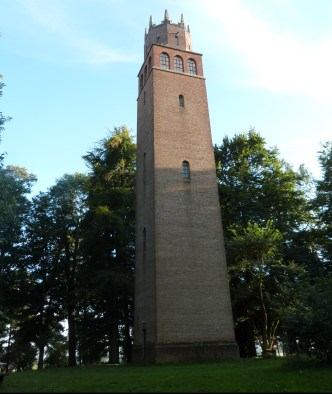 Note you might want to leave time at Faringdon to go up the hill to see the incredible Lord Berners’ Folly which looks over the town. Although it looks Georgian Gothick, it was built as late as 1935. Even if you can’t go up the tower (which, umm, you probably won’t, it’s only open for special occasions, and there’s no lift by the way) the view from the edge of the hill is wonderful (path from Stamford Road up to the hill is marked on map above)
Faringdon, All Saints
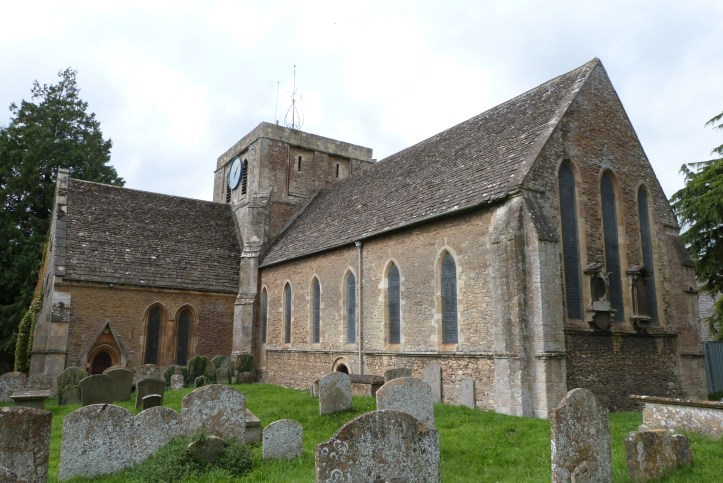
Faringdon is a mid-sized market town, but you can park right next to the church which is just a bit on its own past the Market Square. The church is rather Evangelical and full of music equipment, so it’s not left unlocked. It’s advertised as open on Saturdays and Bank Holidays, but the key is available Monday-Friday 9-4 and Saturday 9.30-1 at the Tourist Office just south of the church in the Market Square. It’s one of the most hassle-free key collections I’ve ever had, and of course the added bonus you get the church to yourself!
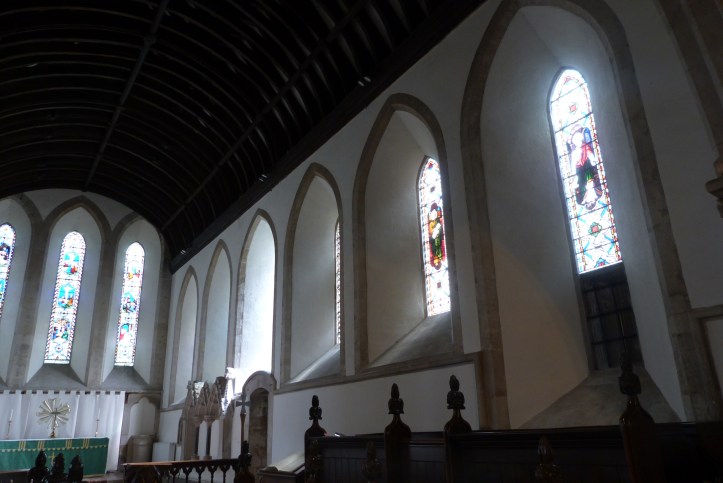
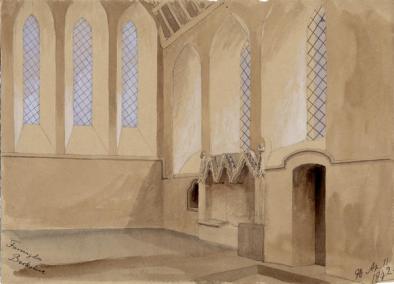
The obvious first barnstormer the church possesses is its gigantic 13thc chancel, no doubt at the behest of the canon of Salisbury Cathedral who had control over it by virtue of it being his prebendary. There are explicit instructions that the vicar (the prebend’s “vice” who actually does the work as a parish priest but gets of the parish’s tithes) had two chaplains to assist him saying the Liturgical Hours everyday “decently standing in suitable places” (“locis conventientibus decenter consistentibus“). The interest of the Cathedral in its prebendary’s liturgy is also shown by the rather gross sedilia that later were retrofitted into the chancel. They have the sort of over-the-top exuberance you’d expect from the early 14thc, but their motifs are early firmly Early English Gothic. So this is the 1270s or something REALLY pushing what ornament they have.
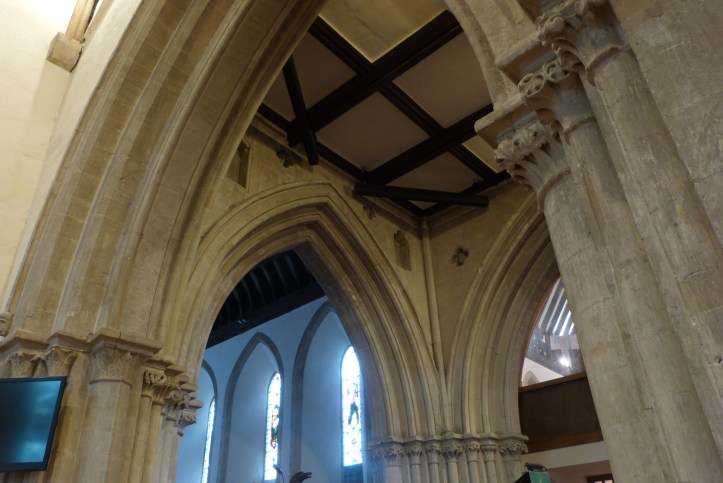
Like so many places round here, the rest of the interior is slightly spoiled by the steeple getting knocked over in the Civil War. Incidentally, it fell onto the S transept, and that’s why that’s got the mezzanine floor in it with the Bible Break-out Room and kitchen/loos. But there’s still the wonderful late 12thc arcades and crossing tower to enjoy. This is a church you can spend a good hour or so exploring.
Uffington, St Mary
(Not to be confused with Uffington in Lincolnshire, near Stamford)
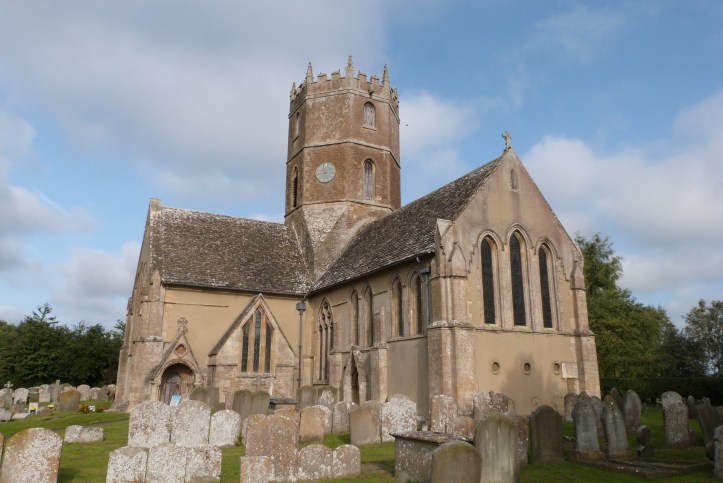
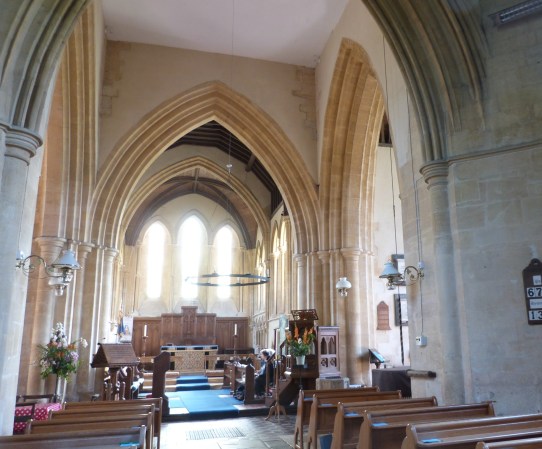
An absolute belle of a church, almost a perfectly preserved early 13thc aisleless-and-cruciform plan, if it wasn’t for the fact the spire fell off and disfigured the nave (the whole height of the nave has been compromised, most notably the W triple lancets are now cut off). However, the crossing space has a moving sweetness, one of the best achievements of the Early English style.
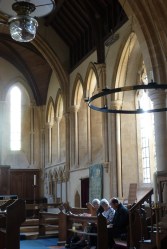
The chancel ends with a sedilia/piscina group in perfect condition, but seemingly totally medieval. It also unusual, ends in a wooden rib-vaulted bay (entirely restored but predicated by the transverse arch just before it). The whole thing is thoughtfully composed in a way it’s rare for churches of this date (which is probably, uhh, 1220s?).
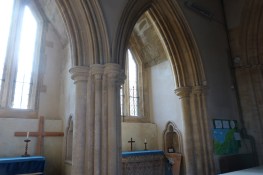
The transepts are justified by the presence of small chapels, extending as chunks of wall with stone roofs, just enough to fit an altar and a piscina in there. It’s really unthinkable that it wasn’t designed for multiple chaplains to say Masses here daily, like Faringdon’s ordinance. But there’s no easy answer as to why they spent money on this rather than the usual nave arcades you’d expect for a parish. Yes, the manor and advowson (right to appoint the next rector) belonged to the wealthy and powerful Abingdon Abbey, but, um, so did loads of places: that’s they were so wealthy and powerful. Some things are impossible to answer, and who knows, perhaps whatever ambitions the architecture represents were never actually fulfilled.
Anyway, since you enter through the porch on the S transept, don’t forget to go into the nave S porch and see the absolutely wonderful ironwork on the nave door.
Sparsholt, Holy Cross
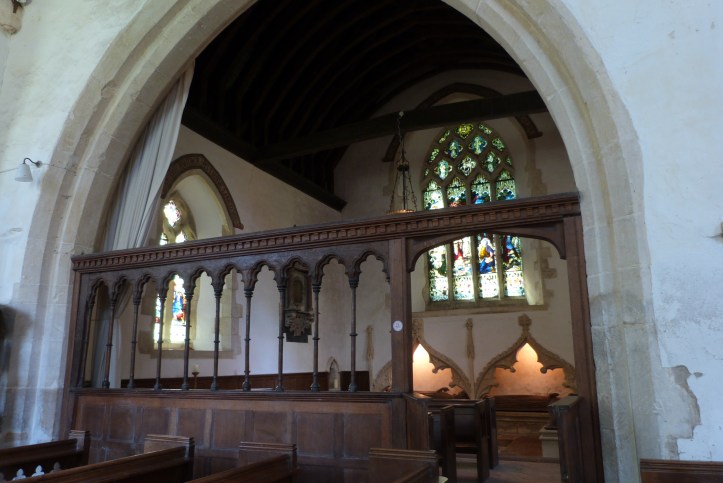
Sparsholt shows how parish-church transepts became more typical auxiliary spaces in the 14thc: as future-proofing the building for getting crowded out by the burgeoning trend in bourgeoise for monuments and chantries. The N transept at Sparsholt is nearly as large as the chancel. The surprise inside the transept (past the wooden screen, which is largely original) are the Decorated tomb niches, with their original effigies of exceptional quality, even more precious for them being carved out of oak.
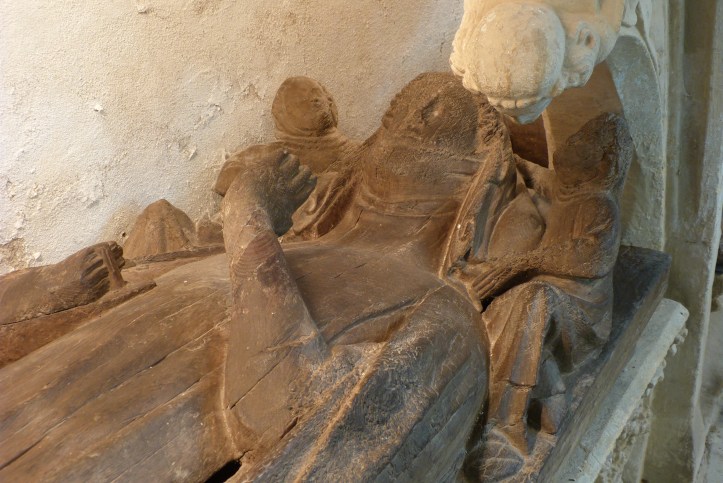
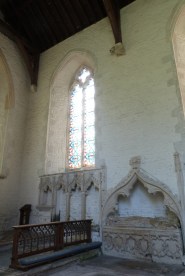
The chancel is probably a 13thc lanceted structure a bit like Faringdon’s is, but one that was later souped up with a new reticulated E window and tracery put into the lancets. Even more niches here, and a stone effigy of a knight of a similar period to the wooden ones. Hierarchy of materials? If indeed they haven’t been shuffled about. Certainly the priest in the N chancel niche has been put in there on a modern base later. At most this would have originally had a brass in it so the Easter Sepulchre chest could be placed inside it.
Childrey, St Mary the Virgin
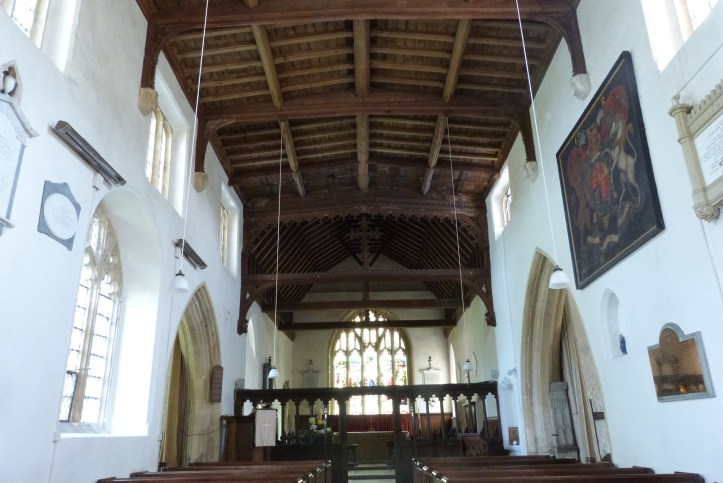
Yet another transeptal church with many medieval monuments, yet less architecturally sophisticated following what appears to be a Perp re-fenestrating and re-roofing. However, it does have the advantage of being high up for a nice view from the churchyard.
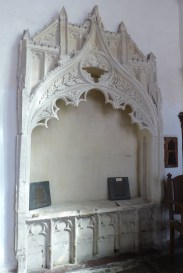
The chancel has a late 14thc Easter Sepulchre receptacle, an early example of the late medieval trend for picking this position for your tomb to essentially serve as a table for the chest that took a crucifix and and host on Good Friday to symbolise Christ’s burial and Resurrection on Easter Sunday. Even though it means you couldn’t have a sculpted effigy because of it.
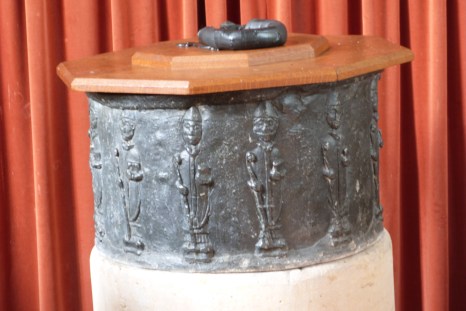
There’s lots of things not to be missed. The 12thc lead font, for one, which shows how they just reused the same mould over and over rather than carving all the bishops on it separately out of stone. There’s some glass high up in the N transept which is 15thc, beautiful essays in yellow-stain: notably parts of an Annunciation, an Ascension, and a BVM in glory.
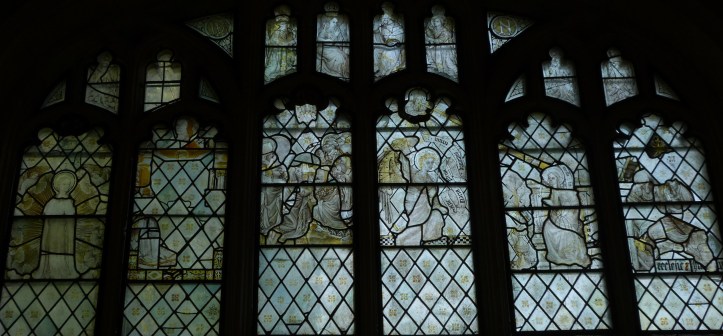
Stanford-in-the-Vale, St Denys
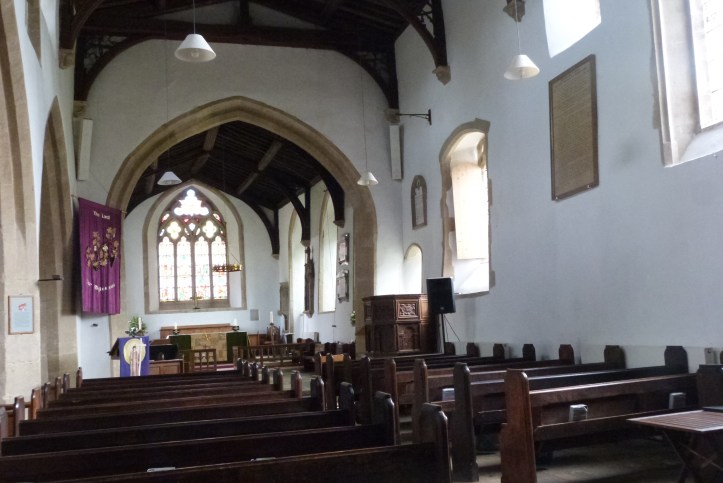
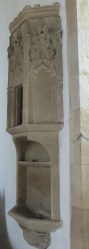
Not the best church in the area: if there’s any to skip, it’s this one, but it is nevertheless worth a visit and left open. The outstanding item is the bizarrely grand, canopied niche over the piscina. The reserved Sacrament (leftover consecrated Hosts from Masses) was usually kept suspended over the altar or on the N side of the altar, but this does not preclude it being kept here in this particular church. Very high quality first-quarter 14thc Oxfordshire Decorated. Did they have more that’s been lost? Or maybe this was all they could afford?
Buckland, St Mary the Virgin
(Not to be confused with Buckland in Gloucestershire)
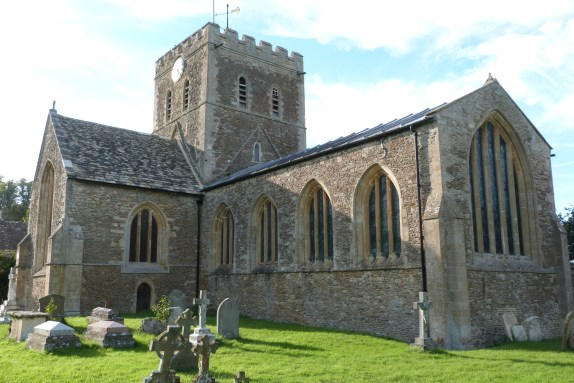
Church from SE. Note how the chancel roof has been lowered from its original pitch. The windows may have been altered in the late Middle Ages before the 17thc gave them their current strange form.
The outstanding impression of this large cruciform church is that all the tracery has been taken out in the 17thc and replaced with transoms going straight into the heads of the windows, making it look like it’s got iron bars from a comedy old-West jail. It’s a typical, but not common (probably because the Victorians often got rid of it) post-medieval bodge-job repair, as well as the transepts at Uffington above, you can see examples of it at Egglestone Abbey (County Durham) and Stretton-on-le-Field (Leicestershire).
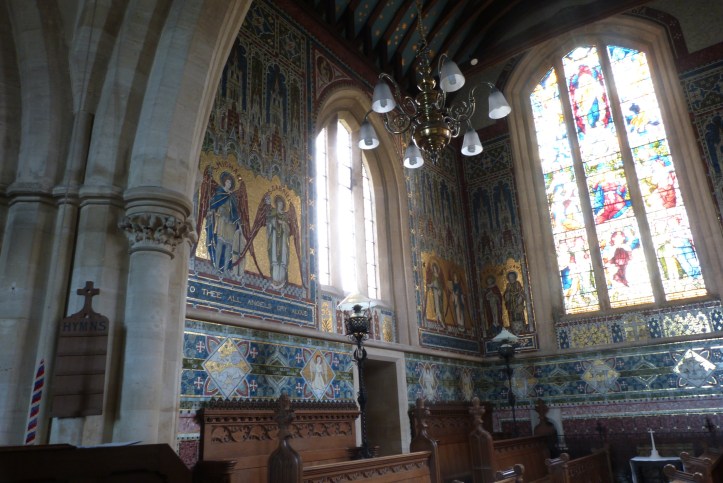
Inside the N transept you can see earlier lancets, but the Victorians instead invested their time on the S transept, covering it head to toe in glittering mosaics, executed by Powell’s of Whitefriars in the 1890s. Undeniably, this ends up being the showstopper in this building.
Bampton, St Mary the Virgin
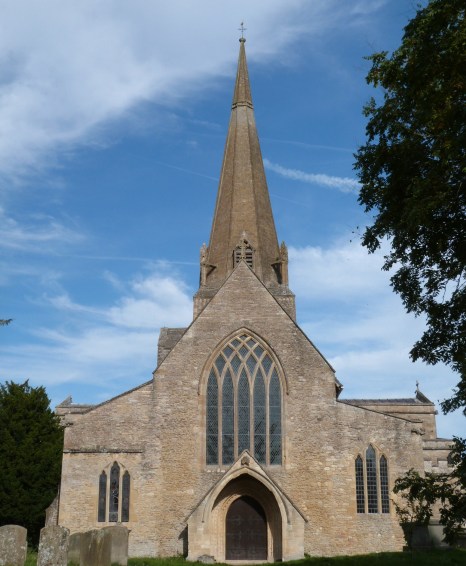
The only place on this list which is still in Oxfordshire. It’s on the edge of another group of interesting churches, but fits better for these for being yet another example of being cruciform, and the only one lucky enough to retain its spire. And what a spire! It has extremely small broaches on the corners, topped by little flyers with original statues. One, a St John the Baptist, fell off relatively recently and is kept in the nave.
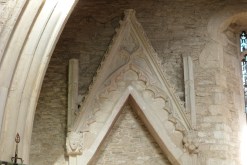
Unusually, the church was a minor pilgrimage site, for local pre-Conquest Saint, Beornwald. The great niche in the N transept seems to have been related to his shrine. The shrine itself, long lost, maybe be related to the remodelling of Romanesque chancel and some of the earliest sedilia to feature gables. Although the left half of these are Victorian, the overall design is authentic, and bears comparison with the style of the W front of Salisbury Cathedral, so 1250s.
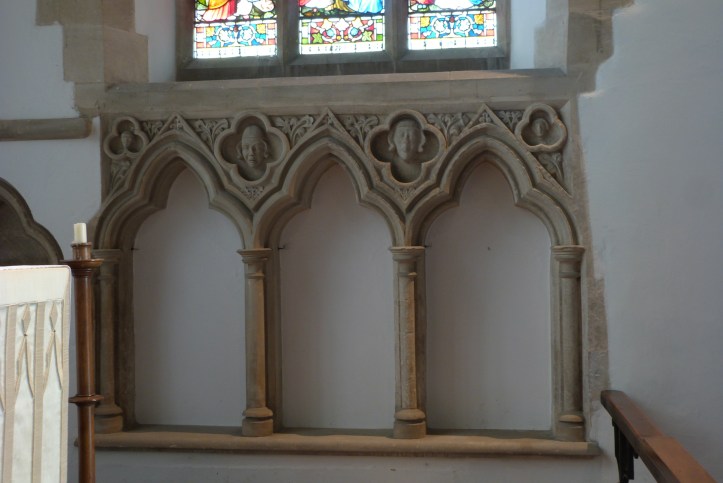
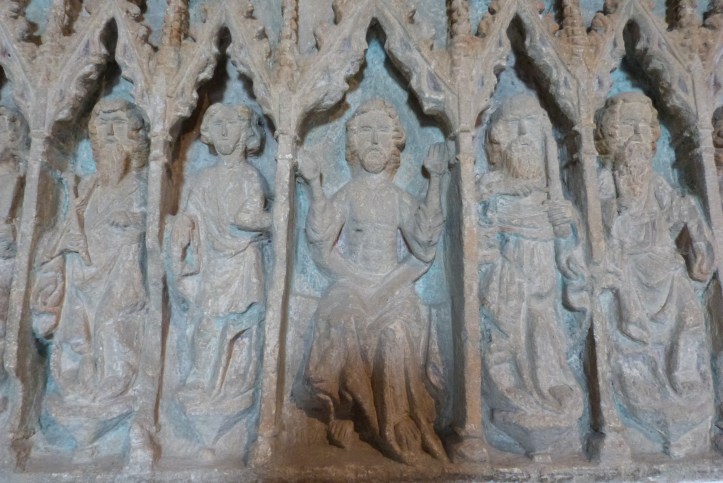
However, perhaps the greatest treasure at Bampton is this stone reredos, probably 14thc, showing Christ and the Apostles. Pevsner calls it “rustic work of c.1400”. Yeah, it’s hardly Claus Sluter or the Pisani, but he’s kind of underselling it. It’s a remarkable survival, and the fragments of colour very evocative of how it originally looked. Yeah, they obviously messed up on John’s chin, but that gives it all the more charm.
In the same day as most of these churches I went out to Little Faringdon, which is a deep cut for people who love small-but-perfectly-formed Early Gothic arcades. But it’s quite a bit out of the way, so I didn’t include it in this trail. Where might you venture next? Let people know in the comments!
 Stained Glass Attitudes
I’ve been visiting these churches recently, as they’re on the route I follow from Cambridge to Swindon when I go to visit my aged parents. Not a church, but no one should miss Great Coxwell tithe barn. Charney Bassett has one very fine feature, a Norman tympanum now in the chancel, said to represent Alexander the Great’s flight to Heaven assisted by two gryphons. I know, weird. Back in Buckland, I was especially taken by the late Vic and Edwardian stained glass.
A couple of corrections. The church in Faringdon is dedicated to All Saints and not St Mary the Virgin. And the area is the Vale of White Horse with no the before White.
Well that’s Google Maps for you… Will be double-checking their dedications in future!