At the beginning of this year I completed another comparison of 3D models of medieval cathedrals … in Space! This time it was the cathedrals of the Holy Roman Empire. So join the Imperator Romanorum in his flagship of the Aachen Palatine chapel to survey all the cathedrals of the dioceses under his rule (that I could get hold of 3D models of, anyway).
By the way, I did the terrible YouTube sin of deleting and reuploading this from its first upload in January, since after all this research into the Super Universas I noticed some glaring mistakes in their diocese divisions (and also could correct a few small errors that always get past the checks in these big animation projects). So if you watched it in January, please do click the thumbs up again (i.e. pls like and subscribe, sorry).
I have mapped the Holy Roman Empire’s Cathedrals already, but at that time did not include the Super Universas dioceses of 1559, which fly out of the sun to provide reinforcements at the end of the rather thin narrative conceit I applied to my animation. This was under the logic that they were not built as cathedral churches. However, many of them, such as Mechelen, Ypres and especially Antwerp, are generally thought of as bona-fide cathedrals in much the same way as Peterborough, Gloucester, Bristol etc. And since I spent quite a while making some of the models (especially Antwerp) for them only to appear in a video for a few seconds I thought I would upload them as separate models to sketchfab and make a little gazetteer of all of them.
But then I had questions. Who decided the dioceses? Where did they get the canons for the new cathedral chapters from? Who were the bishops? How far can you compare it to the episode of establishing new dioceses under the English Crown two decades earlier? Turns out it is a very different and tougher process when you don’t declare yourself head of the Church and you can do just about anything you want with religious houses because you got them to sign an Act of Supremacy to you (although, funnily enough, Phillip II of Spain, who finally pushed the project through Rome in 1559 and continued to work on it through the 1560s placating upset prelates and nobles alike, was King of England jure uxoris 1554-8).
So it all got a bit complicated, and here’s what I’ve put together in a couple of months. First, we are going to look at the administrative project, then we’ll look at each of the buildings that became cathedrals after the Bull’s enaction.
The Super Universas dioceses project
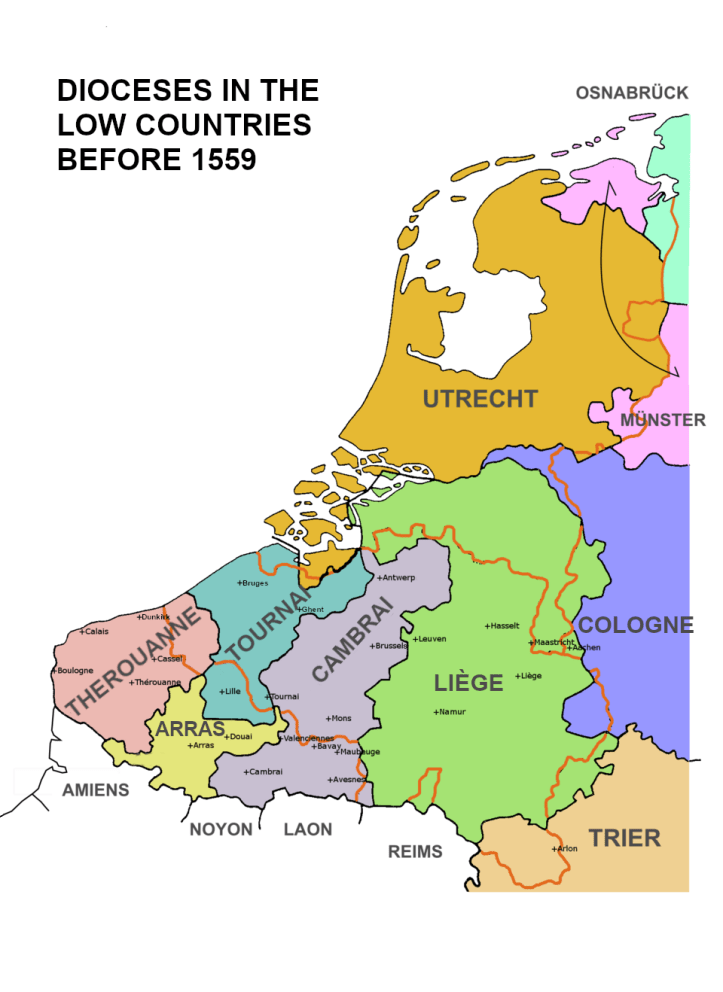
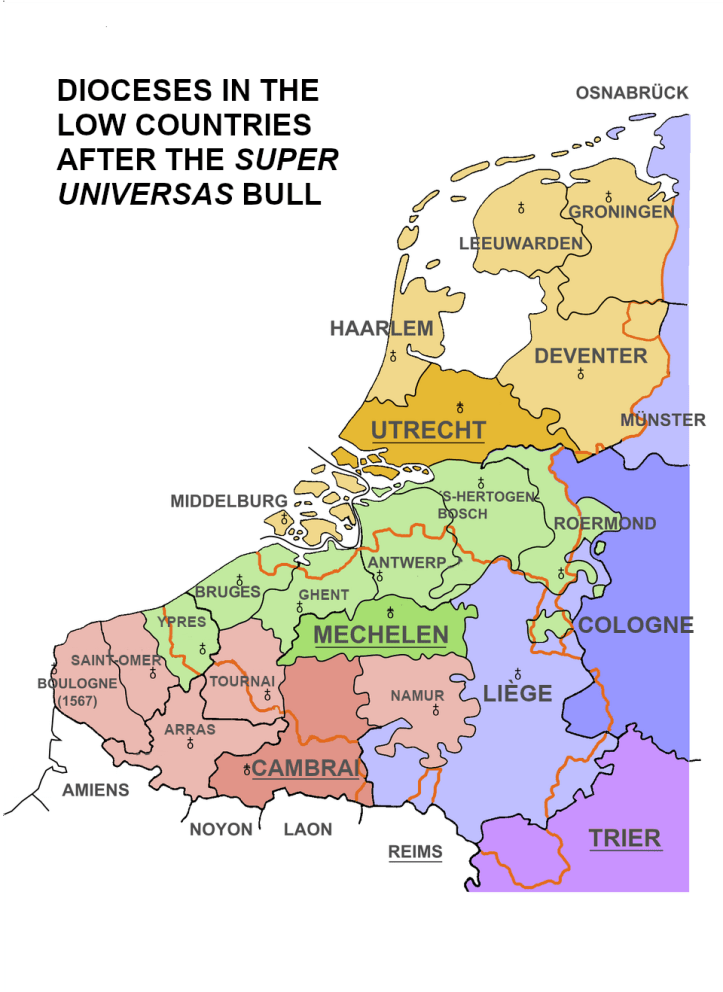
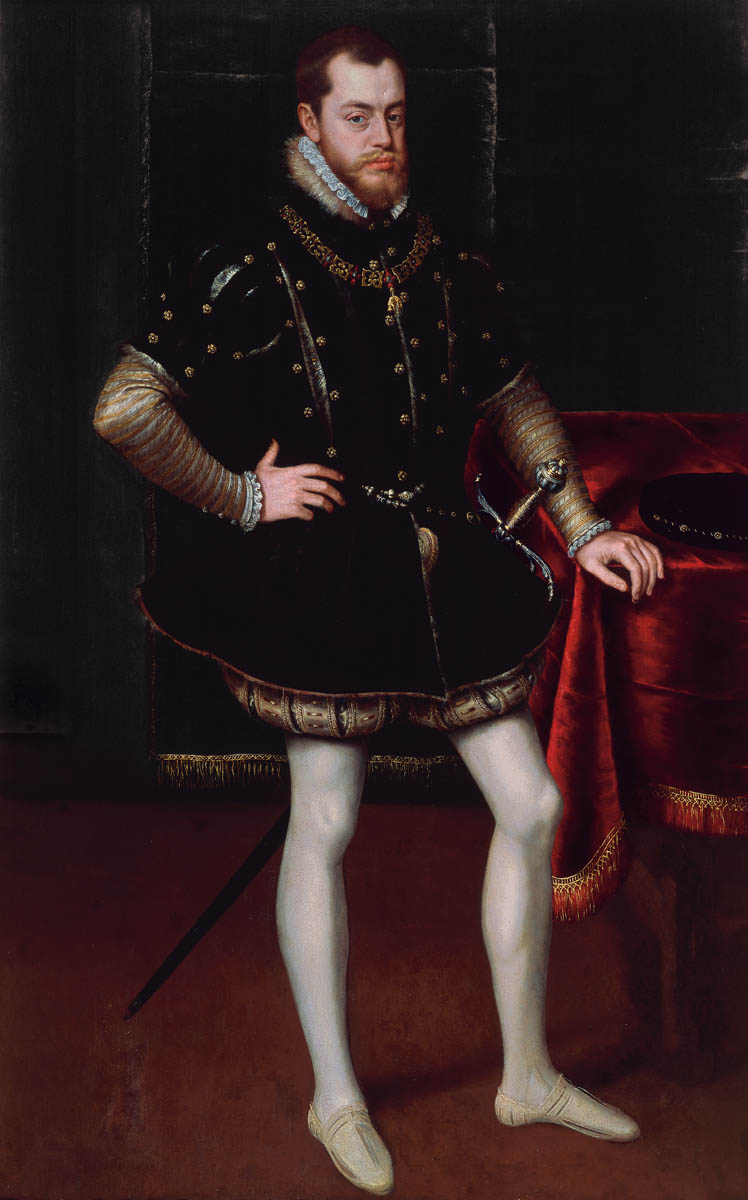
For well over a century before the Super Universas bull was issued in 1559, the lack of cathedrals in the Low Countries had become a problem.1 Particularly what is now the modern country of the Netherlands, which had had a huge economic upsurge in the fifteenth century, and only had one bishop living within its borders: the Bishop of Utrecht, a suffragan of Cologne.2 There was also the complaint that the Dutch-speaking regions had a language barrier with the German and French metropolitans.3 Emperor Charles V first expressed a desire to establish new bishoprics in the area “to safeguard the Catholic faith and the salvation of souls” and plans were drawn up in 1552 but ultimately came to nothing.4 The total destruction of Thérouanne, a French enclave in west Flanders in 1553 by Emperor Charles and with it its Cathedral (suffragan to Reims) somewhat escalated the issue. However, with Charles’ abdications the task fell on his son, Phillip II, Lord of the Netherlands (from 25 October 1555) and King of Spain (from 16 January 1556) to carry it forward. Franciscus Sonnius, canon at Utrecht and Professor of Theology at the University of Leuven was instrumental in ultimately coming to the fore of mastering the practicalities of the project, but had to accept the collegiate church of St Peter in Leuven was not getting selected as a university-associated metropolitan seat over Mechelen.5 He was sent by Philip to bring the completed plans to the attention of Pope Paul IV Carafa in March 1558.6
BBVA (Banco Bilbao Vizcaya Argentaria) Collection, Inv. No. P01495
This was a shaky time for Phillip to be pushing the legislation through, as in 1557 during the conclusion of the Italian Wars, the fundamentally anti-Habsburg Pope Paul had narrowly avoided a repeat of the 1527 Sack of Rome by an Imperial army, this time under Spanish troops led by the “Iron” Duke of Alba, but it was either this or start from scratch with a new Pope.7 Later in 1558 the plans leaked and the Archbishops of Reims and Cologne, the Prince-Bishop of Liège and the chapter of Cambrai planned a counter-delegation against the annexing of their episcopal territories.8 After the Peace of Cateau-Cambrésis was declared between France and Spain to bring the half-century of Italian Wars to a close on 3 April 1559, the following 12 May the Super Universas bull was finally issued.9 Getting the bull over the line in Rome cost Phillip 10,000 ducats that he struggled to get out of his debtors after the costs of the treaty.10
Getting the Bull past the Pope was only the first challenge. What followed in the early 1560s was also wider secular resistance among nobles about how the Spanish Crown would have exclusive nomination rights over the new bishoprics, and with those prelates’ voting in the States of Brabant, would solidify Habsburg power in the region.11 There was wide speculation of the project being used to launch an Inquisition, which would prove catastrophic to trade in the region.12 But by 1570, all the dioceses were occupied by consecrated bishops.13 Even overlooking the fact that Leuven was the only university in the region, it is notable how many of the new bishops were professors, headed colleges at or held doctorates from Sonnius’ university.14 While they did not quite shatter the pattern of appointments from the sons of the nobility, they did lessen their grip in the favour of fully-schooled theologians.15
Although the new dioceses centred mostly around pre-existing collegiate churches, some quite wealthy with large numbers of canons who held valuable prebendal estates, all of the bishops’ incomes had to be supplemented by appropriating the income of local abbeys and priories: something which many of the heads of these houses were understandably not happy about.16 Some of the dioceses in the Netherlands that had the bishop’s seat placed in a parish church that had to have secular cathedral chapters totally pulled from the brethren of appropriated houses of regular canons.
Despite all this top administrative work, the Dutch Revolt two years later from 1572 and Protestant control in the region meant it mostly unravelled and the Catholic Hierarchy suppressed most of the new sees in the territory of the modern Netherlands in the 1580s: holding out on Middelburg in the south until 1603 (Roermond in Limburg is the only outlier, this generally was outside of the Dutch Republic). Subsequently ‘s-Hertogenbosch would go in 1646 after it was lost by the Spanish Netherlands. Five more would be lost in the Napoleonic Concordant of 1801. Only three dioceses have survived essentially uninterrupted from 1559 to the present, although a number have been revived, but not always in the same building.
So as you can see from the numerous citations, there has been much research into the political, religious, social and economic aspects of the Super Universas bull in its Counter Reformation context. But no one has looked at the actual church buildings that became cathedrals. Possibly because they are a rather varied bunch that gained a bishop’s seat for reasons of geographical and administrative reasons rather than architectural merit, but nevertheless, they encapsulate the history of Gothic architecture in Low Countries rather well, including some of its more over-ambitious moments towards the close of the Middle Ages…
The Super Universas Cathedrals
(churches declared as bishops’ seats in 1559 that still exist above ground today)

L-R:
Cambrai archdiocese: Saint-Omer, Namur
Mechelen archdiocese: Mechelen, Ypres, Antwerp, Ghent, ‘s-Hertogenbosch
Utrecht archdiocese: Deventer, Haarlem, Leeuwarden, Groningen
And, for old times (c. 2020) sake, here they are (including totally demolished ones) in the universal language of vaulted ground plans on a starfield. Haven’t done one of these for a while!
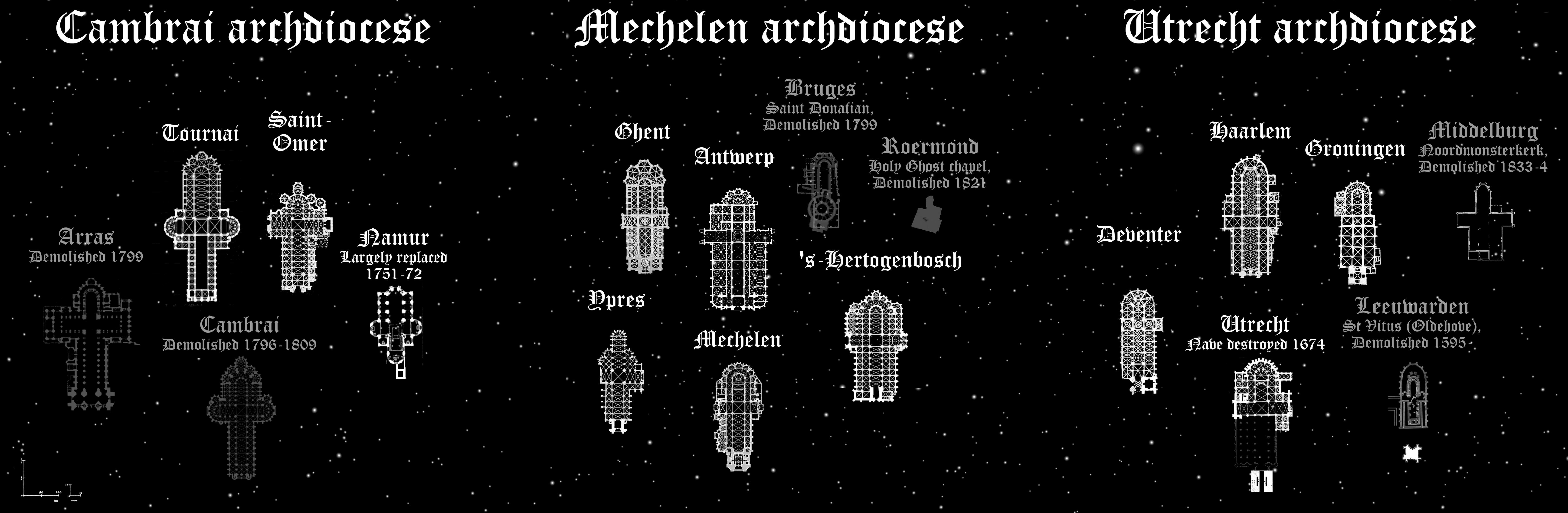
I must admit, I’ve only been to one of these buildings in person (possibly the most boring one, at least internally), and make no excuses for using 360 panoramas to study them for this project, hence why I’ve made no attempt to disguise when I’ve screengrabbed stuff off G-Maps, even if it is trivial for me to download them and do my own custom projection (as I have done on some where it’s necessary to make a visual point beyond what the web-viewer allows). All credit goes to the original photographers who uploaded their images.
Cambrai archdiocese
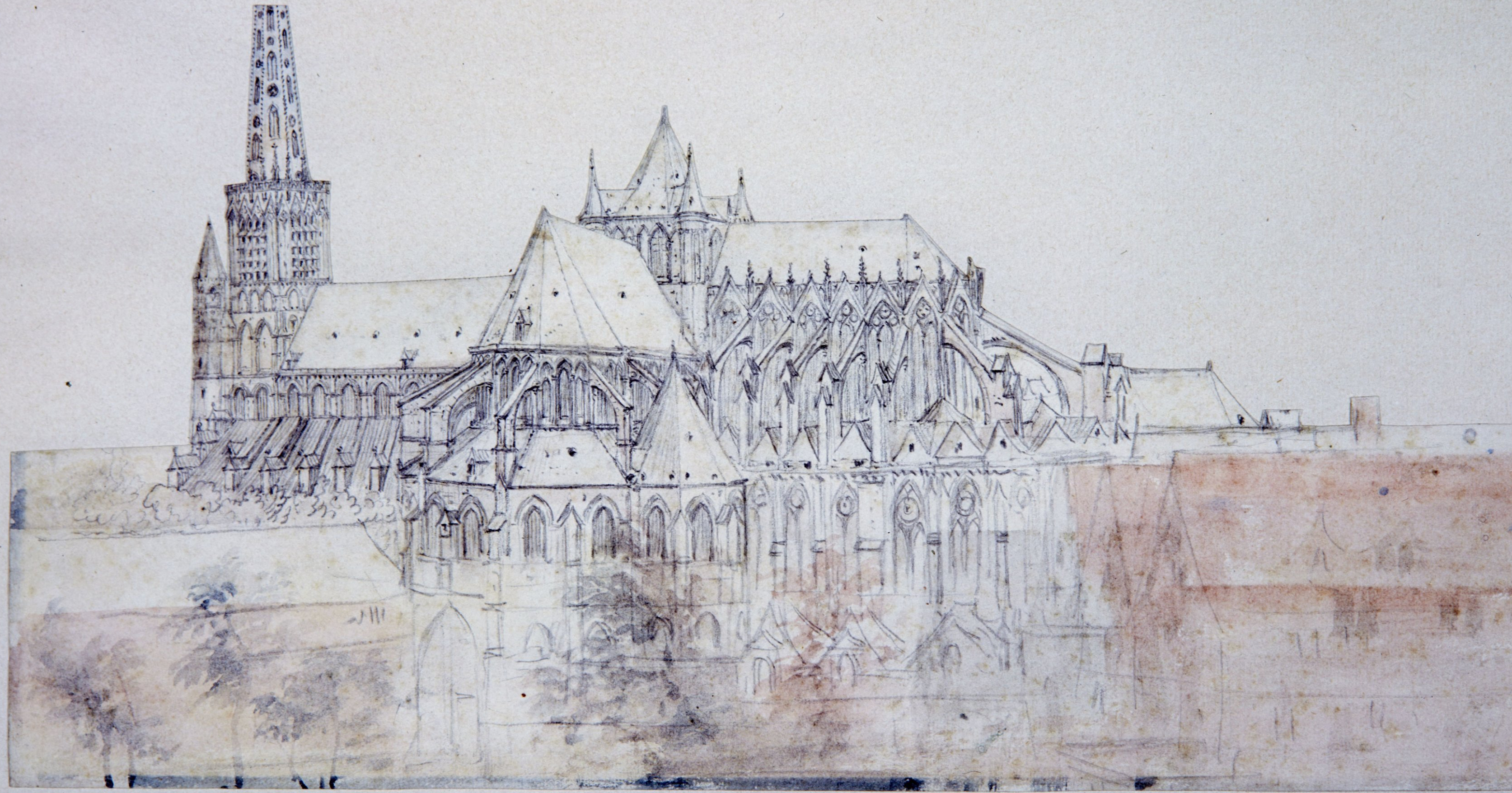
Graphite and watercolour highlights on paper, by A.F. Van Der Meulen (d. 1690). Mobilier national, NO 44.
Cambrai, previously a suffragan of Reims, was elevated to an archdiocese for these new sees, although by the terms of the Bull, the Habsburgs did not have nomination rights for its new archbishop. You can read about the totally demolished Cathedral of Cambrai here. Former suffragans of Reims – Arras (also totally demolished after the French Revolution) and Tournai – were transferred to it, as well as the two new dioceses below.
Saint-Omer, Our Lady
Collegiate church founded mid 7th century
(Diocese suppressed 1801)
A proper photogrammetry/laser scan, including roof and tower spaces, has been made by 3D Patrimoine and stills of it can be seen on the all-round excellent architecture pages of the official church website.
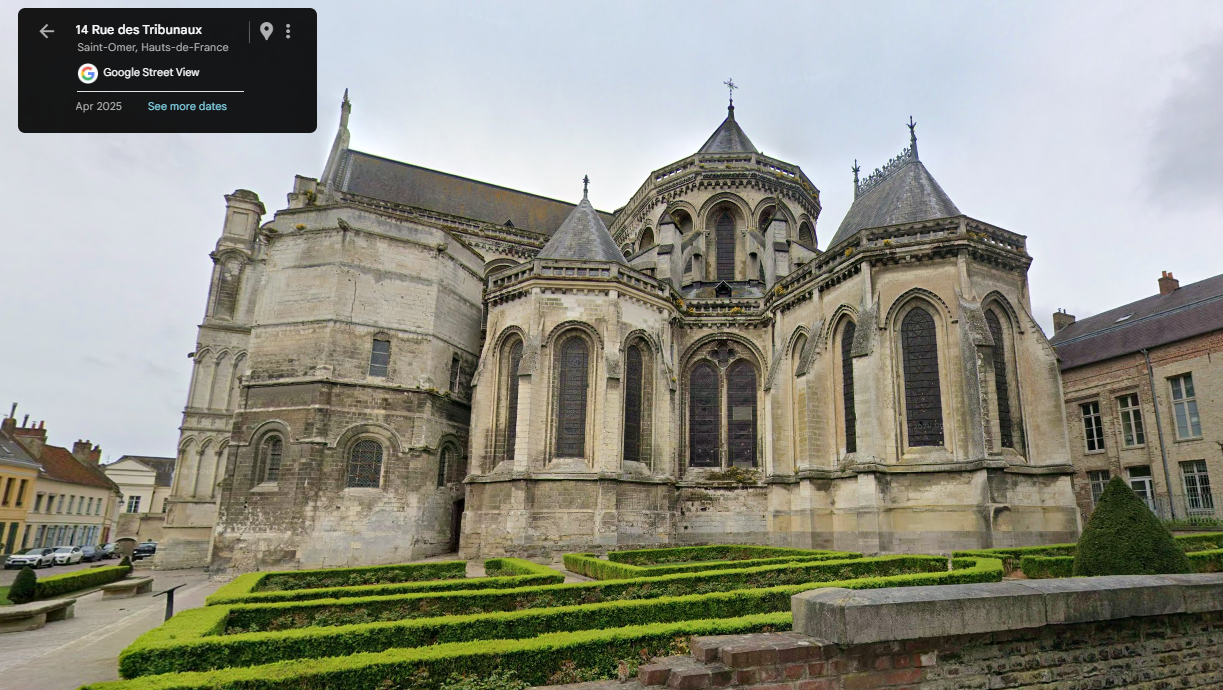
The “Tour Octogonale” to the L is widely-held to be contemporary build with the E arm beginning 1191×1207: although the axial chapel was extended 1628/9.
Although now French, Saint-Omer was an Imperial town until it was annexed in 1678. The collegiate church which became a cathedral shared an origin with the Abbey of Saint-Bertin on the other side of town going back to Merovingian times: the missionary bishop Audomarus being the patron of the canons, and his contemporary Abbot Bertinius whose corpus was held by the monks. As the town’s modern name was actually a corruption of Saint Audo, there must have been an impetus for the canons to make sure his burial church was at least the architectural equal of the abbey of his companion. That said, the first bishop of Saint-Omer was Gérard de Haméricourt, the incumbent abbot of St-Bertin. Saint-Bertin Abbey survived until its closure after the French Revolution, and the bishopric also prevailed until the Concordat of 1801.
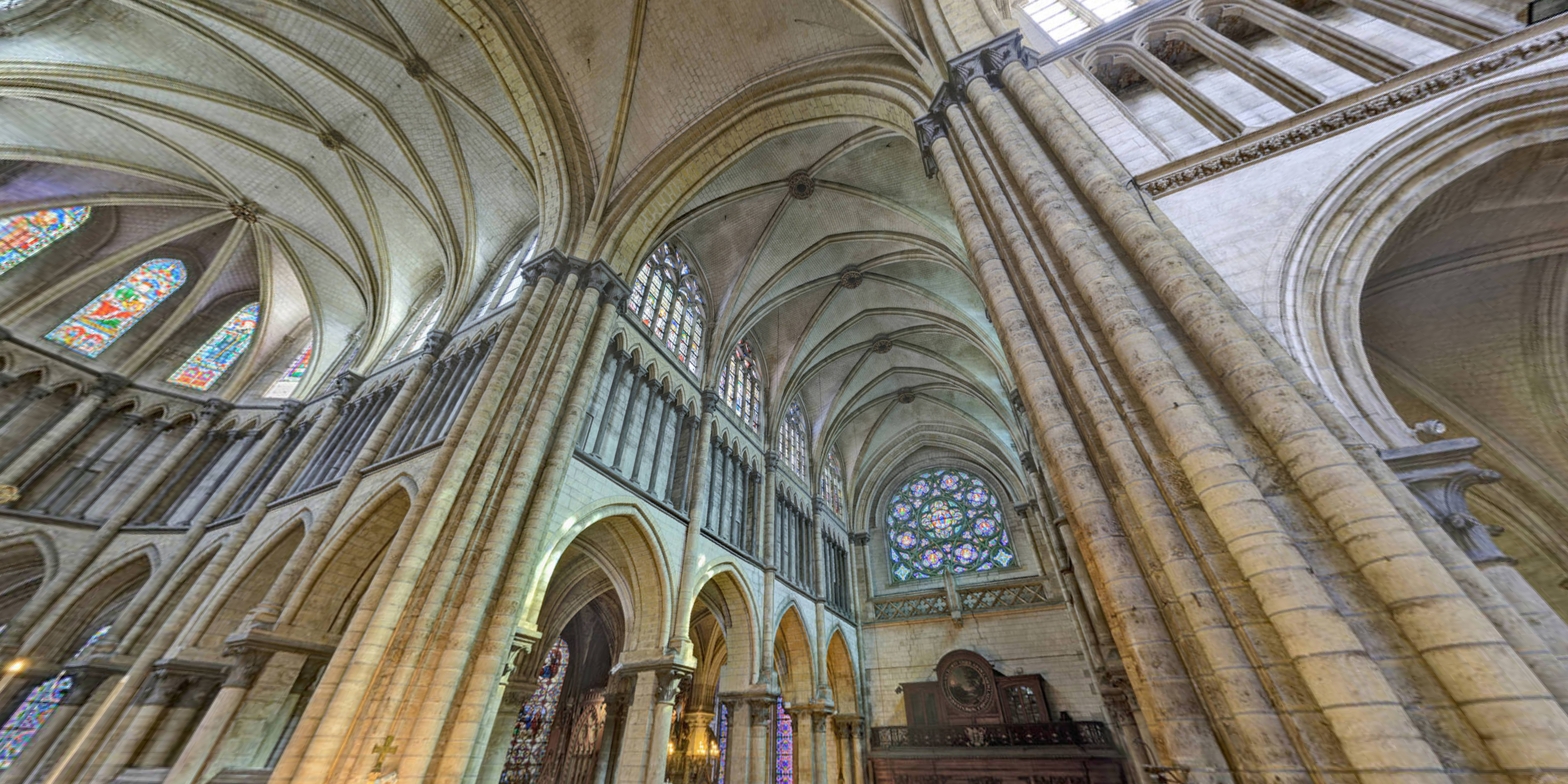
This 360 view is available in extraordinarily good high-res here, as well as a view from the S transept.
Exemplary of the first main phase of Gothic in the Low Countries is the elevation of the early 13th-century east arm, which has a large blind triforium when Chartres and its French High Gothic successors were massively reducing the middle storey in their designs. What isn’t typical Low Countries are the initial pier-forms, which, rather than stout columns, incorporate en-délit shafts (i.e. monolithic, edge-bedded, long pieces of stone) attached to a square masonry core, except in the transition between the apse and straight bays, where the double shafts on the core are pilier cantonné (that is through-coursed masonry blocks). The plan of the east arm is very conservative to the Romanesque it was replacing, with three separate octagonal chapels (the centre one was extended at the end of the 16th century), when great churches in France were favouring the continuous chevet of joined chapels.17
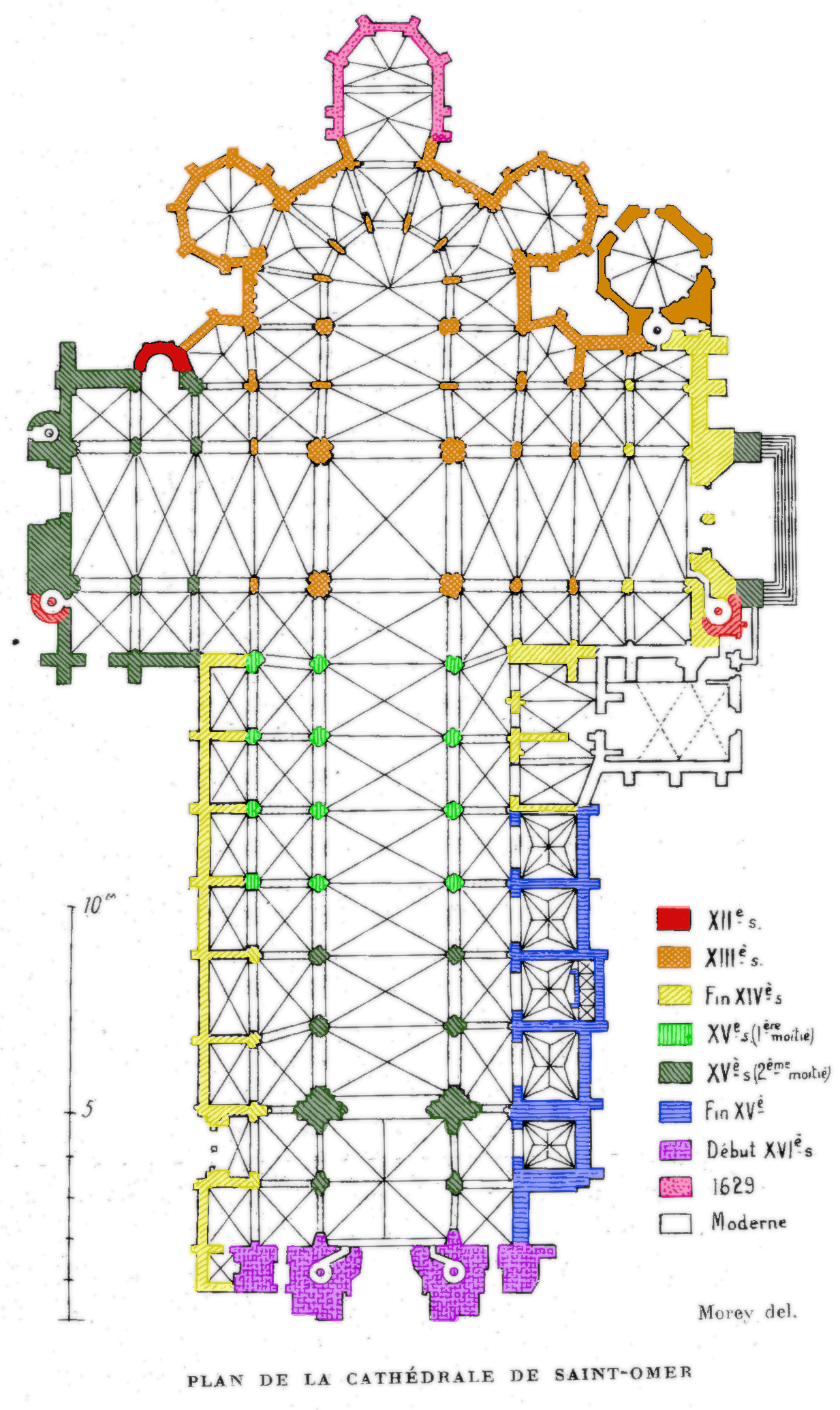
The south transept, with Rayonnant tracery, was built in the third quarter of the thirteenth century (although it kept the pier forms, no one was interested in maintaining en-délit anymore, so the shafts are all coursed masonry), with the nave following on in the late fourteenth century into the mid-fifteenth. In the later nave the Tournai marble columns of the triforium are eliminated in favour of continuously moulded tracery trefoil-headed openings, and pier forms changed to a profile of a cylindrical core fully-coursed with four attached shafts. The north transept would be the last part of the Romanesque plan to be replaced (delayed due to its connection to the canons’ cloister), a project carried out within the years 1448-72 to renew the arm in the Flamboyant style while carefully retaining one Romanesque apsidal chapel in the east wall.18 The squat west tower, which concerned the college’s building works into the sixteenth century would also seem to be essentially Romanesque masonry reskinned. The axial chapel was also extended at some point in the seventeenth or eighteenth century and subsequently remodelled.19
Left: phased plan of Notre-Dame, Saint-Omer.20 The S transept should be dated earlier than late 14thc but otherwise it gives you a good idea about the phasing of realising the gothic build. I’ve imposed the transept stair turrets to the primary Romanesque phase as noted in Olympios 2018, and have also included the Tour Octogonale in the primary Gothic building phase.
Namur, St Aubain
Collegiate church founded 1047
(Diocese never suppressed)
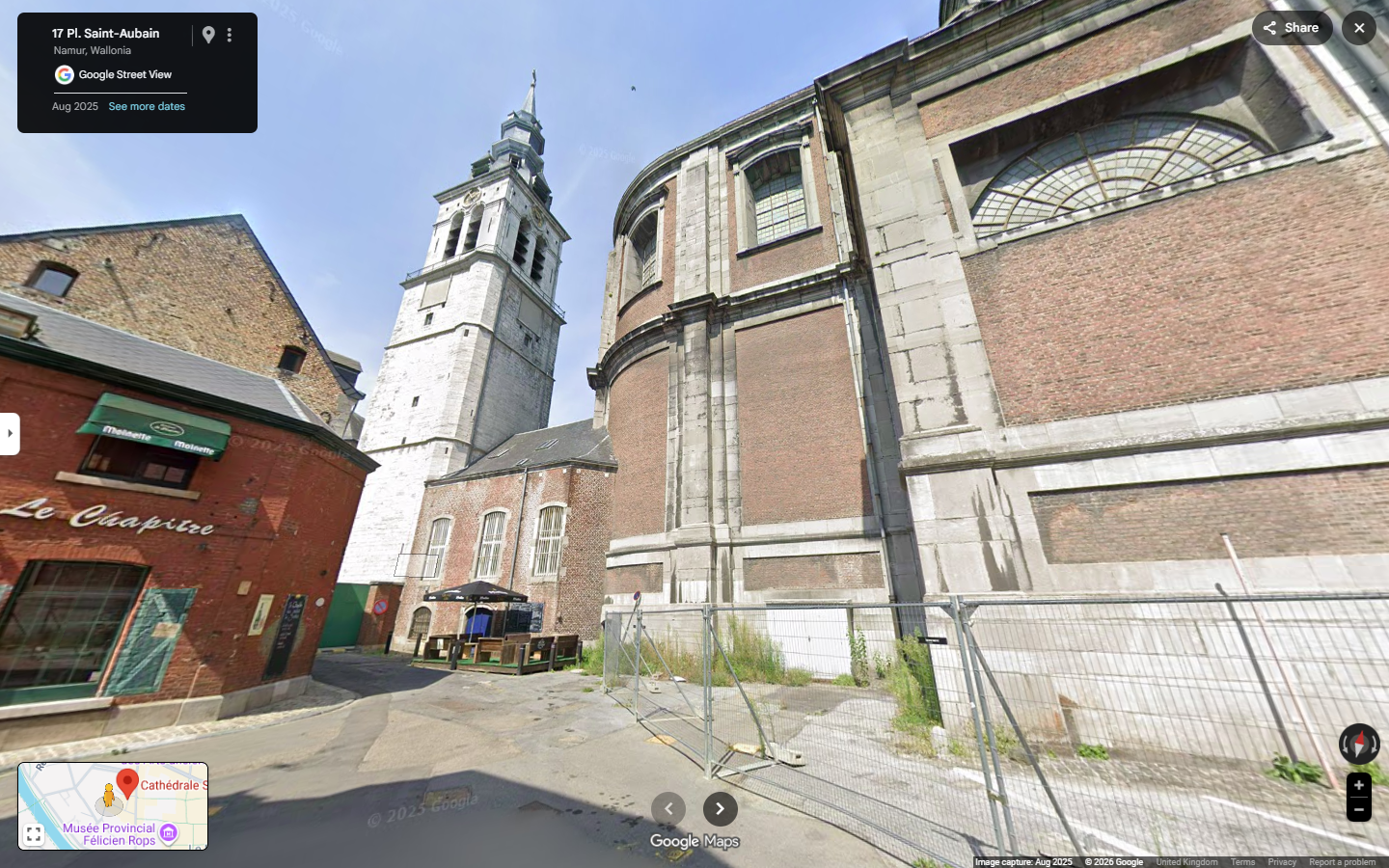
Unique to the Super Universas cathedrals, the episcopal chapter of Namur had their church almost entirely rebuilt, 1751-72 to the plans of the Swiss-Italian architect Gaetano Matteo Pisoni. The new build was occidented (i.e., the entrance is at the east end and the apse points west) allowing for the the medieval collegiate church’s south-west tower to be retained at the “back”. As far as I can tell there’s been no archaeology on the site of St Aubain regarding the old cathedral (isn’t it fun trying to confirm a negative?), therefore we don’t know a huge amount about the church that was chosen as a site of a bishop in 1559.
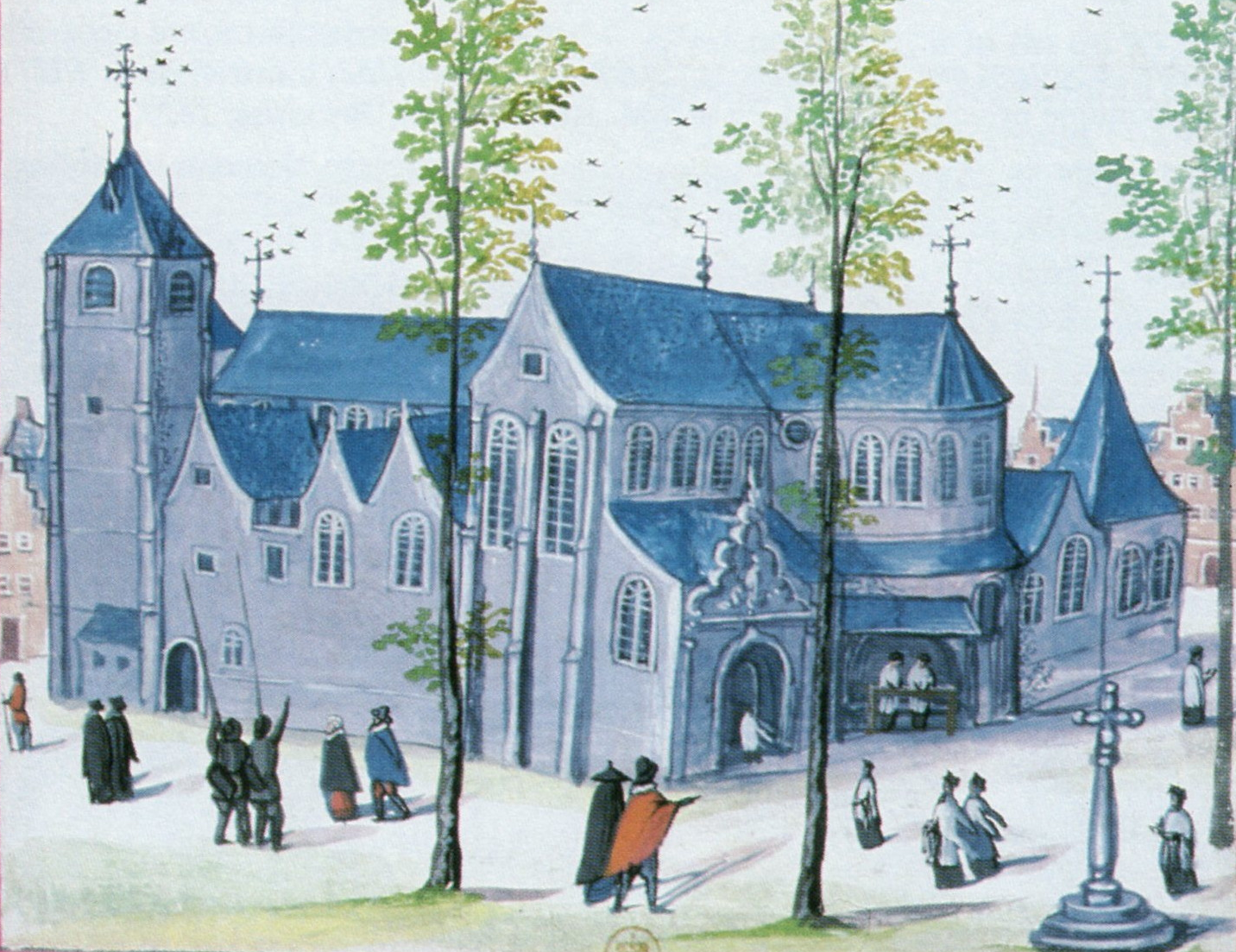
The best view of the medieval Cathedral of Namur is in the Albums de Croÿ made for Charles III de Croÿ of Hainaut.21 The surviving tower is clearly shown to the left, adjoining some sort of domestic capitular buildings around a quad with an upper storey adjoining the nave. The transept has four clerestory windows in its east face, with a lean-to roof below. While formerly it would have been chapels, it appears to been knocked through for a Baroque porch. The east arm is apsidal, and has an ambulatory. Two canons seem to stand under an arch with what looks like a veranda above, which may have been the site of an apsidal chapel. It is difficult to estimate the date of the structure overall, but judging from the rest of the Albums de Croÿ (and by Jove, there is a lot of them), the artist, Adrien de Montigny, is seemingly incapable of drawing a pointed arch, thus the lack of any prominent buttressing on the apse is the most likely indicator it may have been Romanesque.
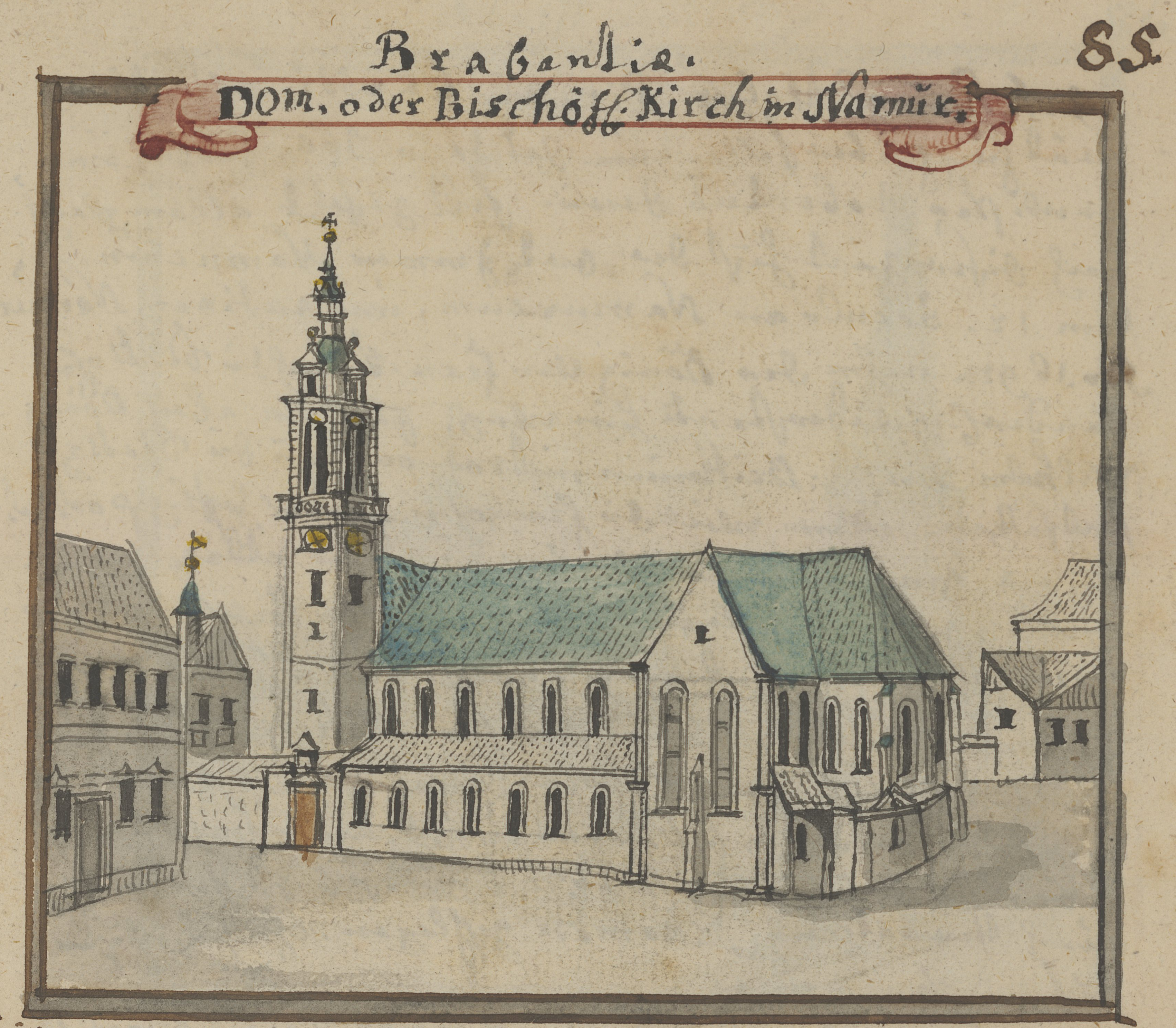
Another view, by the Silesian draftsman Friedrich Bernhard Werner, c. 1770, seems to show the existing tower with its current belfry and a version of its current spire (albeit with the clock mounted in the square inlays that still exist below the belfry stage). The church appears to have been massively tidied up from the depiction of the previous century, with the east arm looking like it’s had an ambulatory and chapels removed. But there’s no sign of that Baroque porch into the south transept, so perhaps it simply isn’t a very accurate depiction. And there are some buttresses with set-offs on the east apse now. They were definitely looking at the same building, but in details it’s very hard to make them agree on much. But looking through Fredrich’s drawings he struggles with pointed windows too.22
You may have noticed on the initial map that another new Diocese appeared next to Saint-Omer: Boulogne. This was the titular successor of utterly obliterated Thérouanne, with its Abbey there taking in some of the former canons of the chapter from the much-besieged and now-annihilated town, with which they had long-standing links. Thérouanne diocese lost territory to Saint-Omer in the 1559 Bull, but continued as titular bishopric of that north-east corner of the Kingdom of France, and suffragan of Reims. Paul IV’s successor, Pius IV Medici, in a bull of 3 March 1566, taking advantage of the death of the to-be final abbot Jean de Rebinghes, confirmed the former Abbey Church of Boulogne as a bishopric, remaining as suffragan of the archbishopric of Reims.23 The medieval building was demolished in 1798 as part of the post-Revolution selling-off of appropriated church property by the French state. Unlike Habsburg Saint-Omer, Boulogne was firmly in France: so I won’t concern myself with it here.24
Mechelen archdiocese
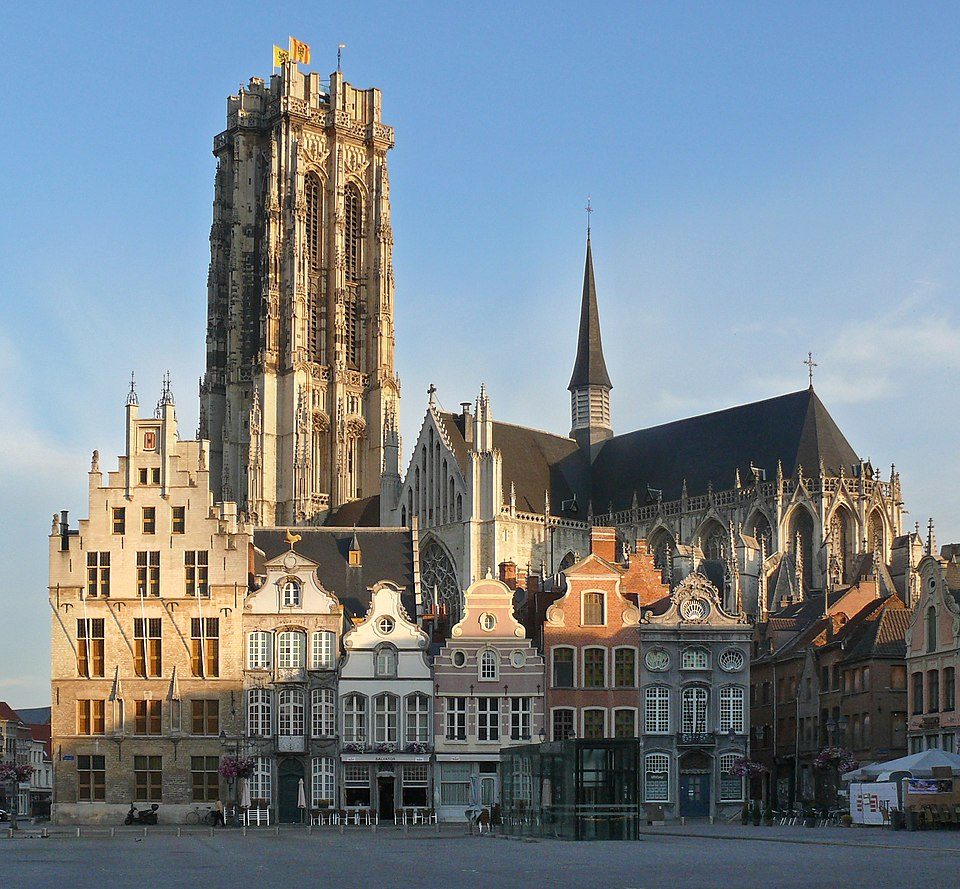
Wikicommons – Ad Meskens
Mechelen was the only church in the Super Universas bull to go straight from a collegiate church to archiepiscopal with three suffragan dioceses under it. Thus it was the only diocese to receive a translation of a sitting bishop, Antoine Perrenot de Granvelle who sat at Arras.25 Granvelle, subsequently Cardinal, was the son of Charles V’s Imperial chancellor, Nicolas Perrenot de Granvelle and served as keeper of the Emperor’s seal, thus was a largely unwelcome figure in the Netherlands for what he represented regarding Habsburg control.
Mechelen, St Rumbold
Collegiate church founded 996 or 1000 on site of monastery established 8th century by Saint Rumbold and revived 10th century. Twelve prebends instituted 1250-8.
(Diocese never suppressed. Made co-cathedral with Brussels, collegiate church of St Michael and St Gudula 1962)
360 panorama from Visit Mechelen
Aside from Saint-Omer, its origins, traditionally owing to Irish missionary Rumbold, are the earliest of any of the churches promoted to cathedral under the Super Universas bull and perhaps why Rome allowed it to be accorded such an extraordinary status as a brand-new metropolitan see.
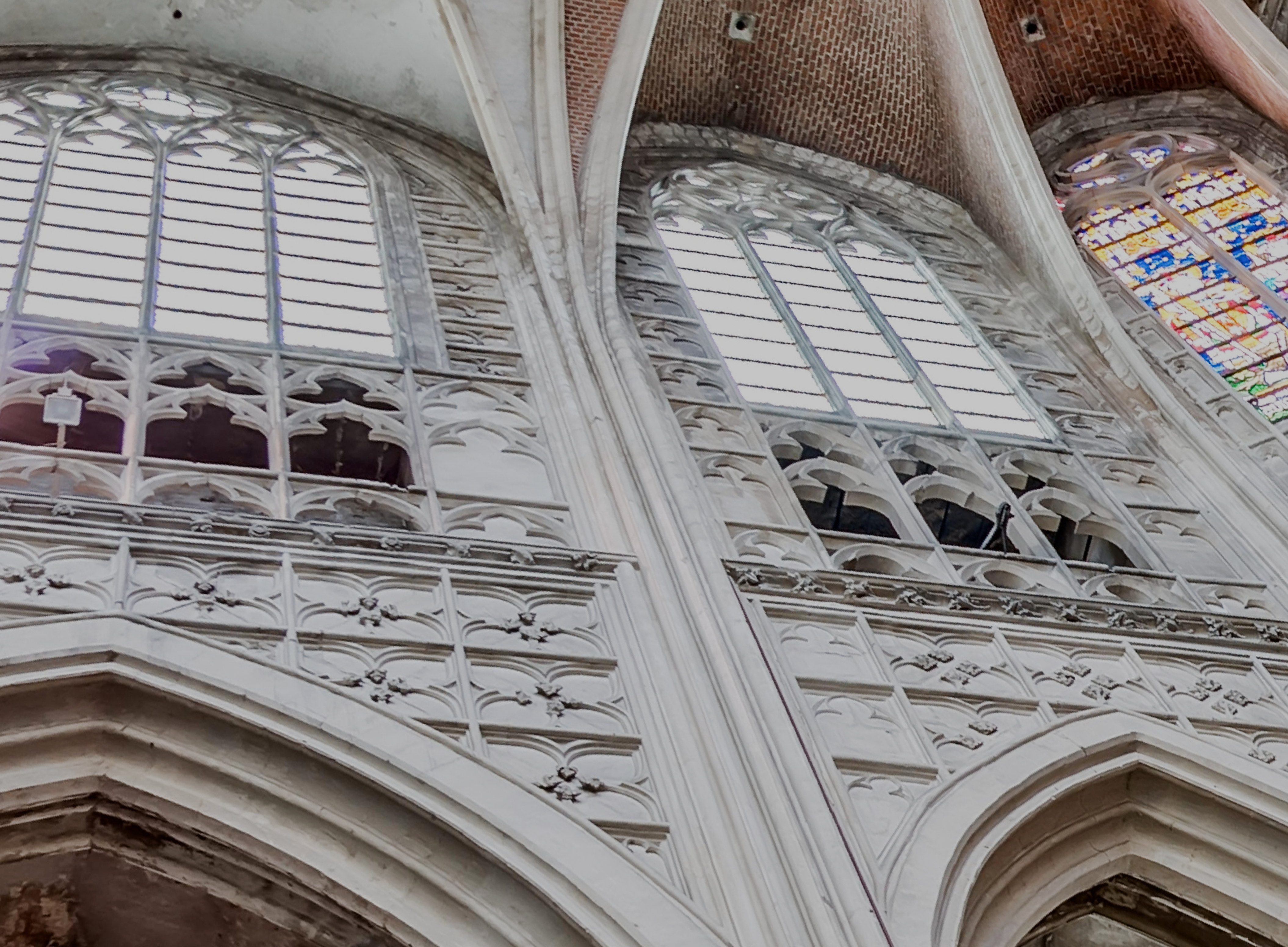
At first glance the church of St Rumbold seems rather consistent as a building, but actually realising the Gothic church was quite a slow process, dating from around 1200 with an essentially Rayonnant stage for the nave aisles and a higher nave elevation in the later thirteenth century. The most important phase in terms of architectural invention and influence are the straight bays of the east arm, often dated to after a a city-wide fire in 1342 that is assumed to have destroyed a pre-1200 east arm (but perhaps begun in the 1330s) which again upped the height of the elevation.26 Overlaid above the Mechelen choir arcade arches is a splendid grid-like system of classic Gothic motifs (pointed trefoils and quatrefoils and trefoil-headed arches), both as relief carvings and pierced stonework over the triforium passage. This approach of covering surfaces with all-over system of grid-like patterning herald the second phase of Low Countries Gothic, the Brabant, and would also be used on the successive new build at Antwerp from 1352 and is often attributed to Jean d’Oisy.27
360 panorama from Visit Mechelen
Seemingly so pleased were the canons with the design, the grid-like triforium was subsequently retrofitted to the nave elevations. The rebuilt hemicycle bays, that were likely completed for a consecration in 1451, are more or less a direct copy of the work of a century before. Only in the much less refined mouldings of the openwork grill do they give themselves away (Right).
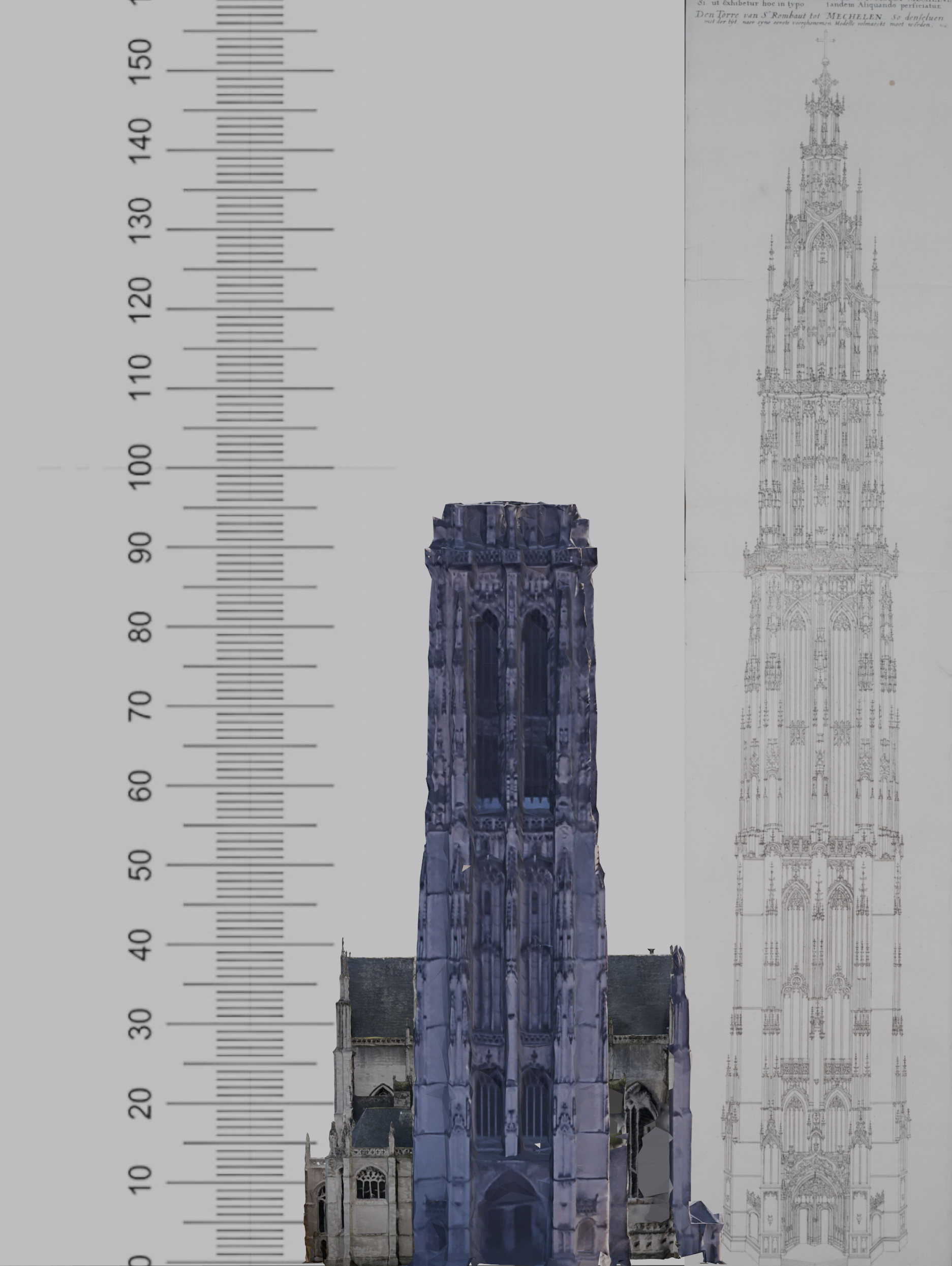
However the church of St Rumbold is most famous for its western tower, begun in 1452, but with only seven metres of the spire above the belfry built before being capped off at around 96 m c.1520. A mid-16th century architectural drawing shows how sublime the planned steeple was to be. The drawing was meant principally as a presentation piece for the secular canonesses of St Waltrude, Mons in 1550 to represent how the work at Mechelen could be copied for their new west tower (which ultimately reached only to the height of the nave clerestory roof parapet).28 The master of their works, Jean Repu, seems to have had access to the designs of the Keldermans dynasty, city architects of Mechelen for three generations, to copy the largely unbuilt spire, and also updated the rather conservatively-detailed portal storey to confirm with the Florid style of the rest of the tower.29 There is only so far you can get the drawing to match reality exactly (Left) – it is perspectival rather than an orthogonal elevation – but most estimates put it at 163 m. This would be taller than the spire of Ulm of 143 m completed in 1890, and would rank as the tallest pure masonry church tower in the world.30 Unlike most hugely ambitious late medieval building projects that seemed doomed to failure, it is unfortunate this one was never completed. That nothing happened with the project after the church became a metropolitan seat demonstrates that becoming a diocese came with little reward for the existing collegiate institutions: if anything it was a burden.
Antwerp, Our Lady
Collegiate church founded 1088×1100
(Diocese suppressed 1801. Re-erected 1961)
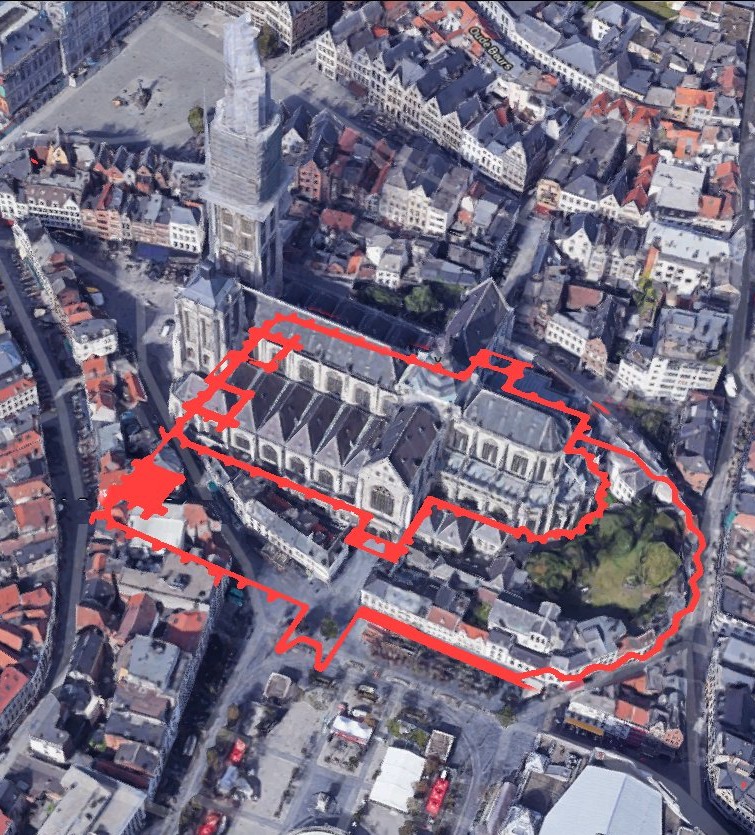
Photogrammetry model of Antwerp Cathedral, comped from multiple sources, with outline of the plan of 1521 “Nieuwe Werk” project underneath
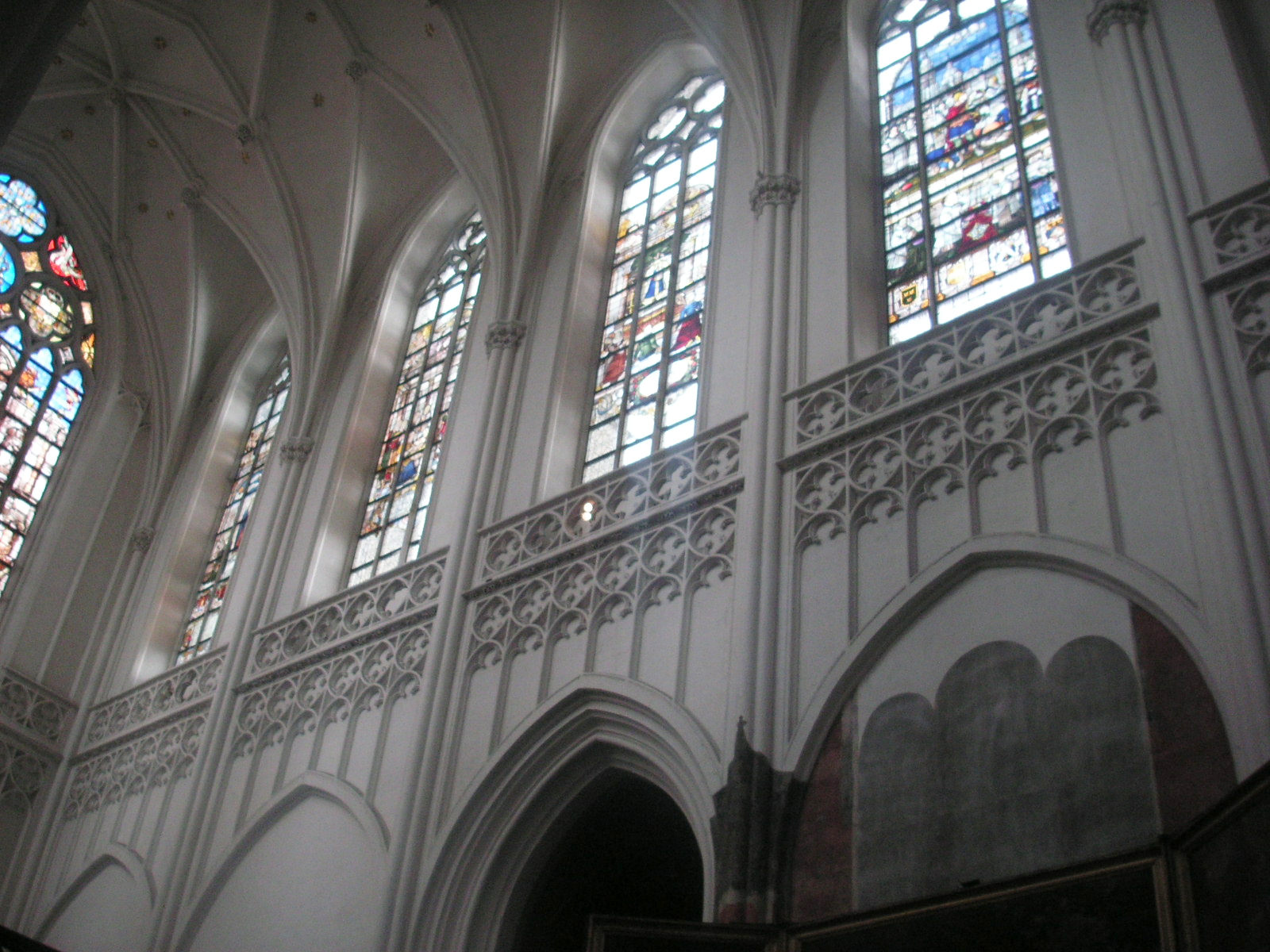
I took this! It’s about the only picture from my 2013 visit there that’s usable!
Partly due to its enormous north-west tower which is almost exactly the same height as the crossing steeple of Salisbury Cathedral (123 m), Antwerp is probably the best-known cathedral on this list, and it would surprise most of its daily visitors to learn that not only was it not built as a cathedral, but that the current incarnation of the bishopric that sits there only dates back to 1961. The current building was begun in 1352 with the ambulatory east end opening into a series of five polygonal chapels. Something that is rather un-cathedral like is the complete elimination of a middle-storey due to the almost flat roofs over the vaults of the aisles and chapels which means also there is a sill wall-passage with a quatrefoil parapet. This is (partly) compensated for by the blind panel tracery of quatrefoils impaled on trefoil-headed panels which fill the arcade spandrels, generally thought to have been inspired by the straight choir bays at Mechelen. The system is taken over for the rest of the building: the nave with its double aisles being constructed from 1419-70, subsequently a third, wider set of outer aisles being added part way through the build.
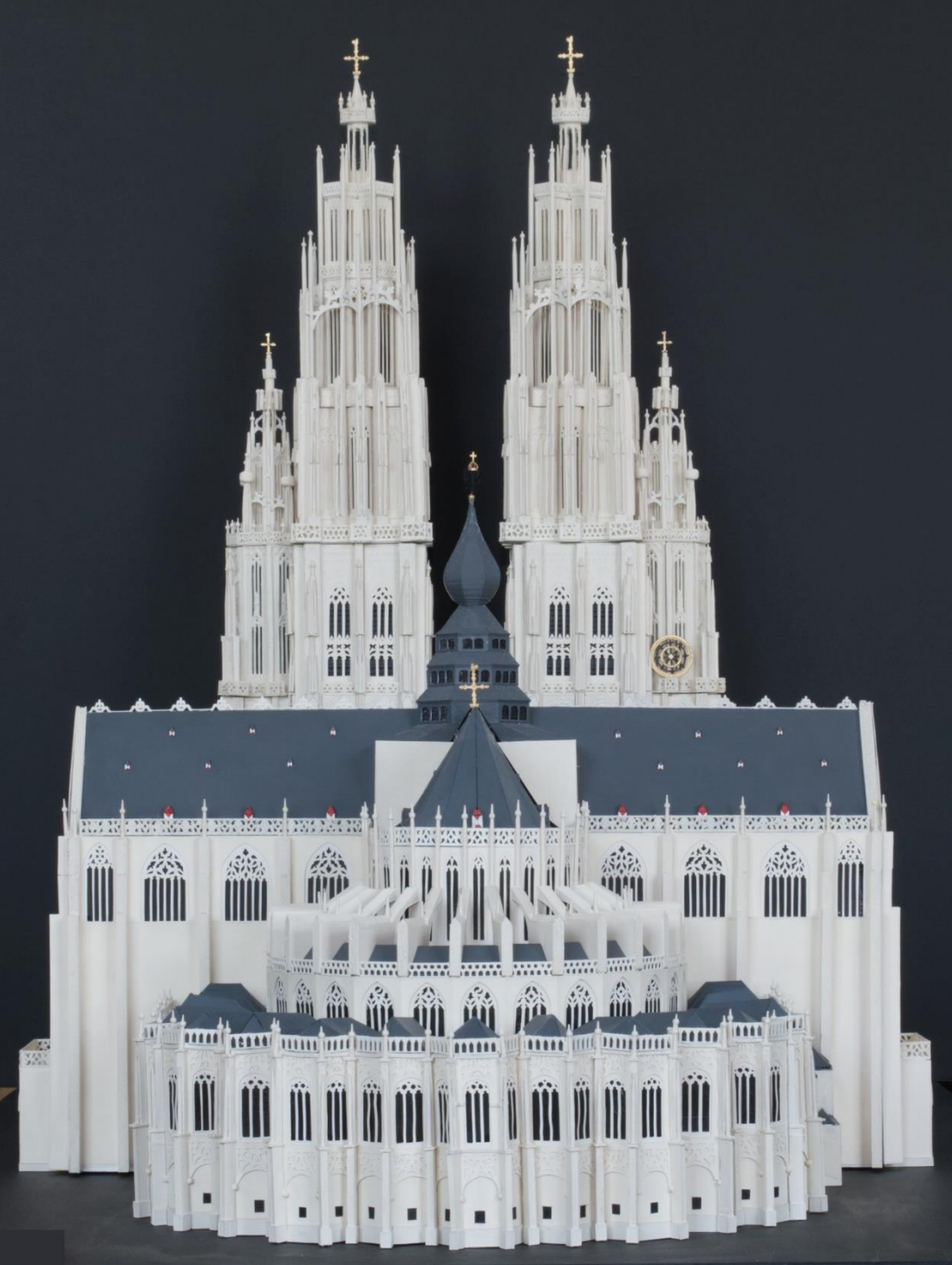
Maquette of largely of foam cardboard with wood and some 3D-printed PLA elements, by Kasper Dupré, 2020.
The north-west tower reached its current, super-tall status during 1501-18 when a Florid Gothic octagonal stage crowned with a spire concocted of a cage-like structure of traceried flying buttresses was added on top of the 1460s belfry. It is the only super-tall Florid Gothic tower fully realised to the ambitions of its custodians and builders before the Dutch Revolt put the dampers on such construction projects. But that tower was only the beginning of an utterly megalomaniacal ambition at Antwerp, as on 15 July 1521, Emperor Charles V ceremonially laid the foundation stone of an outer wall of an absolutely gargantuan choir, the outline of which can clearly be seen today in the buildings that sit atop its foundations after the project was abandoned by the canons.31 No doubt partly inspired by the Spanish Netherlands wishing to have something the proportions akin to the Cathedrals of Habsburg Spain,32 it would have outstripped Seville Cathedral’s 90 m width with around 115 m, making it the widest church in the world. Even today, only St Peter in the Vatican would rival it for sheer volume for a church building.
A fire in the existing church in 1533 scuppered the project well before the 1559 bull turned it into a cathedral, and the Dutch Revolt and economic decline after the migration of Protestant adherents from the city pulled down the shutters on it forever. Like so many unhinged Gothic rebuild projects, such as that planned at Siena in the second quarter of the 14th century, it was probably for the best it got shut down: because it seemed like it was a really, really bad idea.
Ypres, St Martin
Parish church elevated to collegiate 1102
(Diocese suppressed 1801. Building largely destroyed between 1914-8. Essentially reconstructed anew as a replica 1922-30)
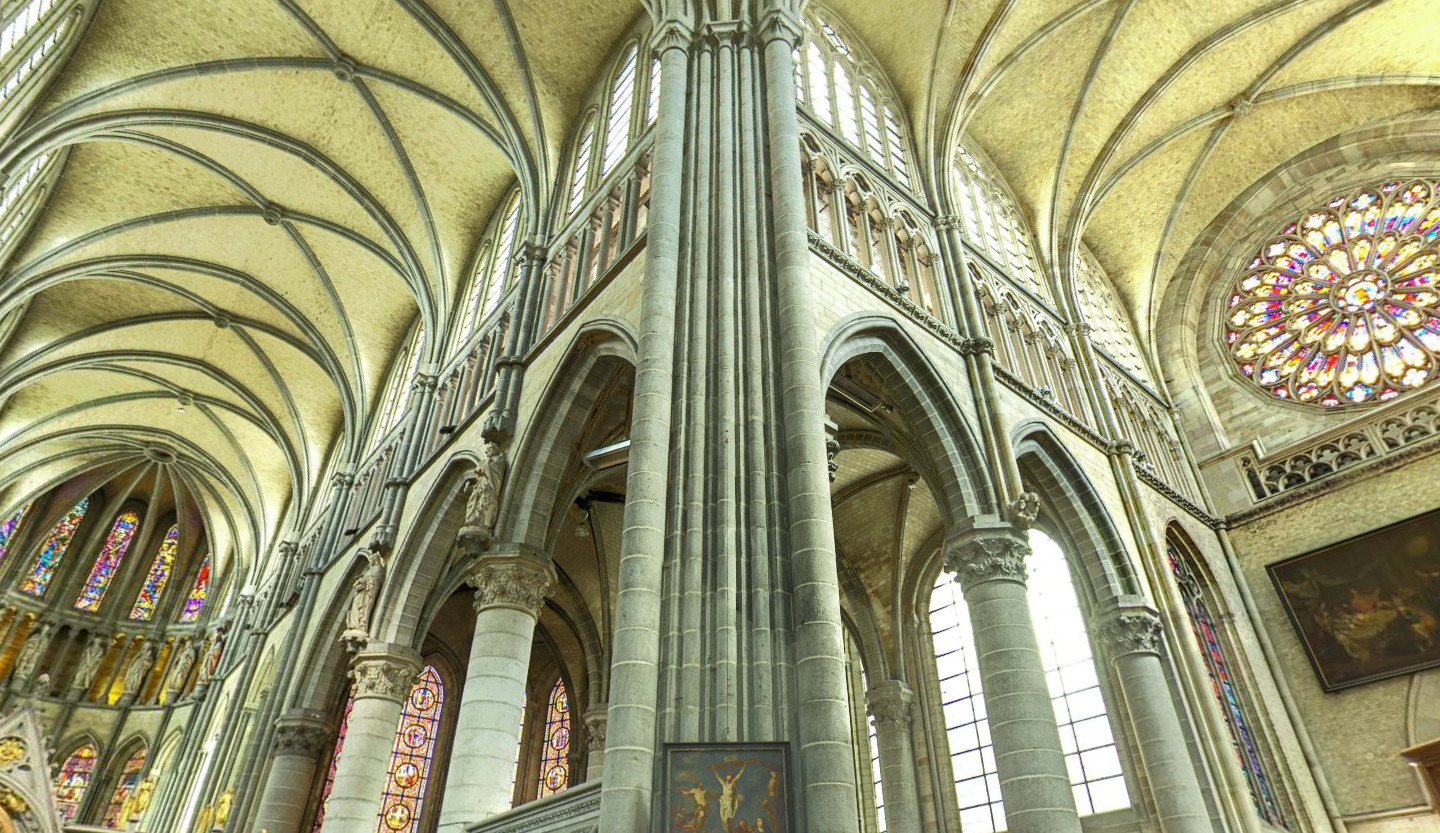
Part of a 360 panaroma shot by Philippe Vercoutter
Ypres has a solid start date of 1221 for the east end, and another good early example alongside Saint-Omer of how Flemish Gothic differs from contemporary mainstream French. Instead of the tall Chartrain clerestory, space is given over in the elevation there is a large blind triforium. Unlike Saint-Omer there is no ambulatory around the eastern arm. Instead, the high apse is unaisled, and chapels are placed in the angle between the choir and transepts, in a clever rethinking of the Romanesque en echelon plan. Such a design, which became popular in Flanders, is of uncertain origin but is best exemplified in the surviving east arm the Premonstratensian Abbey church of Braine, near Soissons.33 Although the collegiate church’s Gothic build took over a century to complete – the nave was begun in 1321 – the elevation remains largely consistent except for superficial changes in style regarding foliage and the window tracery: including a brief fling with Parisian Rayonnant in the south transept. Although with its high triforium, external clerestory passage it is similar to Saint-Omer, it overall feels more slender and light due to, as well as the lack of an eastern ambulatory, it not having lateral chapels along the aisles. In fact they totally prevented them being retrofitted on the north side by including a canons’ cloister.
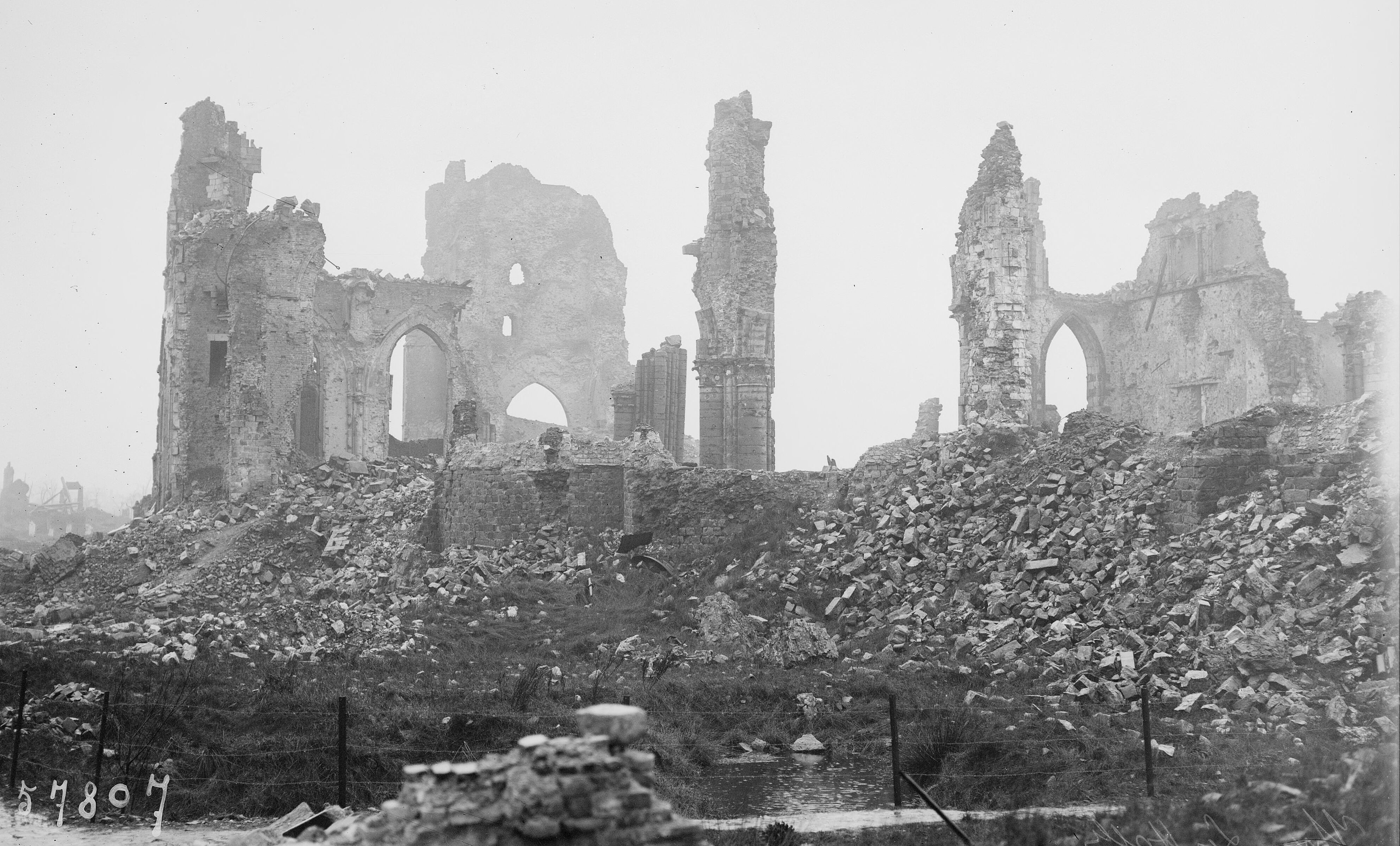
Left is the S transept, with SE stair turret collapsed so you can see the door up to the S sill passage, and connected to it the arcade of the chapels at the base of the E arm. The lump in the centre distance is the front face of the W tower, then you have some of the crossing piers and the N transept attaching to the “Proosdijzaal” off to the N.
BNF.
Ypres’s importance as a piece of medieval gothic architecture is of course somewhat overshadowed by the fact that the building there today is essentially a clever replica of an original which no longer exists. Between 7 October 1914 and 14 October 1918, the town was almost completely destroyed by long-range heavy field artillery fire from the German army.34 The Cloth Hall and St Martin’s at the heart of the town were no exception – progressively damaged through the years of The Great War and eventually pulverised to almost complete annihilation.
You absolutely cannot exaggerate the extent of destruction of Ypres: all that remained standing of the former cathedral church after the Armistice was the lower parts of the south transept and west tower facades, parts of the crossing piers and bits adjoining them. It’s quite incredible how much the building was pummelled almost entirely out of existence. The standing masonry survivals were moot, as the damage was so heavy the site seems to have been almost entirely cleared to ground level and the church rebuilt entirely from scratch on top of the footings.
The slideshow below focuses on the south transept facade, which was subject to restorative reconstruction just before the War,35 and was one of the few parts left standing in early 1920.
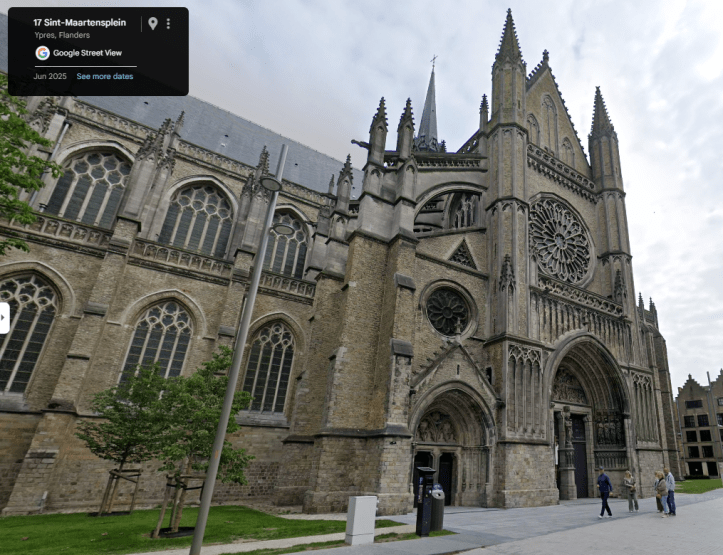
Streetview of St Martin, Ypres, S transept from SW 2025 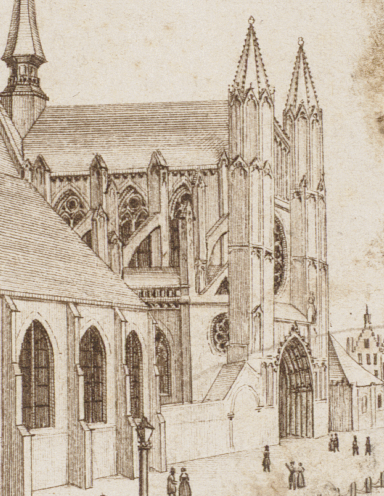
Detail of 1844 print by F. Böhm. Note the arrangement of oculus in the end of the aisle with triangle in the lean-to roof. Foreground is the dean’s chapel which was destroyed early in the War and not rebuilt. 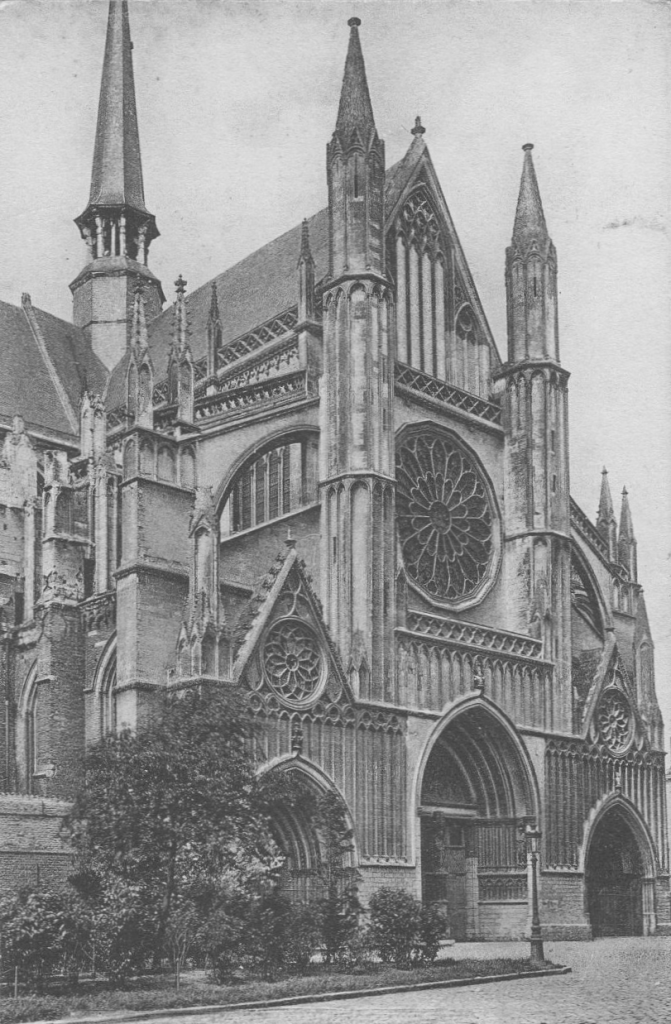
S transept SW angle from before the Coomans restoration of 1907, showing the frankly daft-looking symmetrical false gables flanking the transept instated by J. Dumont in the 1840s-50s. 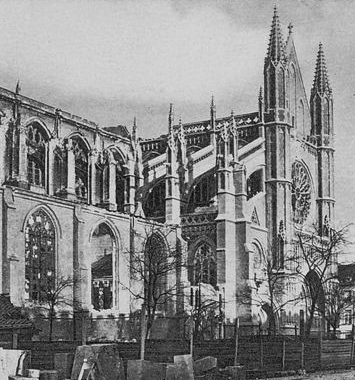
S transept SW angle early stages of the Great War (late 1914 or early ’15), the roofs have burnt off and the Dean’s chapel is gone. Note however Cooman’s reinstatement of the previous S transept facade arrangement. 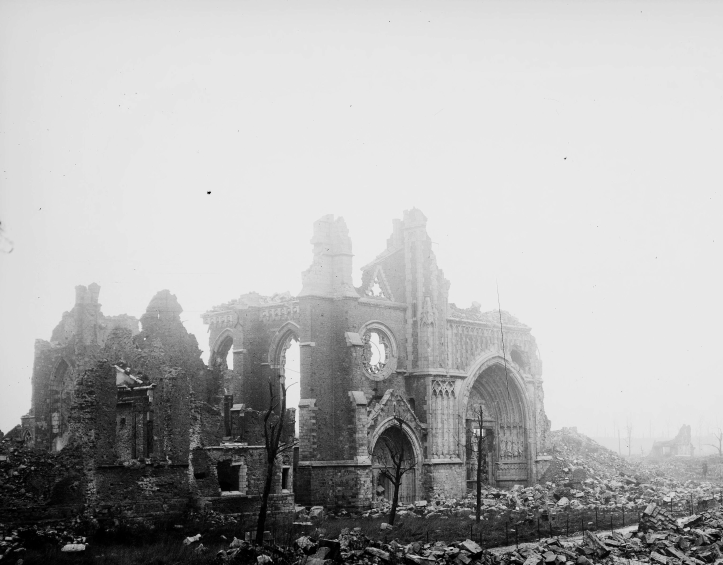
S transept SW angle in 1920. Only some outer walls stand to aisle roof level. The wall in front to the L is the inner side of the N wall of the Cloth Hall.
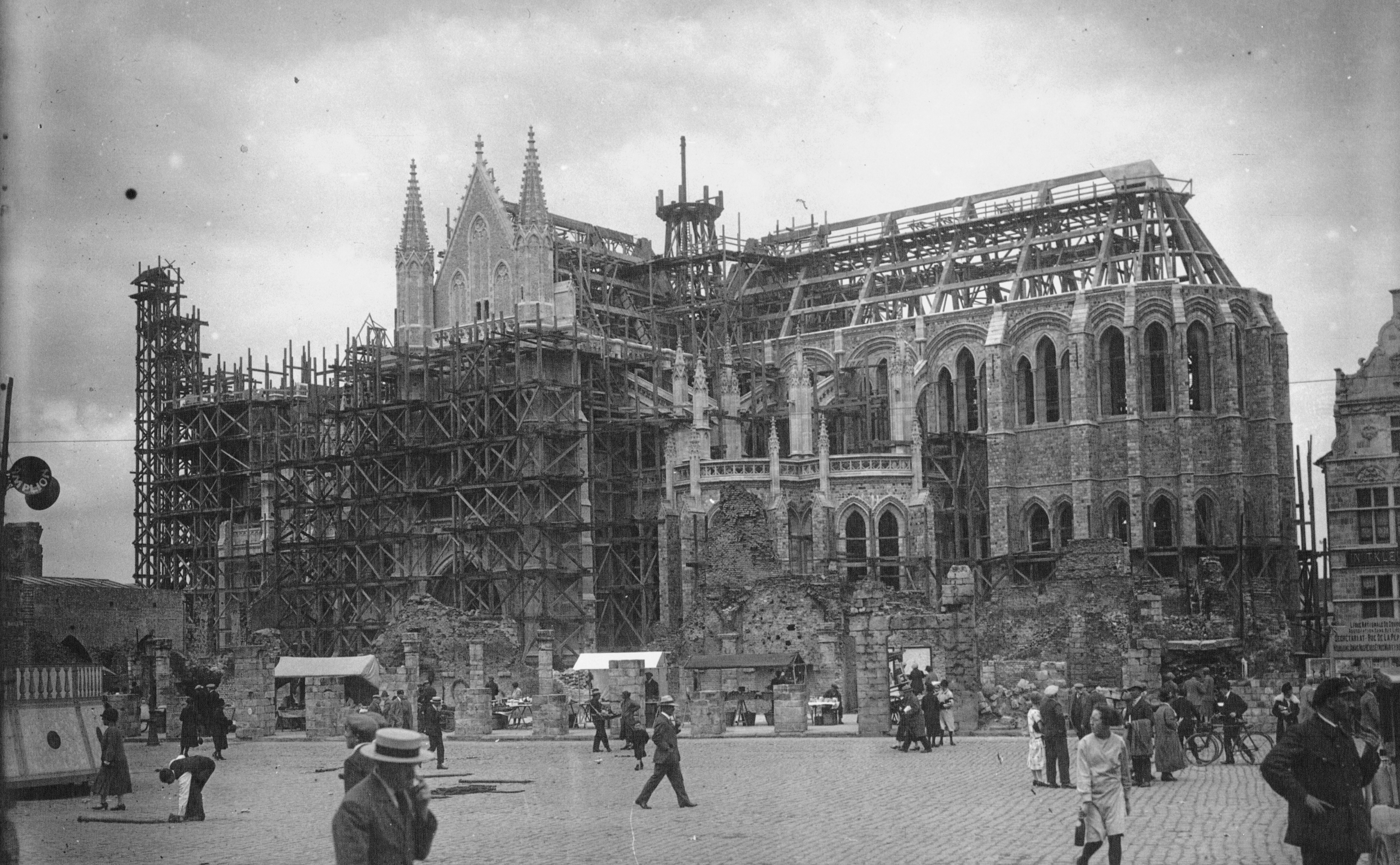
BNF
The architect in charge of rebuilding, Jules Coomans, had already restored the church in 1907, so much of the work was reinstating the design as he had established and documented then. The facing masonry components – Arras sandstone for the east arm and a mixture of yellow local brick and stone dressings for the rest – are particularly admirable for their authenticity. It should be noted however that many of the details you can see destroyed in the Great War and reinstated today, were in fact introduced by Coomans in 1907. The rebuild was completed at the conclusion of the decade and the grand rededication was on 13 April 1930. Although no rebuild can be a perfect replica of the building, partly due to the speed of reconstruction, Ypres has been appraised as showing a greater conformity of treatment to the capitals than in the original, that took over ten times as long to realise.36 Nevertheless, rebuilding it was a triumph to be treasured as an artistic achievement in its own right.
Ghent, St Bavo
Parish church, elevated to collegiate 1540
(Diocese never suppressed)
This was originally a parish church, only becoming collegiate after the destruction of the abbey of St Bavo for the construction of an Imperial Citadel on its site. Emperor Charles V secularised the chapter and installed them at the parish church of St John, changing the dedication to that of the old abbey.
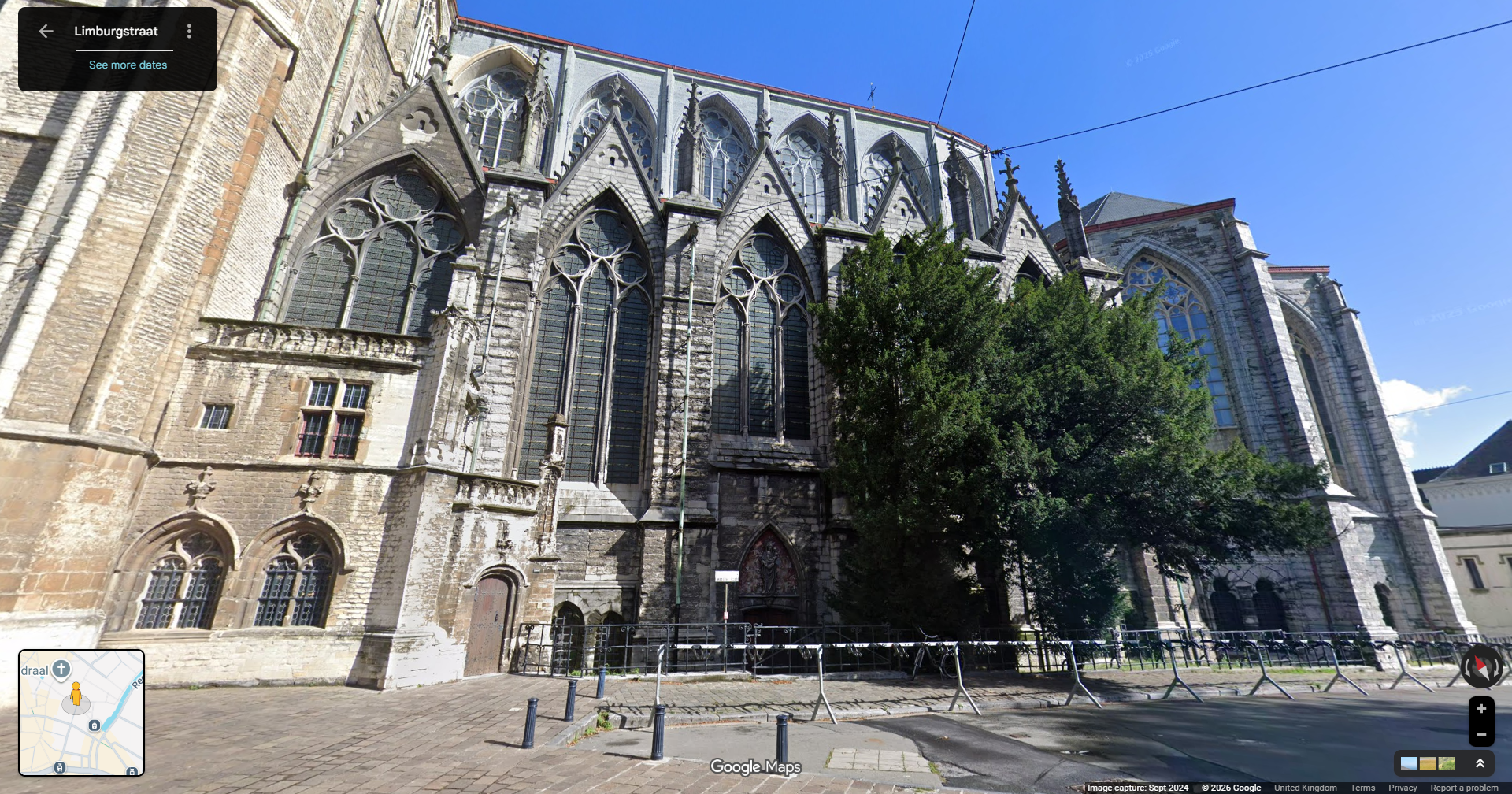
The crocketed gables over the early 14thc aisle chapels, although derived from High Gothic decorative detailing such as the clerestory of Amiens Cathedral choir, here do genuinely face transverse roofs which run into valley gutters between the chapels. The later 14thc ambulatory chapel behind the tree to the right became the Vijdkapel and the first home of the Van Eyck altarpiece.
The Sint-Janskerk, such as it was, survived as a Romanesque basilica (represented by the central part of the crypt under the current choir), until it received a Gothic east arm in the early 14th century. One might say, with its through-coursed piers of a cylindrical core with shafts at the angles, simple crocket capitals, openwork tracery in front of a triforium passage, and standard graduated oculi fenestration in the clerestory, this is a rather off-the-peg bit of provincial Rayonnant. That one commentator might be a bit of an annoying know-it-all, but regardless, largely correct. Like pretty much all of pre-Florid Brabatine Gothic, it’s coasting off the cathedrals of Tournai and Cambrai and not doing much new. Aside from the crocketed and finial’d gables over the choir chapels, the exterior is rather plain.
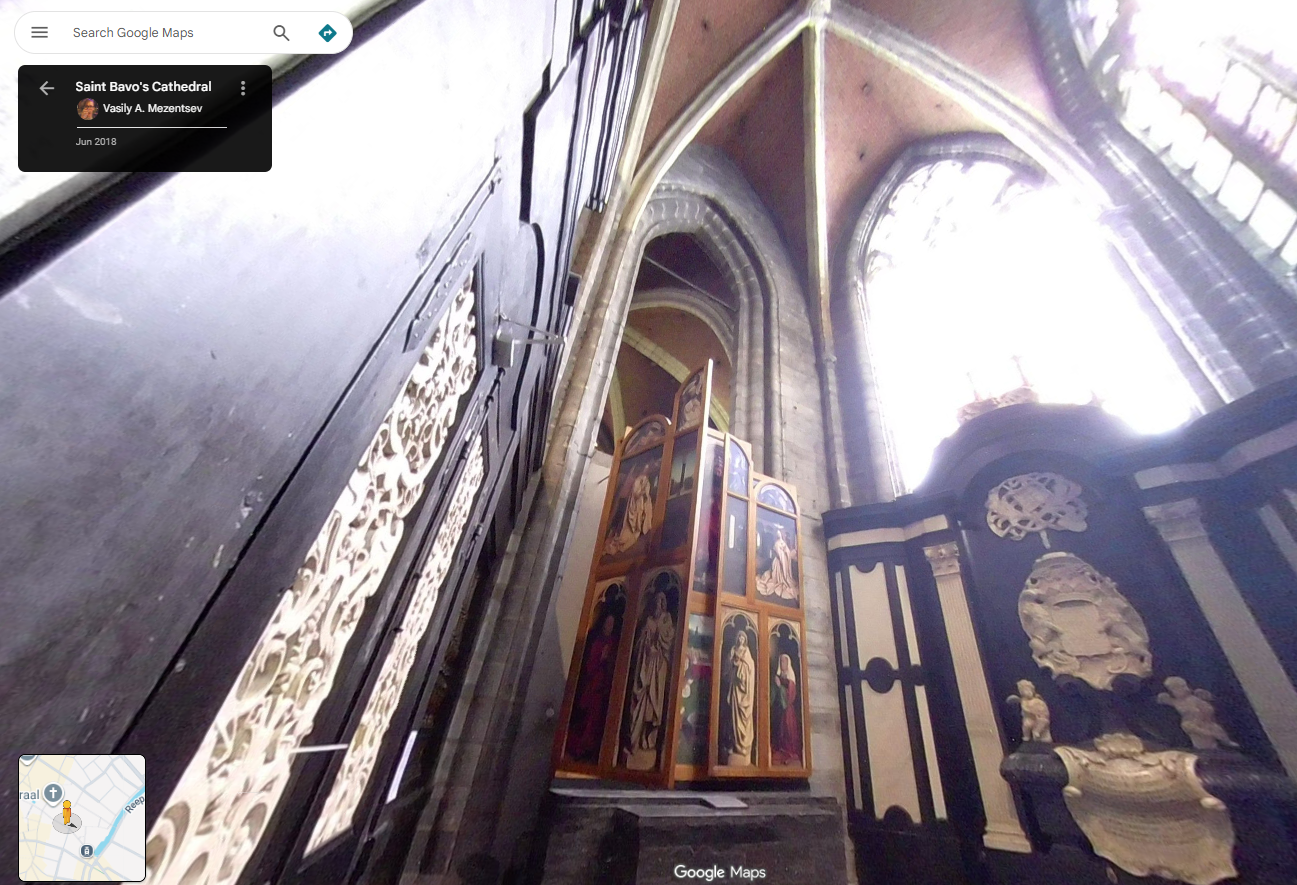
In the 1390s, the ambulatory was expanded and given exceptionally generously-proportioned polygonal chapels, the first one of which on the south side had the world-famous ensemble of oil paint of oak panels, widely known as the Ghent Altarpiece (properly the “Adoration of the Mystic Lamb” Dutch: De aanbidding Het Lam Gods), made for it by the brothers Van Eyck and installed there by 1432. The crypt was also expanded beneath the chapels. From 1462, a west tower was built in front of the remaining Romanesque nave. It is hardly a match to the Brabant towers going up around the same time, either in height or detailing, although with its octagonal top stage’s pinacles at 89 m, it beats any parish church in England (Boston, pinnacles of octagon, 81 m; Louth, masonry spire, 86.6). Especially since in sixteenth-century maps you can see it had a sizeable spire on top of the octagonal stage taking it well above 100 m.37
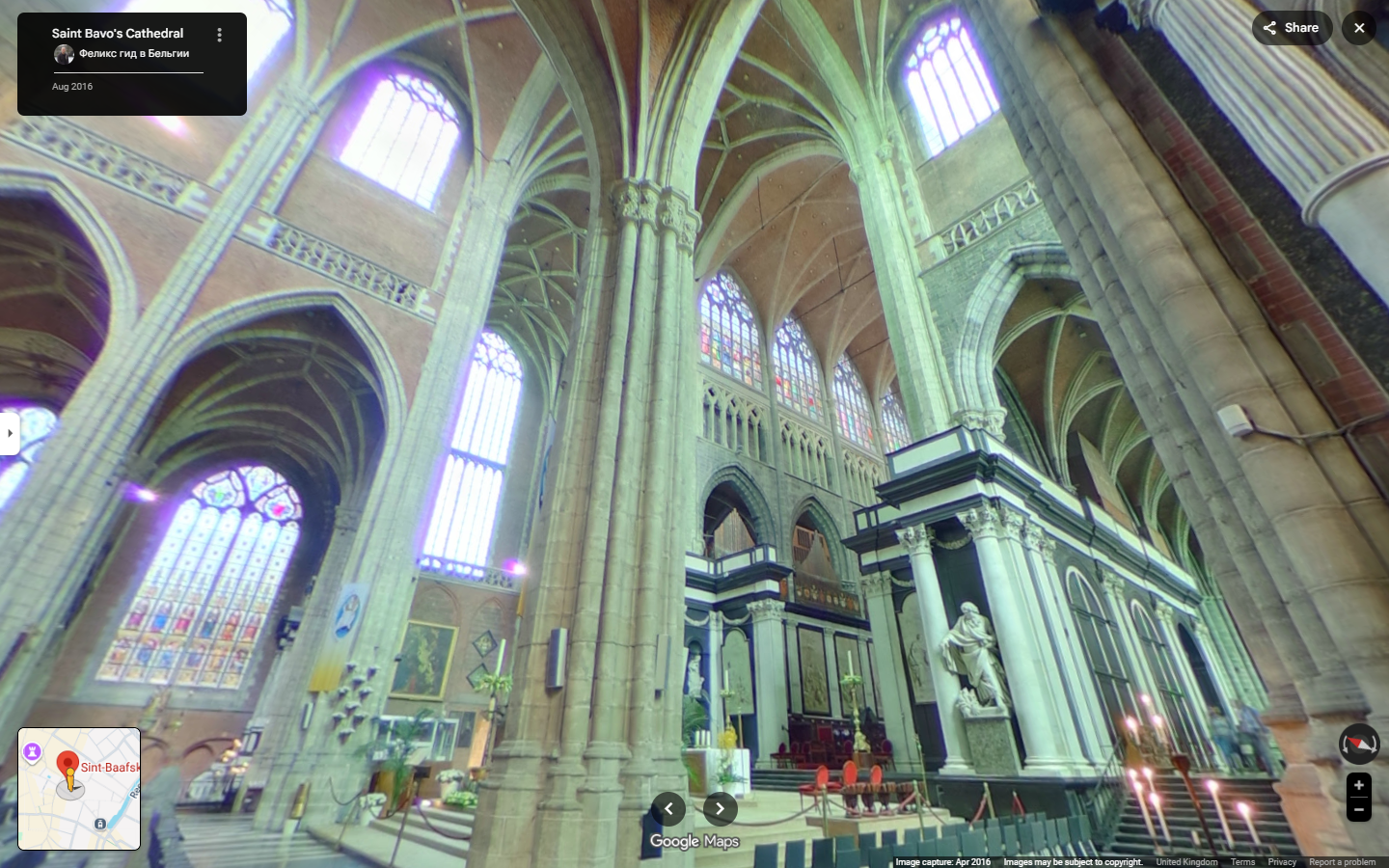
A campaign to replace the Romanesque transepts and nave between the choir and tower was inaugurated 7 August 1533. The build matches the Rayonnant choir elevation but eschewing the triforium for a bare space of brick over some pierced tracery which looks like the balustrade of a walkway but isn’t. The building might lay claim to having the most recent major building work of any cathedral in the Super Universas bull for in 1550, Emperor Charles V, gave the sum of 15,000 Italian crowns, each to the value of 36 sous to the church.38 Sous is an alternative word for shilling, so in units of account the gold coinage works out as £26,250. However, to compare this sum with something like King Henry VII of England’s exceptionally lavish 32-metre-long Lady Chapel at Westminster Abbey built 1503-12 which cost over £19,586,39 we have to recognise that a Flemish groat pound was worth much less than a English pound sterling: between an eighth to ninth in the early sixteenth century.40 Therefore Charles V’s gift was more in the region of £3,000 when converted to English currency. Was Charles motivated by a plan to make it into a cathedral, because he had been baptised there in 1500, or as compensation for destroying the Abbey church of St Bavo? Or a bit of all of those? Probably.
Bruges, St Donatian
Palatine chapel and collegiate church founded 10th century
(Last bishop in office 1794. Church destroyed 1799. Diocese suppressed 1801.
Diocese re-erected in 1834 and bishop’s seat installed at medieval church of St Salvator)
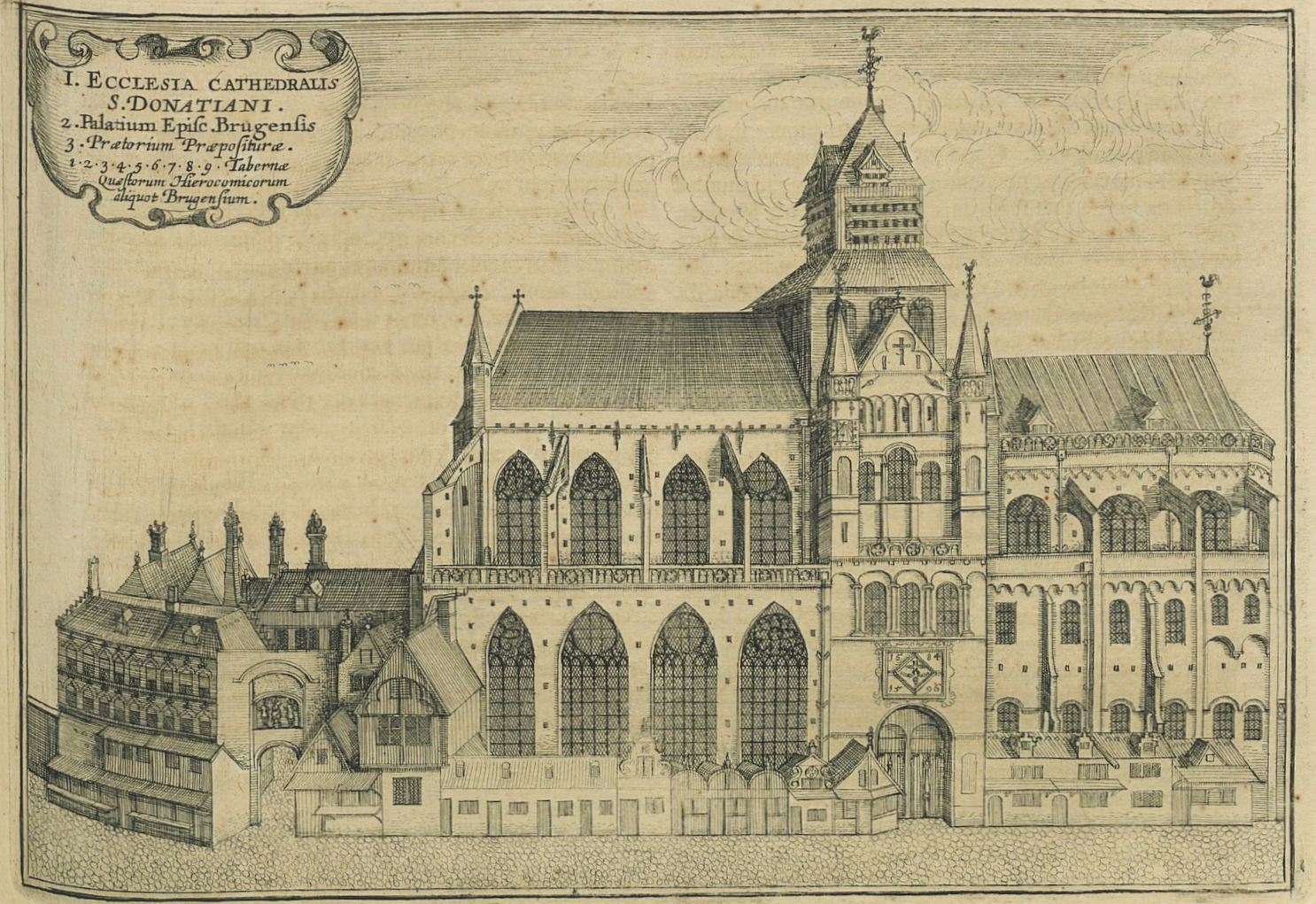
From Antonius Sanderus, Flandria Illustrata, Vol. 1, 1631, p.211. Via Koninklijke Bibliotheek van België
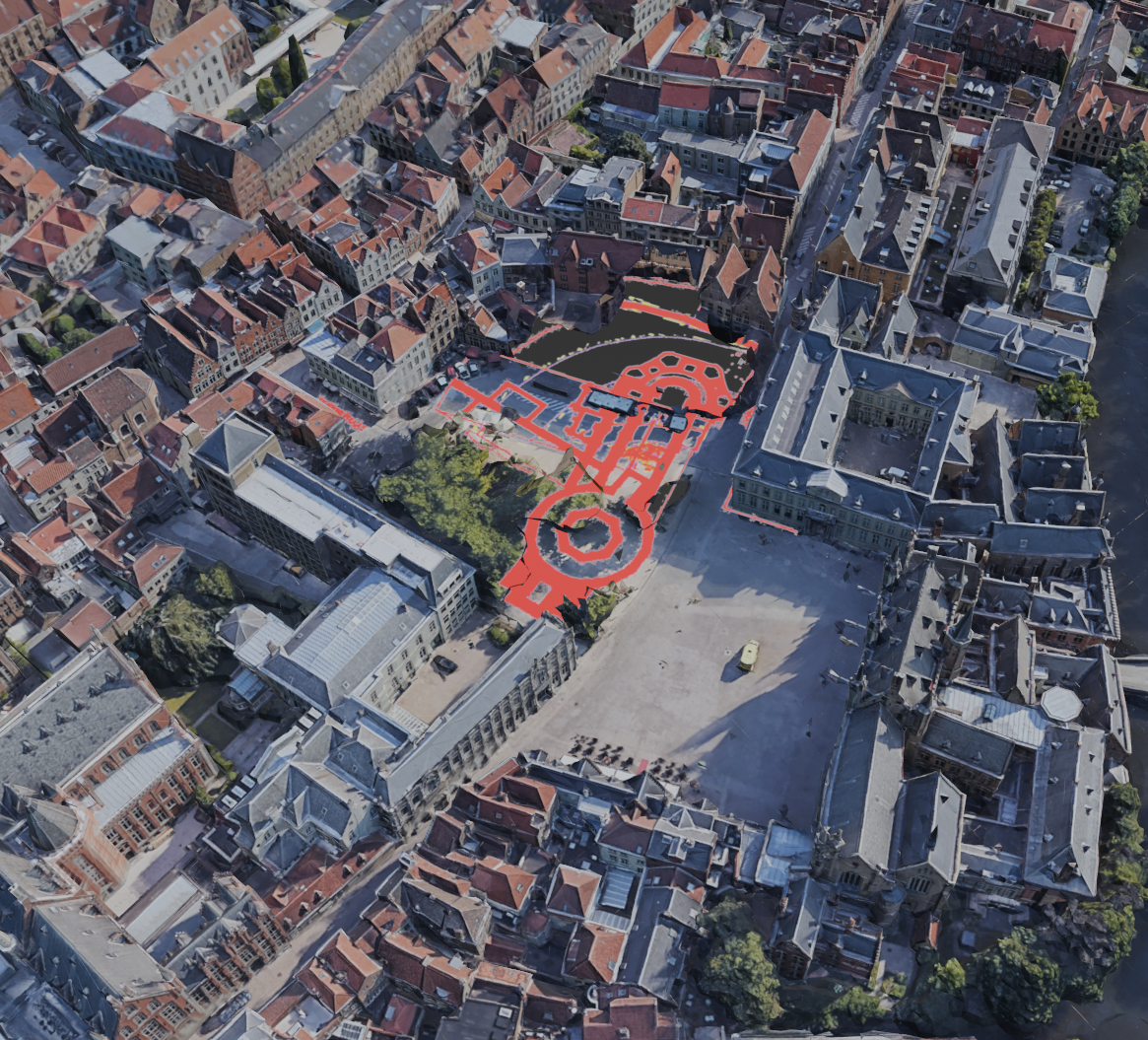
The Crowne Plaza hotel geometry has been removed to show the eastern apse of the cathedral.
The Basillica of the Holy Blood is bottom-right.
St Donatian is now totally vanished above pavement level, and thousands of daily tourists walking over its site in the historic centre south of Burg Square (opposite the Basilica of the Holy Blood) have no idea it was ever there.41
Initially founded as the chapel of the Burg (castle) held by the counts of Flanders in the 10th century, and built as a centrally-planned octagon in emulation of the Palatine Chapel at Aachen, and thus ultimately the Holy Sepulchre in Jerusalem. This is the building in which the Count of Flanders, Charles “the Good” was murdered inside on the 2 March 1127 by knights acting on behalf of the embittered Erembald family with whom he was feuding.42 This church was destroyed beyond repair in 1184, and replaced with a standard Romanesque basilica-form church, which extended out over the former castle moat.
The church nave was rebuilt in the 14th century, and the Romanesque ambulatory modified into a continuous chevet by inserting two chapels between the separate Romanesque ones. Under French rule, the church complex was confiscated as typical for religious buildings, and sold to be demolished for its materials between 25 October 1799 and 1802: mostly the structure was undermined by lighting fires under the walls.43
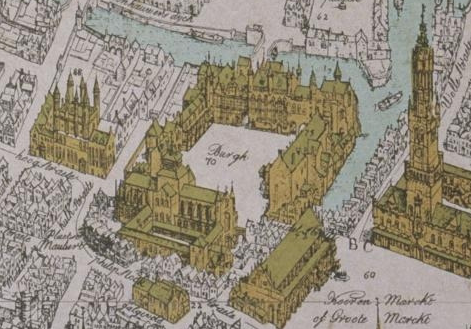
Crop of the 1561 isometric map by Marcus Gheeraerts the Elder. St Donatian’s collegiate complex is at the bottom of the Burg Square. Between it and the Town Hall with its monumental belfry is the Waterhalle, demolished in 1787 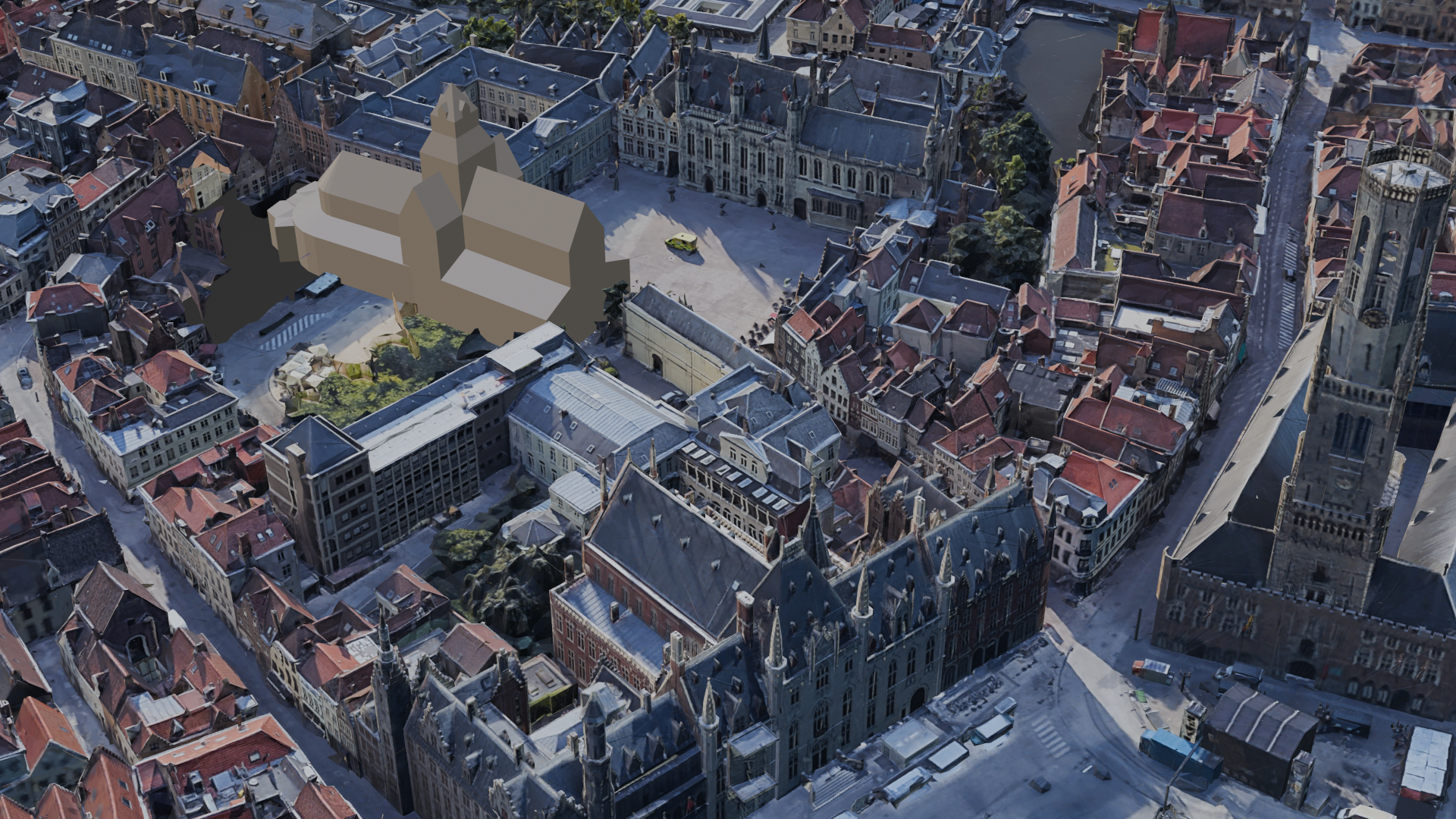
Similar view of modern-day Bruges showing a rough massing of the church of St Donatian. The Crown Plaza hotel has been removed to allow visibility of the E end. 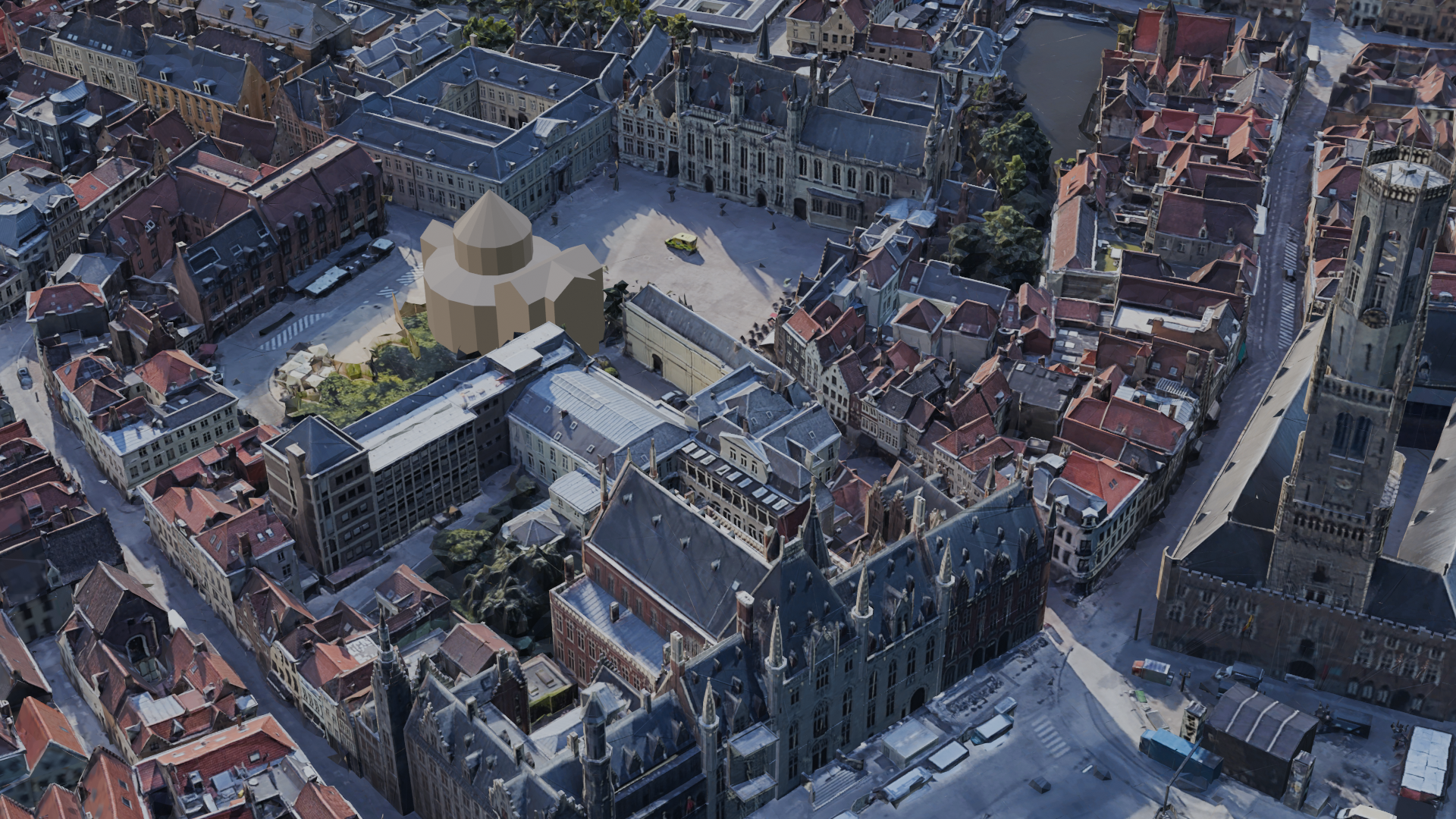
Same view but with the Carolingian rotunda and west block that preceded the basilica in view. The elevation of the model is extrapolated from scaling down Aachen to the same scale.
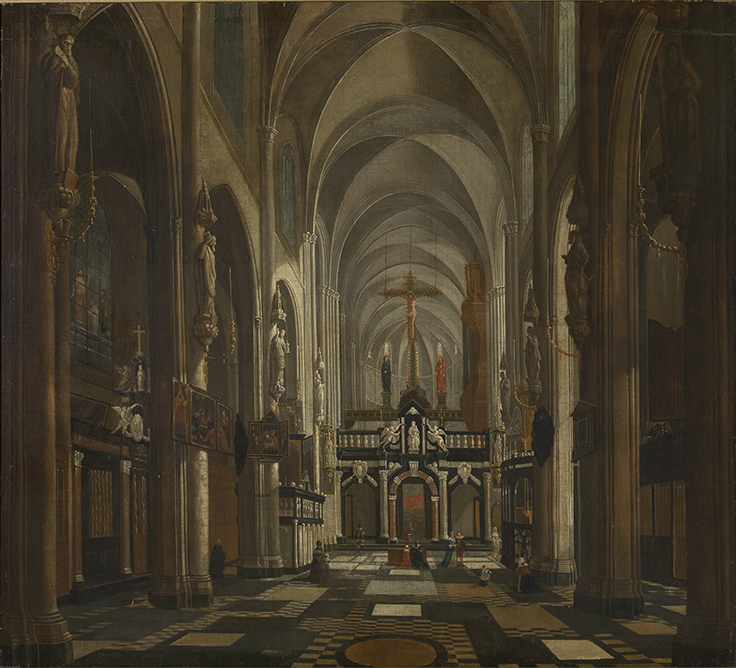
Oil on canvas, c.1696 by Jan Baptist van Meunincxhove,
Groeningemuseum, Bruges 0000.GRO1383.I
There are a number of visual records of the building. One is on the isometric map of Bruges from 1561 by Marcus Gheeraerts the Elder (above), and a 1641 engraving for Anton Sander’s Flandria Illustrata (header). Jan Baptist van Meunincxhove painted a view from the nave with the Romanesque choir elevation tantalisingly behind the Baroque choir screen. These and other visual records correspond to show it had a four-bay nave with a two-storey elevation, and a Romanesque east arm with a gallery and ambulatory, as were found in the excavations of 1955-6, which largely revealed the Carolingian Rotunda and 1987-9, which discovered the east arm of the final church.44 After this, c.1991-2, the Crowne Plaza Hotel was built over the site of the east arm, and the remains beneath are accessible from its basement. They used to be freely available to visit, but in 2023 due to littering and vandalism, the hotel restricted access only to tour groups lead by licenced city guides, which is a huge shame.45
What is striking about the Cathedral it was not the biggest church in Bruges: the church the bishop’s seat returned to in 1834, St Salvator, is larger. But it was the importance of the collegiate chapter that lead for this church, on a constrained site in the Burg, to be chosen. If it survived today, it would be the Romanesque east arm that would set it apart.
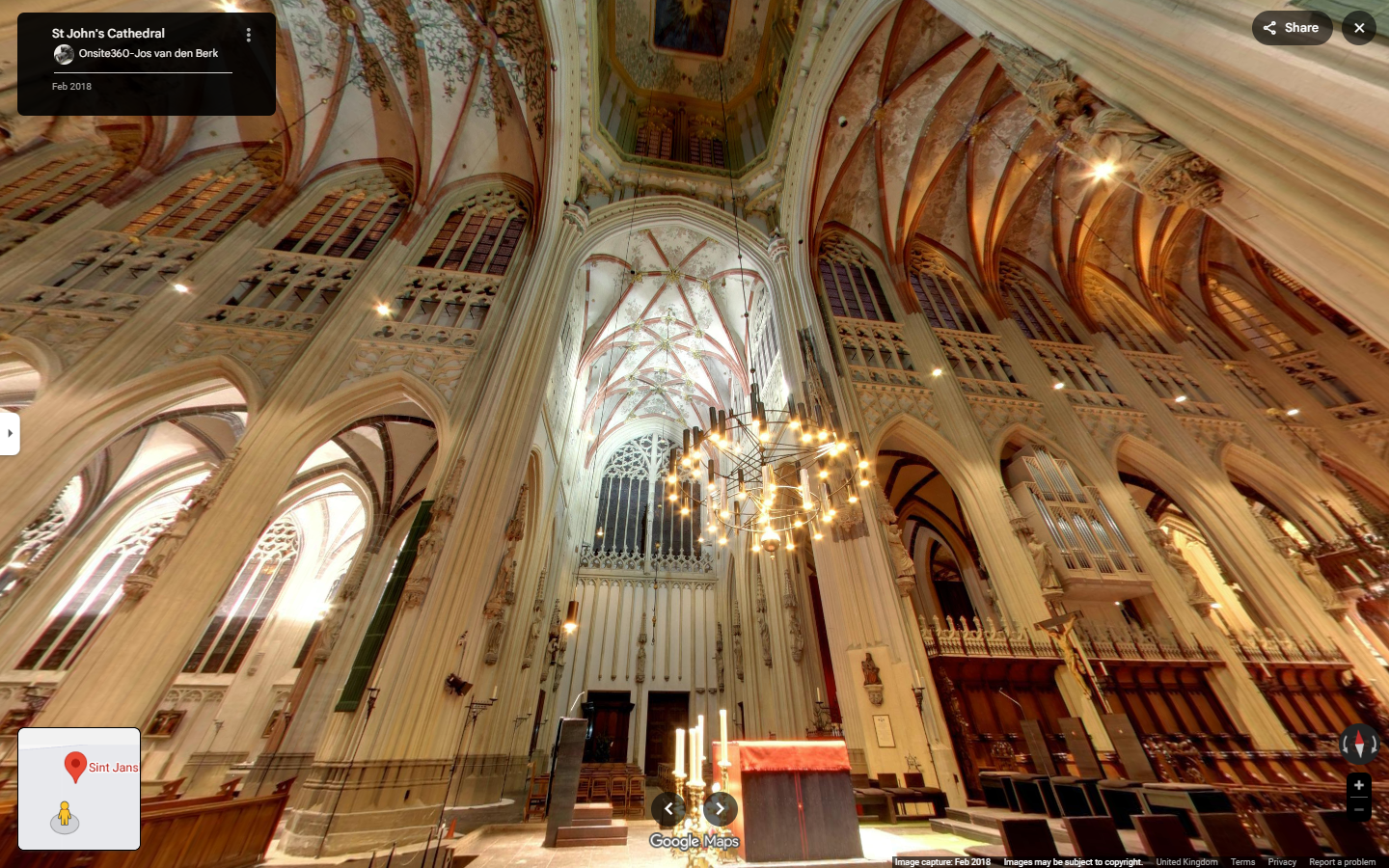
‘s-Hertogenbosch, St John
Parish church, elevated to collegiate 1366
(Diocese suppressed 1646, re-erected 1853)
Photogrammetry capture of ‘s-Hertogenbosch Cathedral
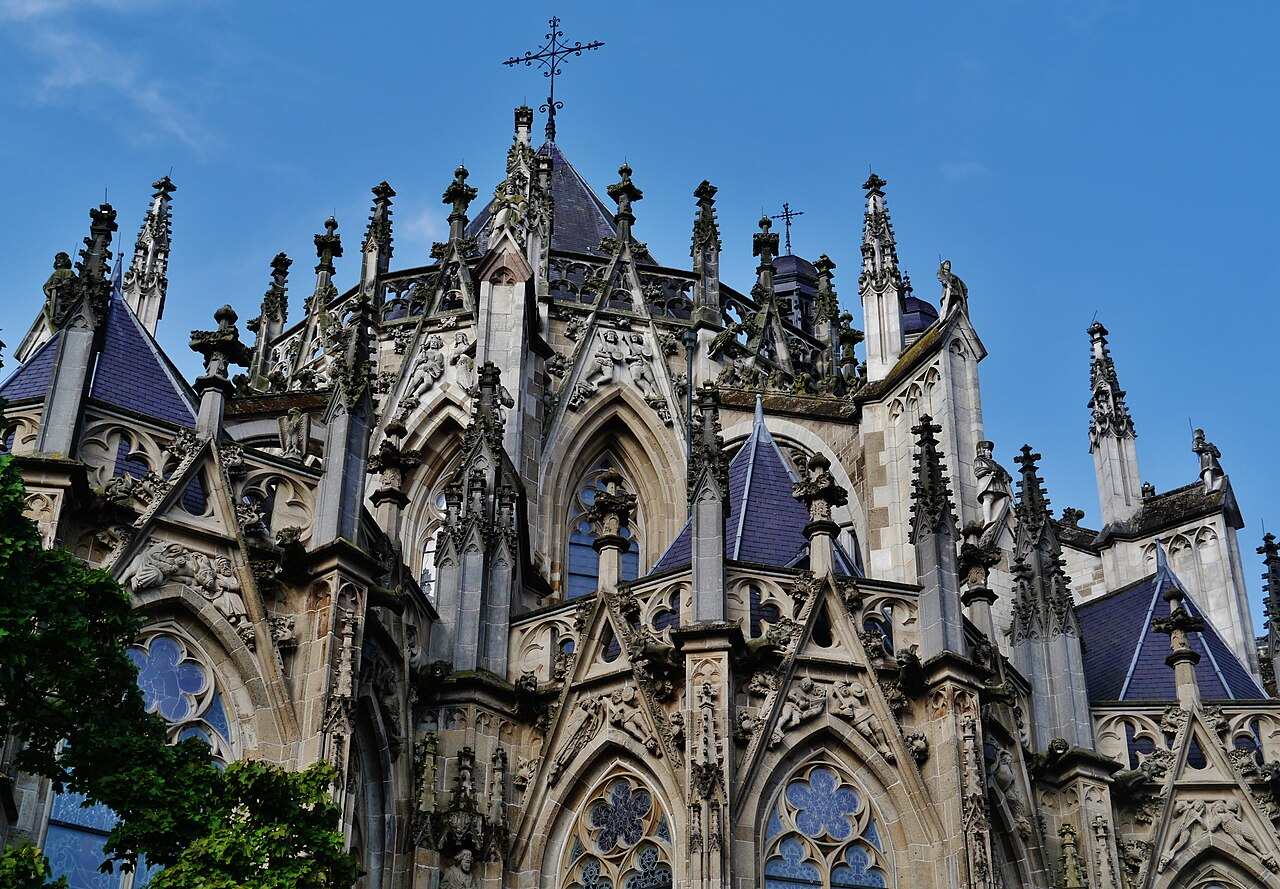
Wikicommons: Zairon. Taken August 2015
The principal administrator of the Super Universas project in its final form that saw through its issuing as a papal bull, Franciscus Sonnius, was rewarded with the appointment of this see in 1561 and was ordained 8 November 1562, however he was translated to Antwerp 13 March 1570. The seemingly unusual name of the town is a contraction of des Hertogen bosch, the forest of the duke, hence the French name Bois-le-Duc, and it is commonly called Den Bosch in Dutch.
What stands now is an absolute hulk of a collegiate church. The feature that gives it this impression, aside from the double aisles of the nave, is the retained west tower of brick from the mid-13th century (mentioned 1268). A chapter was founded in 1366 and it is likely from 1380 that the building of a new east arm with an ambulatory and radiating chapels was begun, with a rich Brabantine Gothic language being used on the interior elevation of arcade spandrels and openwork-tracery pierced triforium passage, but also the exterior, with the buttressing system and decorative gables (Dutch: wimberg) over the windows enriched with an unusual amount of figure sculpture both sacred and profane.46
The south transept porch, with its magnificent cresting of ogees intersecting with inverted curves, is indebted to Parlerian designs such as the main frontage of Prague Cathedral, and its dating in the 1430s means it is likely seminal in establishing the third main style of Low Countries Gothic: the Florid.47 The whole frontage has been extensively restored: even in the early 17th century the reversed-ogee parapet was in a ropey state (possibly from the siege of 1629 by the Dutch Republic, when the city remained loyal to Habsburg Spain, but also perhaps the steeple fire and inevitable collapse of 1584) and much of it was remade in the 1886-7 restoration. We can also see from a splendid mid-seventeenth century watercolour in the Rijksmuseum that the great end window with two subtractions separated with a bold central mullion was even more asymmetrical, with two completely different tracery patterns in the heads.
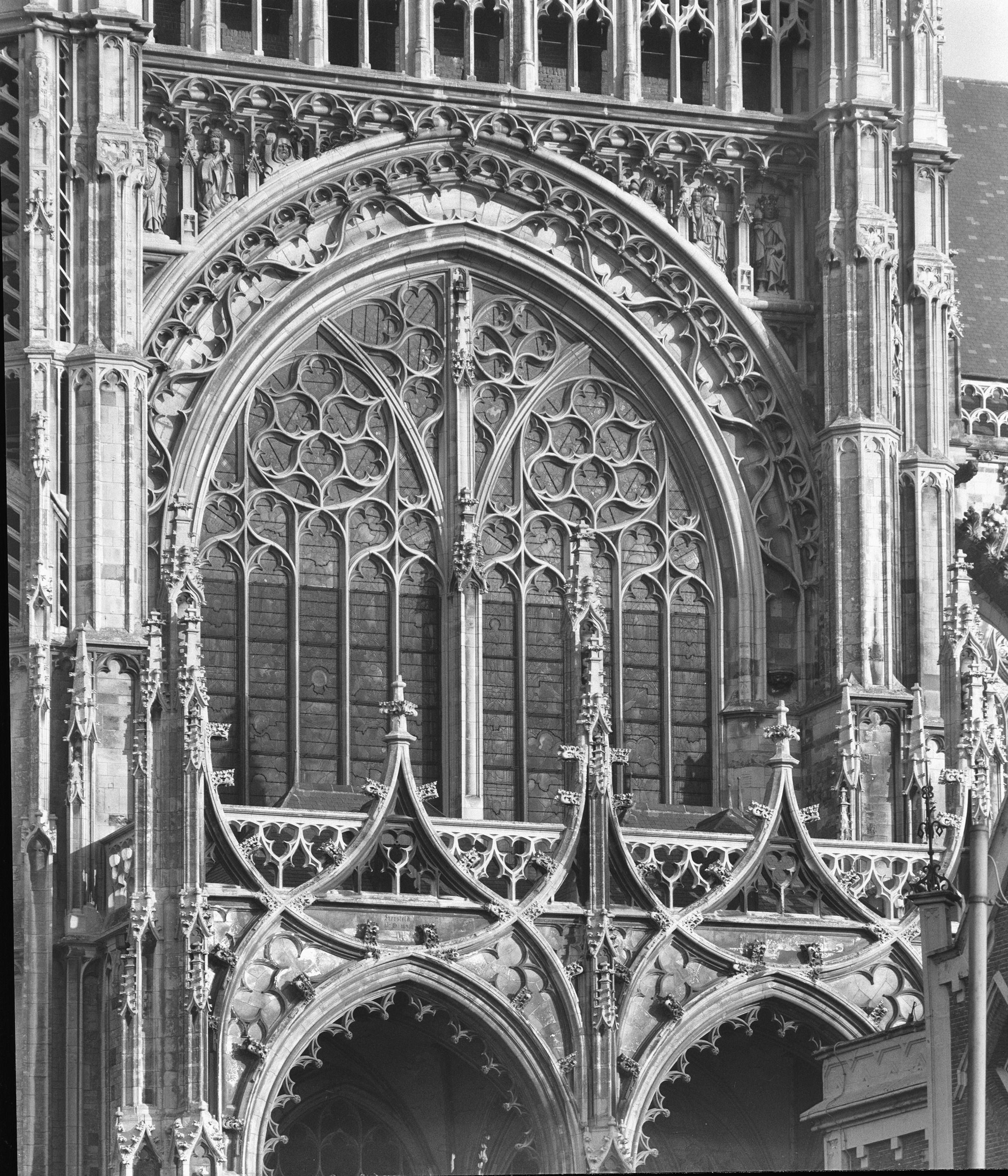
Photograph taken Feb 1964 by G.Th Delemarre: Rijksdienst voor het Cultureel Erfgoed
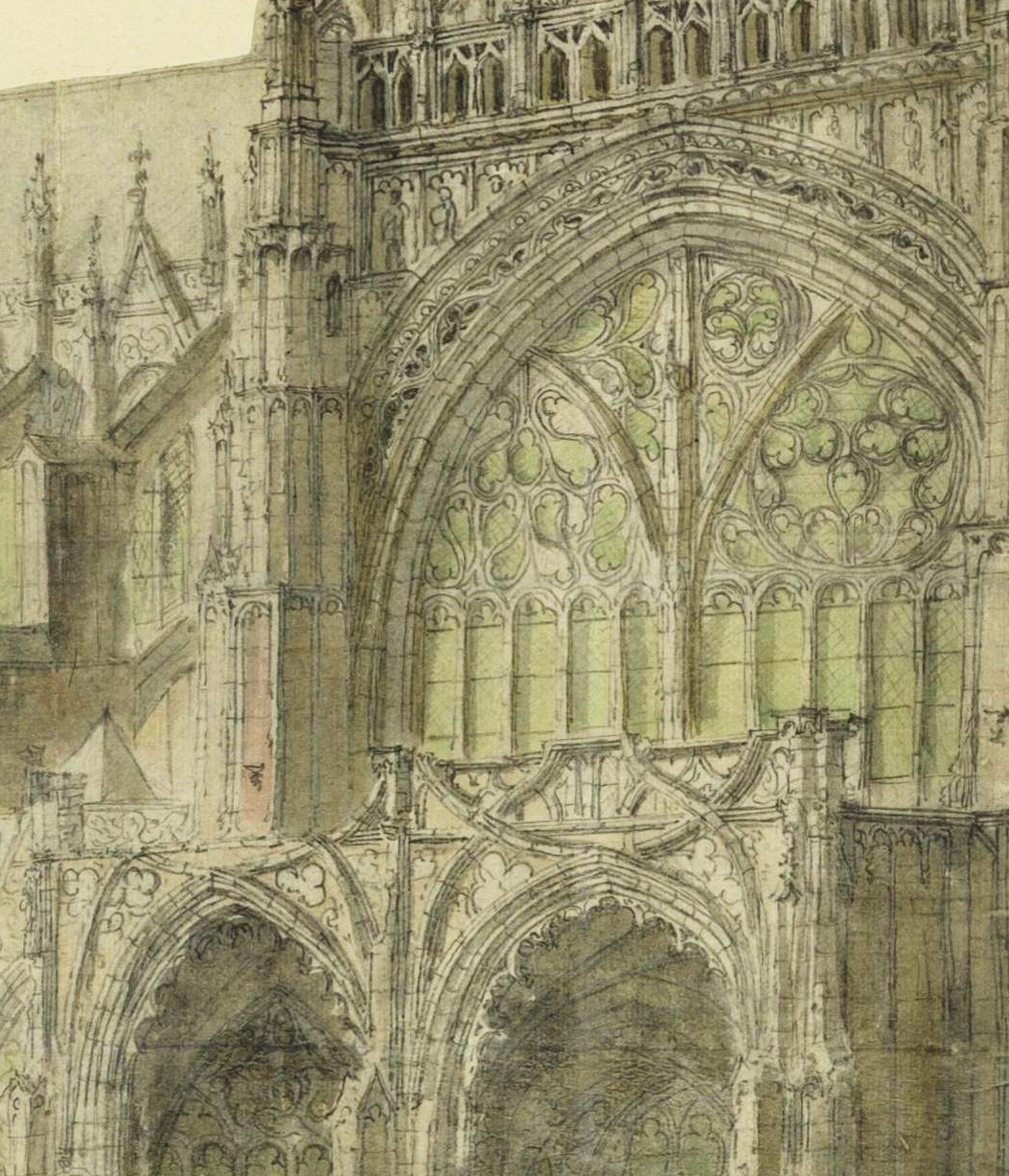
Amsterdam, Rijksmuseum, RP-T-1965-316.
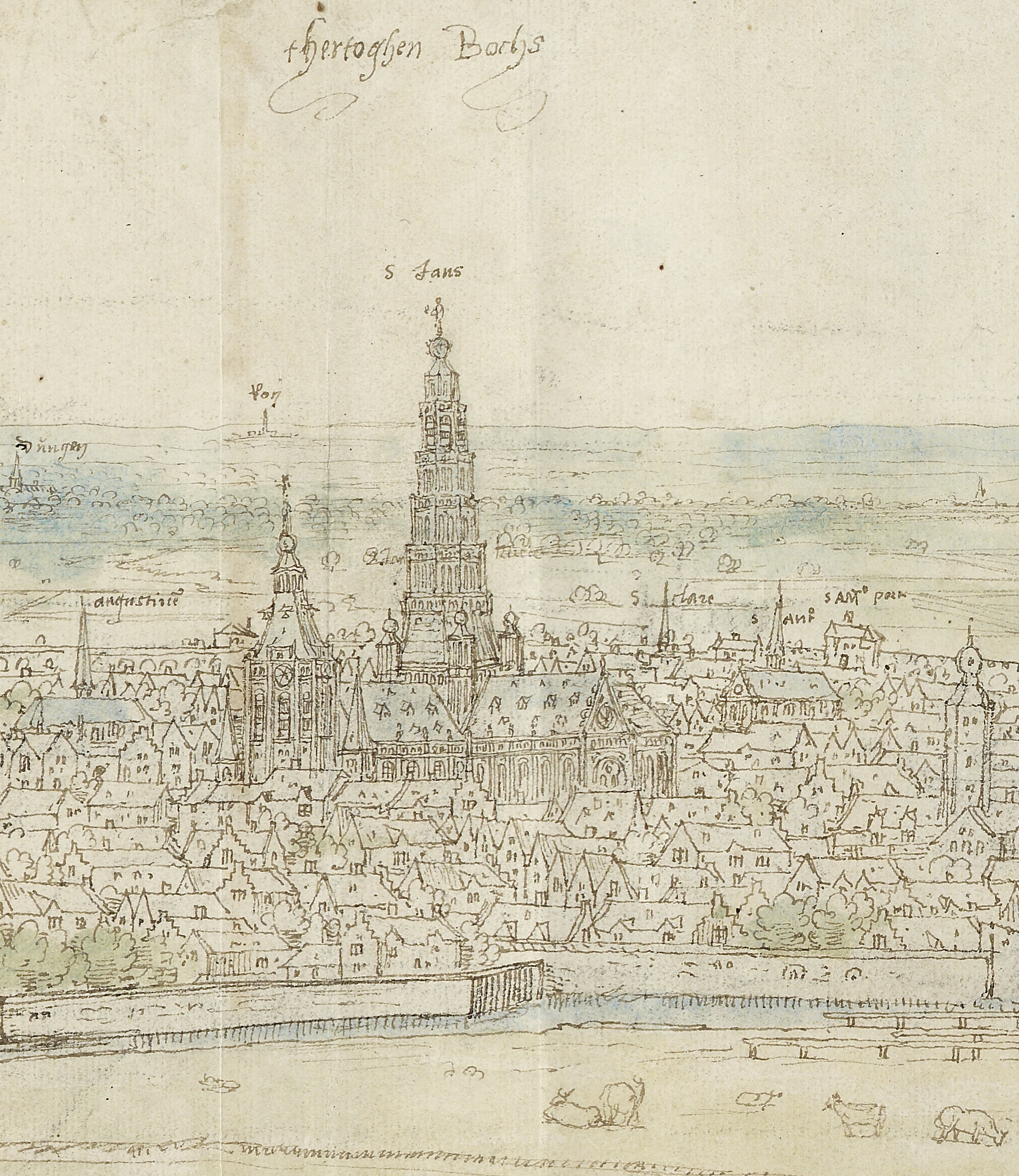
The Florid Style went on to realise some of the highest towers in the world, including Antwerp, but ‘s-Hertogenbosch never received a mega-tall west tower, the existing mid-13th tower being given a relatively modest higher ringing chamber belfry in brick to match the existing parts underneath by 1505. Instead, by 1530 the crossing lantern had an enormous six-tiered timber spire over it. Sadly, it barely lasted half a century, for in 1584 it was struck by lightning and burnt down.
In that period it was however, thankfully captured in exquisite detail c.1558 in a panorama of ‘S-Hertogenbosch by Anthonis van den Wijngaerde (right) which shows it looking positively Babel-esque over the walled town.
(Ashmolean Museum, WA.Suth.L.4.45)
Roermond, Holy Ghost
Collegiate church founded 1361. Seat of the Bishop moved to Grote Kerk (St Christopher) in 1661.
(Diocese suppressed 1801. Holy Ghost Chapel demolished 1821, diocese re-erected in St Christopher 1853)
This is a particularly unusual one. The original cathedral chapter was provided from the collegiate church which had been founded in 1361 by secular canons from Sint Odiliënberg (a village three miles south of Roermond), and subsequently it was their Holy Ghost Chapel was subsequently Roermond Cathedral for a century. The current cathedral, the former parish church of St Christopher, became the seat of the Bishop until 1661, and lasted until the Napoleonic Concordat of 1801: the only diocese in what is now the Netherlands to survive that long. It was re-erected 1853 in St Christopher, where it remains today. But: I’m not going to concern myself with that building here, as we’re focussing full on the original cathedrals dictated by Sonnius’s negotiations and original choices for episcopal seats in the late 1550s.
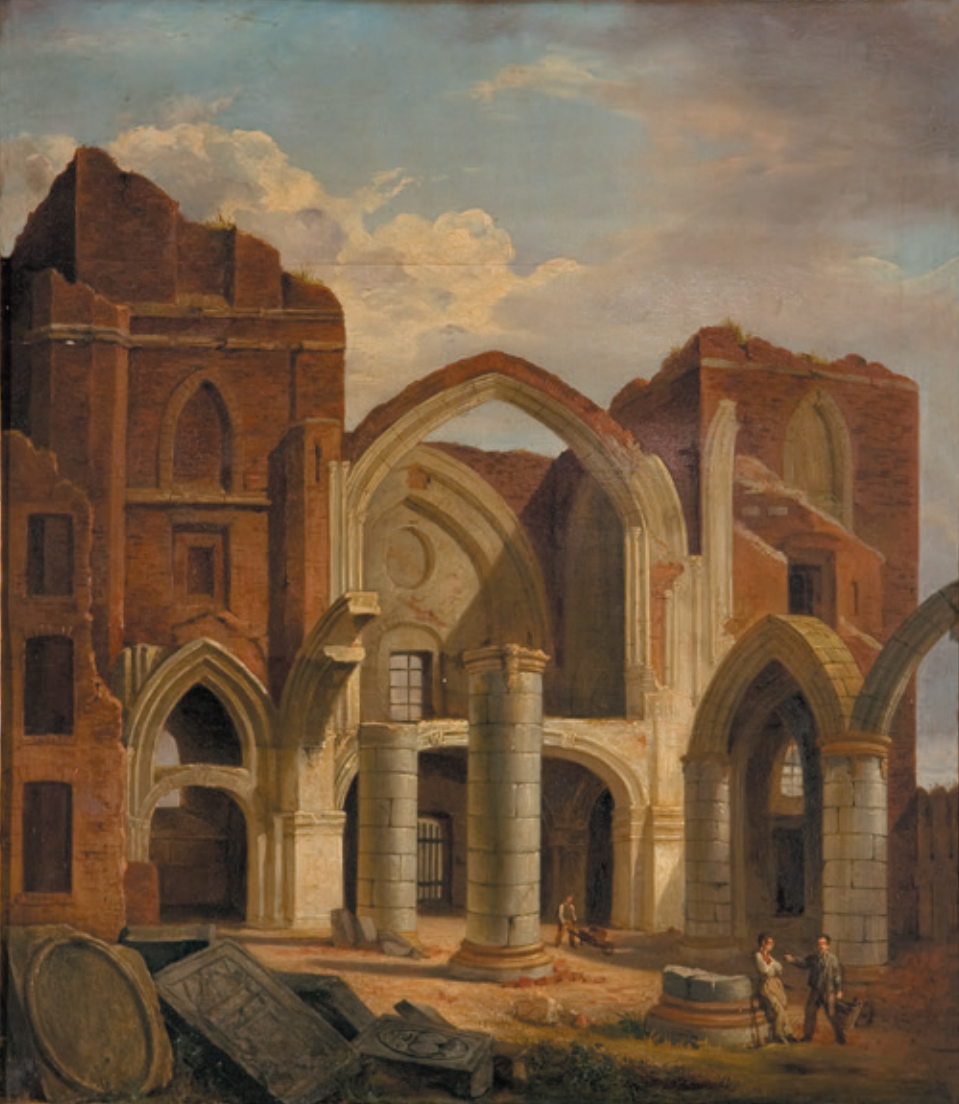
Oil on canvas by Henri Linssen (1805-1869),
probably after 1842, after a watercolour by A. F. van Aefferden (1767-1840).
Historiehuis Roermond.
Photograph: Peter Bors, Beesel
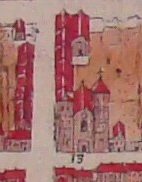
The Holy Ghost chapel (Heilige Geestkerk) stood at the west end of its titular street . As maps show us it occupied no more than half of the length of the block, it cannot have been much more than 30 m long, and probably less (St Christopher is around 60 m long, with a double-aisled nave 32 metres wide). A map showing the damage of the city fire of Roermond in 1665 by the draftsman Herman Jansens shows the best similitude of the church buildings. The Holy Ghost chapel (with its roof coloured red, showing that it was burnt off in the fire) shows a two-towered facade of unequal heights.
This corresponds with a view looking west during its demolition in 1821.48 This shows a typically-columnar Low Countries nave arcade piers leading up to a pair of brick-Gothic towers of differing design, with what looks like a Baroque organ loft inserted in between. While the two towers must have given it some grandeur, this was by far the smallest church building chosen as a cathedral in the Super Universas bull. No doubt it was the convenience of the existing secular chapter and their extant residences around the church that meant the obviously grander church of St Christopher was not initially chosen (the nearby Munsterkerk, with a rich late Romanesque/Early Gothic galleried elevation, was under a Cistercian Abbess until 1798).
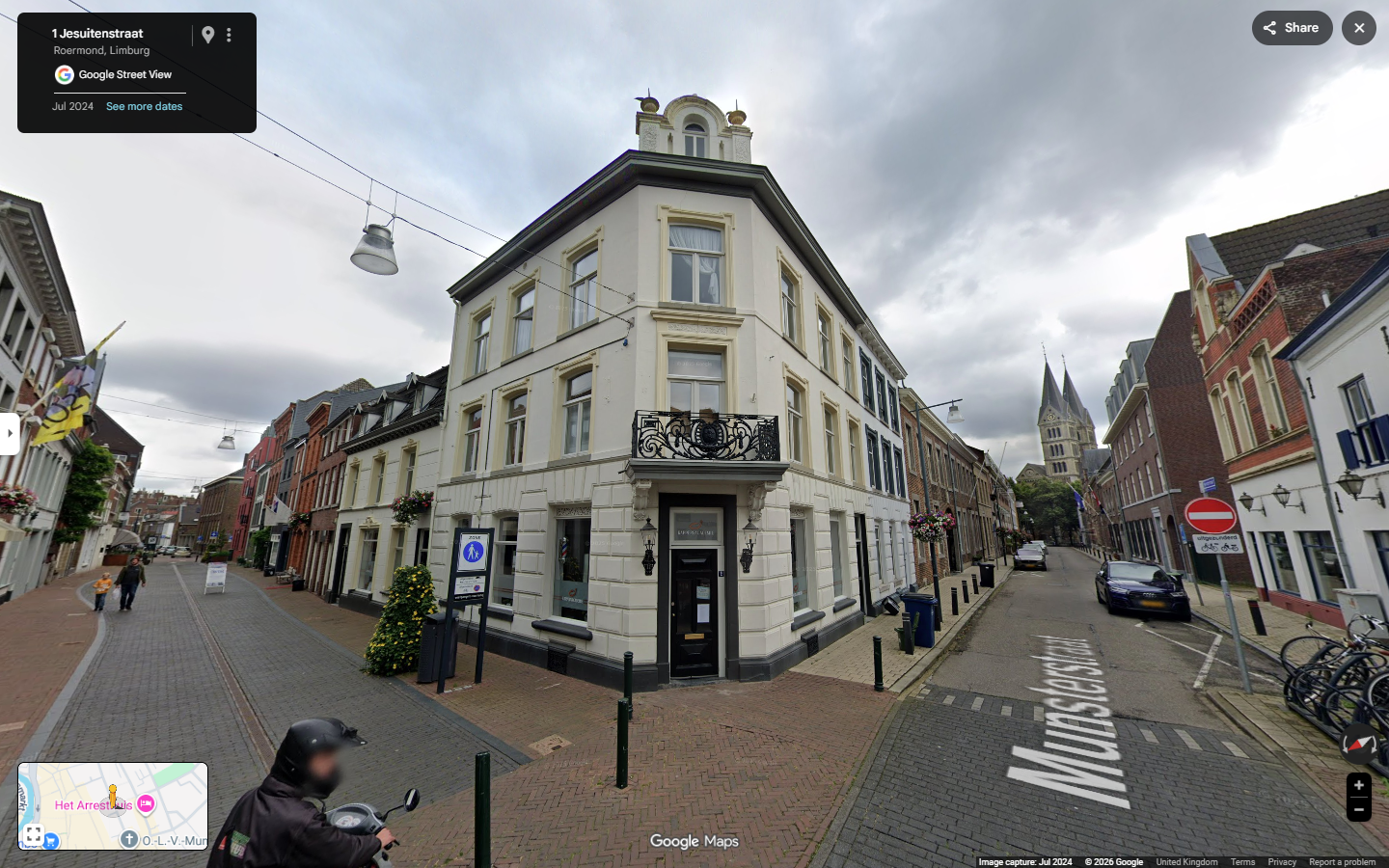
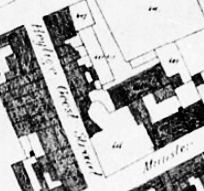
Such is the detail of cadastral maps in the Netherlands under French government, and government-funded digitisation projects to make them available online, the fate of the plot is easy to trace. It is shown as empty in a survey of 1819, with an curiously apse-shaped bulge in the eastern edge of its curtilage (see Right).49 By 1844 it was occupied by the house and yard of Jan Anthoon Jennissen, a merchant.50 The white-stucco’d building that currently stands on the corner was built 1898.51
Utrecht archdiocese
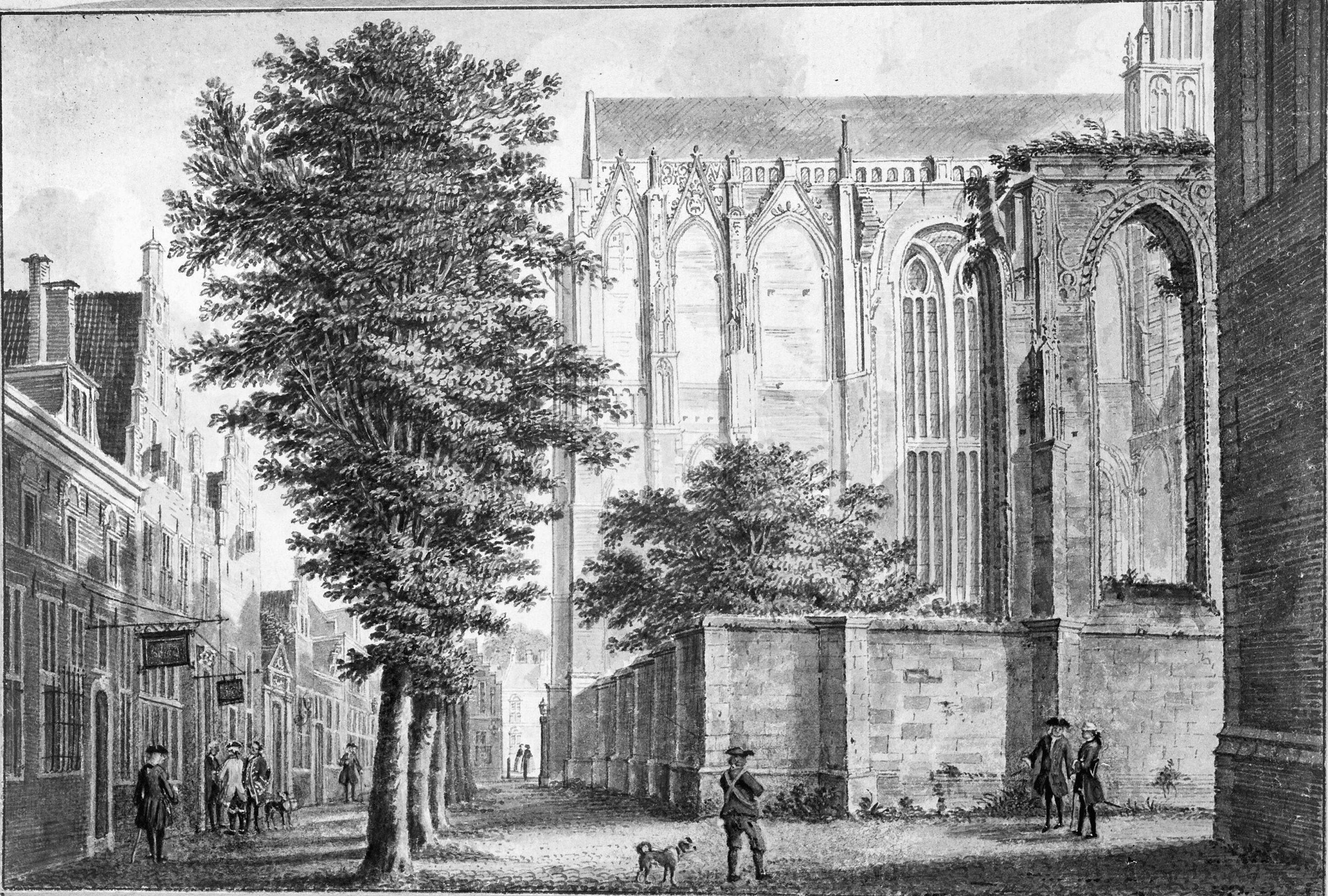
From “Het verheerlykt Nederland of Kabinet van hedendaagsche gezigten“, 1748, etching by Caspar Philips Jacobs after Jan de Beijer.
Previously a suffragan diocese under Cologne, Utrecht, as the only cathedral in what is now the Netherlands before the 1559 bull, was made an archbishopric over eight new suffragan dioceses. The Cathedral had a nave with a prodigious triple aisle on the N side which it lost to a tremendously powerful storm 1 August 1674 (possibly a bow-echo system)52 ultimately marooning its west tower from the crossing when the last vestiges of the outer walls were cleared away in 1826.
Photogrammetry capture of Utrecht Cathedral, comped from two sources, with the plan of the lost nave underneath
Haarlem, St Bavo (Grote Kerk)
Parish church, zeven-getijdencollege first recorded 1452.
Diocese suppressed 1587
(Re-erected 1853 in the 1841 church of St Joseph, before moving to new-built cathedral in 1898. Renamed Haarlem-Amsterdam 2008)
Photogrammetry capture of Grote of Sint-Bavokerk Haarlem
Although St Bavo in Haarlem is sometimes described in the literature as being elevated to a collegiate church at various dates in the fifteenth century, this is mistaken.53 Haarlem was instead part of a phenomenon in Flanders and the northern part of the Low Countries known as zeven-getijdencolleges: colleges of the seven canonical hours.54 In these major town churches, secular bodies established an endowment fund to maintain priests and choirboys to celebrate the Divine Office, without actually setting up a college of canons funded by properties of massively valuable prebendal lands.55 This meant the community could enjoy the prestige of an increase of divine service without establishing a sizeable institution with a degree of autonomy operating under canon (rather than civil) law. Thus an actual chapter had to be established in the church after the Bull of 1559, and the canons were drawn from the collegiate church of Geervliet some 40 miles away in South Holland, and the Austin Canons of Heiloo 15 miles to the north.56 The first bishop of Haarlem was Nicolaas Van Nieuwland, who had been a wijbishop (auxilary bishop) in Utrecht: although he obtained a reputation as wijnbishop (wine bishop).57 He was accused of walking drunk in procession, and being too hungover to attend a pontifical Mass.58 He did have a doctorate in Theology from Leuven though.
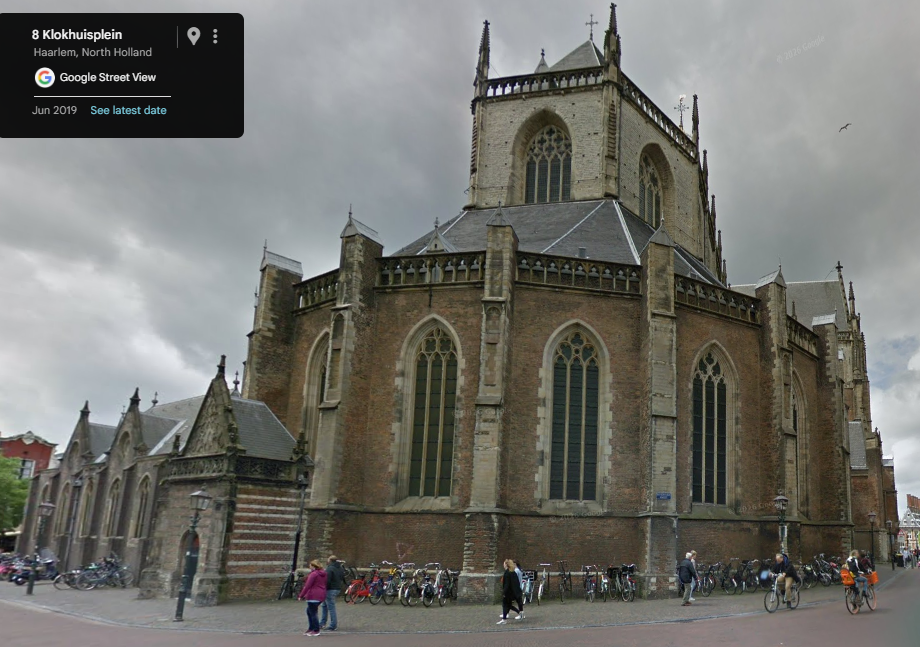
Regardless of its lack of actual collegiate status, Haarlem was one of the largest churches in Holland in 1559. The enormous choir was built in the last quarter of the fourteenth century, with a wide five-sided ambulatory built almost obnoxiously with no radiating chapels but like the Grote Kerk in The Hague and the Oude Kerk in Amsterdam.59 It was almost certainly designed by Engelbrecht van Nijvel (Nivelles, Belgium), stadsmeester of Haarlem, who from 1402 was employed by the count of Holland as master mason in his court at The Hague.60 I really have to say, after going through a lot of Grote Kerken in Holland,61 Haarlem has an extremely strange internal elevation. Above the typical stout Low Countries cylindrical columns with but a roll for a capital, it has a ludicrously tiny triforium. It’s like the usual parapet of a walkway you get in the region, but set into wall, with a massive gap above of completely unarticulated wall space up to the sill of the clerestory, which represents the very high pitch of the roofs over the aisles. I can only assume that the space was meant for a wall painting scheme, decorative fragments of which were discovered in the 1981-5 restoration.62
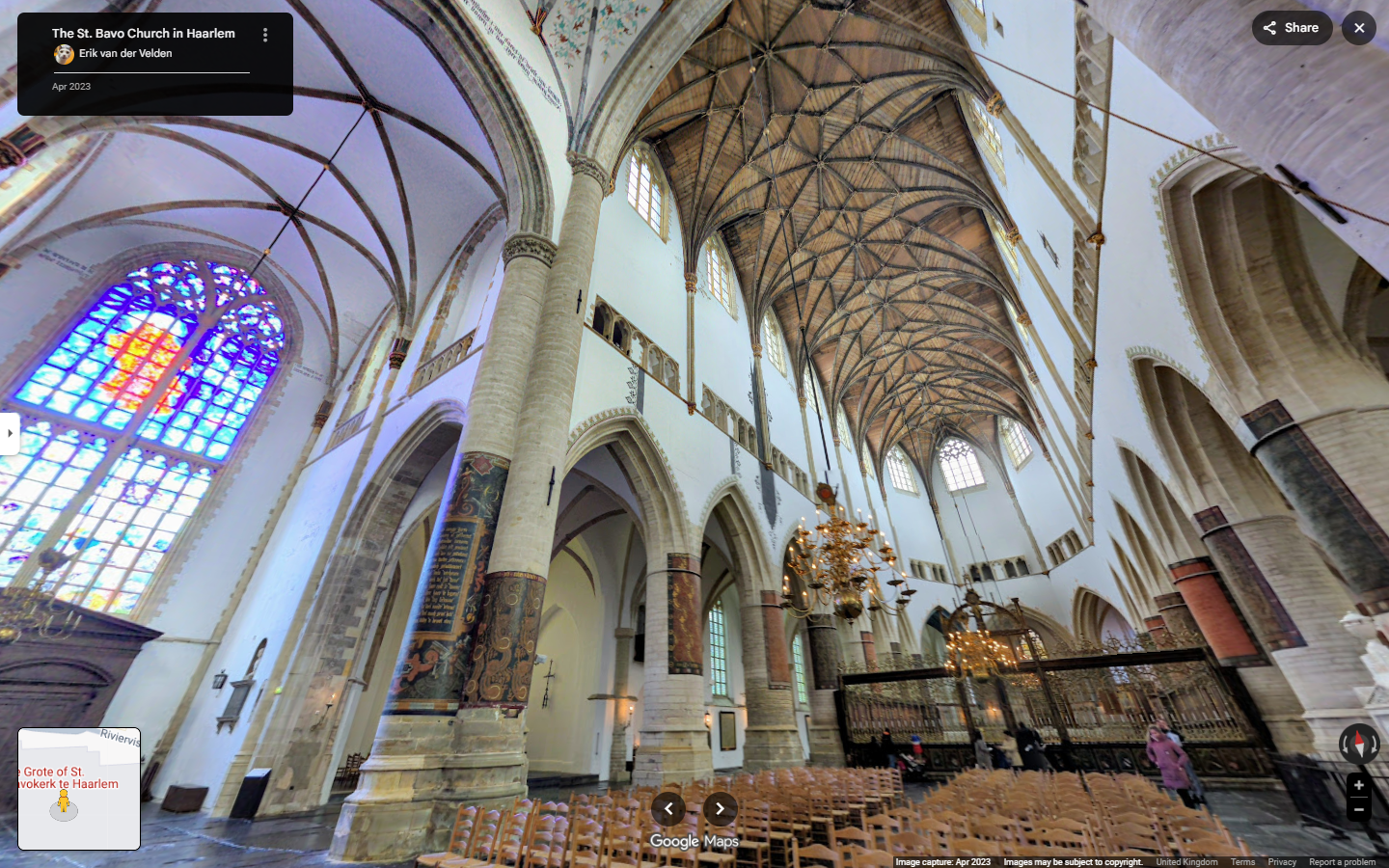
The existing nave of 13th-14th century date was retained until a campaign to replace it begun 1445 under Evert Spoorwater of Antwerp (mason in charge of the nave build at Antwerp, and the collegiate church at Dordrecht) where the north transept, north aisle wall and west facade were built around it.63 Master Spoorwater modified the elevation in line with the typical Dutch type of having an internal balcony rather than the tiny openings to the roofspace passage. In 1470 the work had progressed enough to mean that the lower old church attached to Engelbrecht’s choir could be demolished, and a stone-faced clerestory built on top of the transepts to bring the high parapet in line throughout the building. The church was clearly meant to be masonry vaulted throughout, but only the aisles, crossing and ambulatory were built in the Middle Ages. The high star vaults of the nave and east arm are of timber, installed under the direction of Jacob Symonsz van Edam and Pieter Jansz 1530-8. The transepts received masonry vaults on the intended springers in the restoration of 1891-2.
Deventer, St Lebuinus (Grote Kerk)
Collegiate church founded c.1040
Diocese suppressed 1581
Photogrammetry capture of Grote of Lebuinuskerk, Deventer
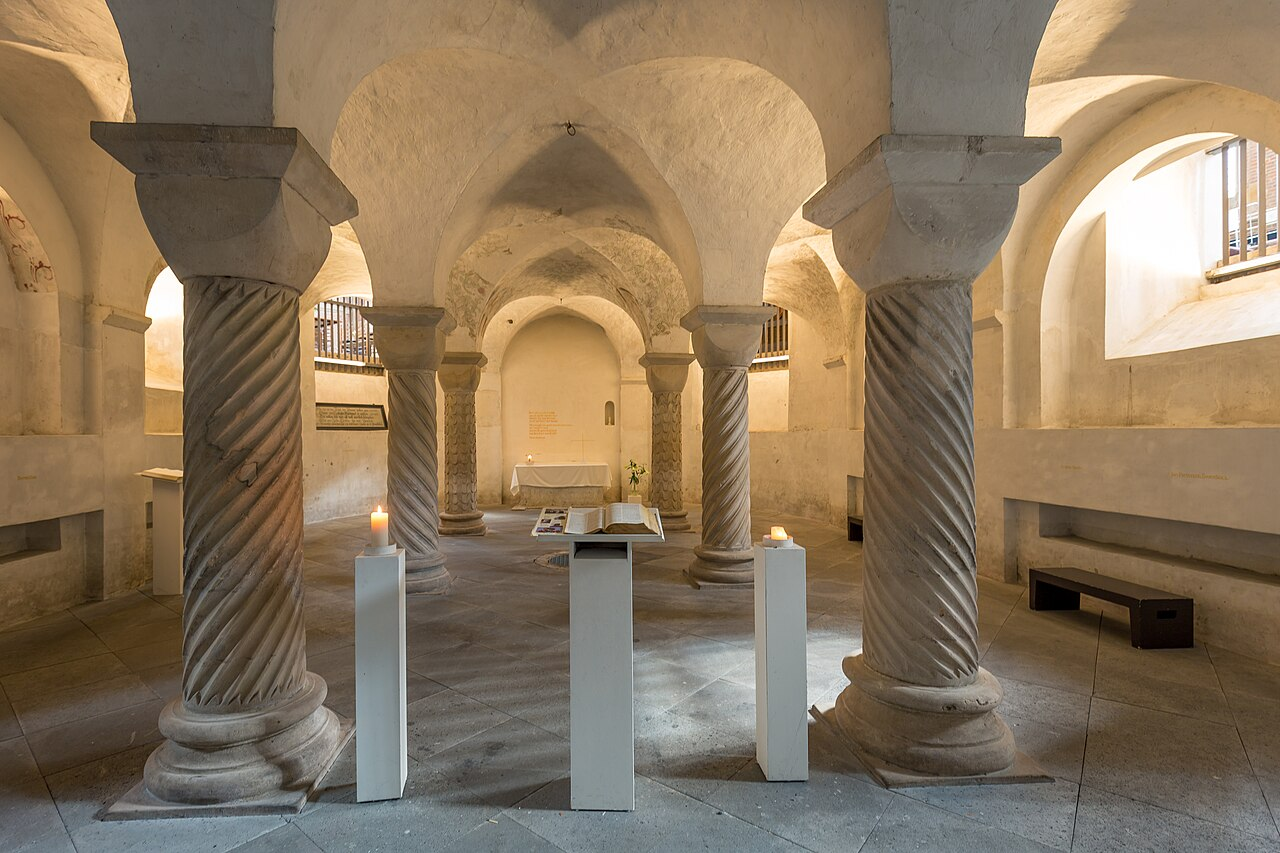
The central bay originally had a splayed window, which was opened and reclosed in the 1990 archaeological works.
Wikicommons: Davidh820. Taken Sept 2017
Deventer is a church with a storied past comparable to Saint-Omer. It had been founded by Lebuinus, a missionary to Germany from the Northumbrian monastery of Ripon, and his burial place around 775. The crypt of the church has spiral and scaled columns, dating from the time of Bernold, Bishop of Utrecht 1027-54 who founded it as a collegiate church. The spiral columns follow the example of the Solomonic Columns flanking the tomb of St Peter in the Vatican Basilica to mark it out as a particularly sacred burial place, and are also seen at St Peter in Utrecht, another project attributed to Bishop Bernold.64
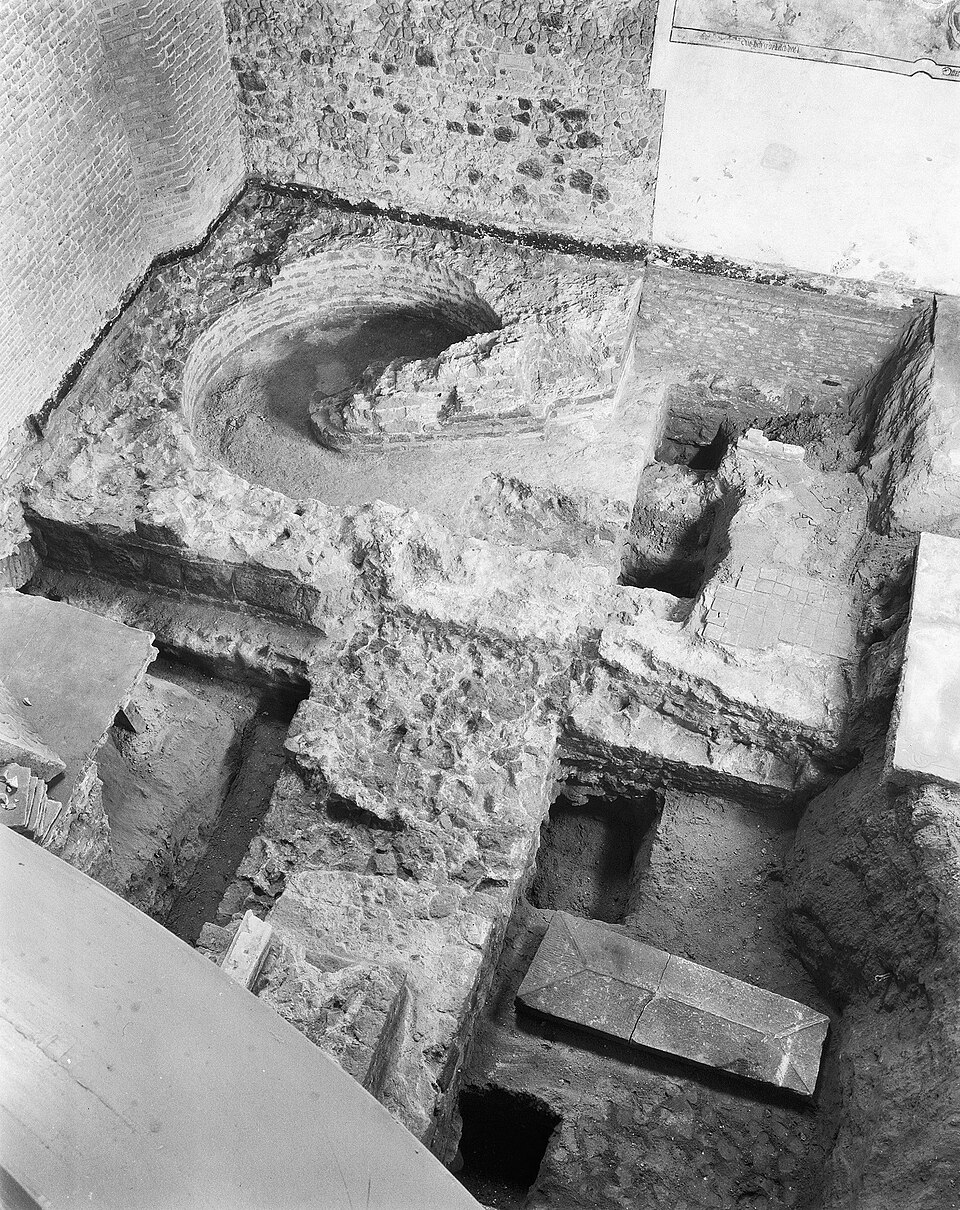
Bernold’s basilica outside the crypt was vast, with a western transept fronted by two towers, and much of it defines the footprint of the Hall Church that largely replaced it in the second half of the 15th century. Contrasting with the volcanic Tuff stone of the 11th century build, the majority of the masonry used for the hall church was brick, with reused Tuff and Bentheim sandstone for dressings.
Left: Footings and newel stair of the Romanesque NW transept tower, now under W end of S aisle, 1961 excavations.
Photographer: G.Th. Delemarre. Rijksdienst voor het Cultureel Erfgoed
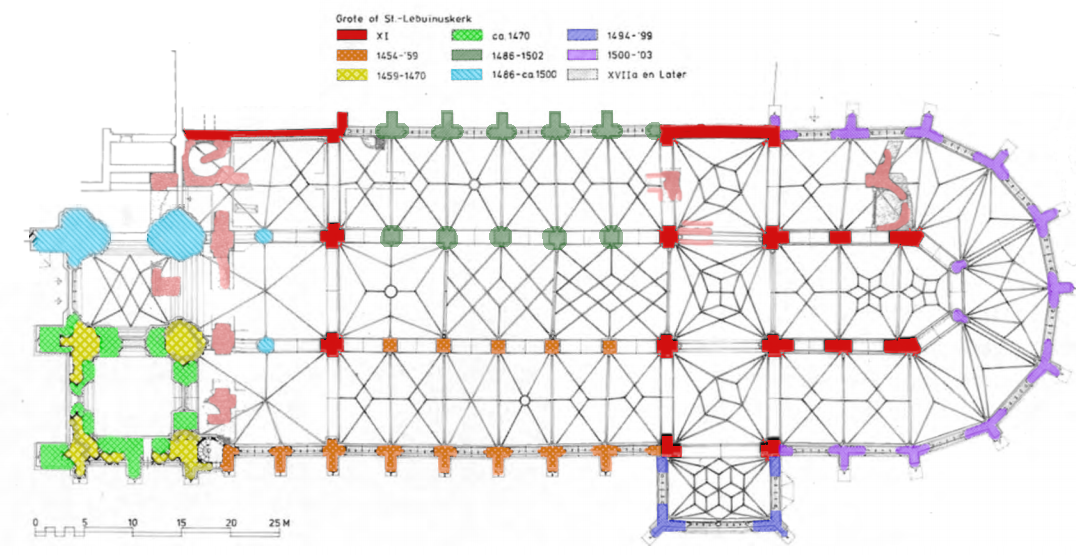
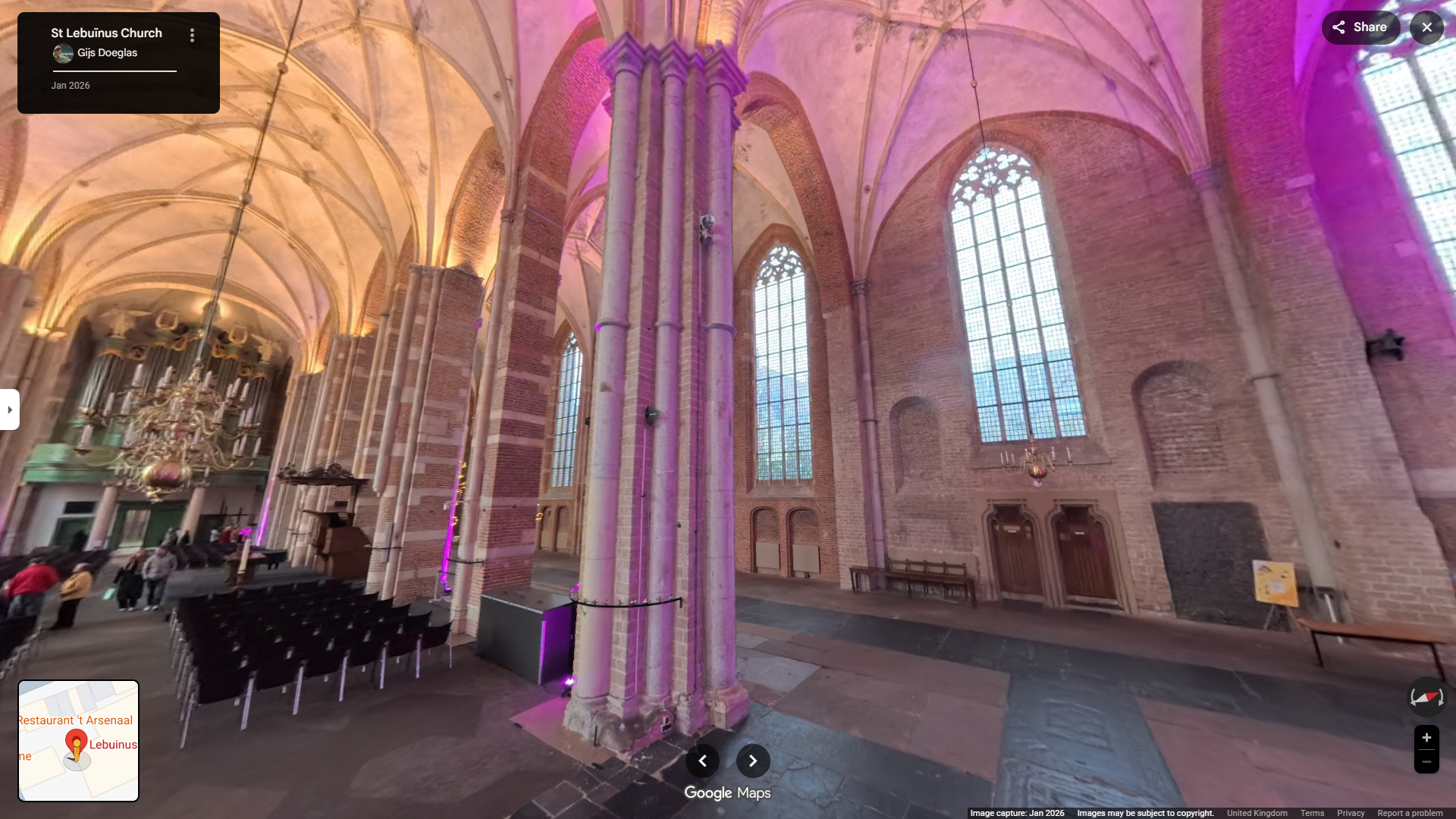
First the high-vaulted south aisle was added, bringing the aisle wall in line with south transept wall, then the north aisle in the same way, the nave covered in net vaulting, and finally the ambulatory almost completely enshrining the remnants of Bernold’s building, with the groin-vaulted crypt at its heart.65 The original basilica’s clerestory windows remain above the level of the high vaults and can be seen from the roofspace.66
Like so many Low Countries churches, the plan for a west front with two spires fizzled out. The south tower never received its intended superstructure above the belfry, being crowned with a small but effective red-brick octagon with domical roof in 1613. A start was made on a north tower, but the Mariakerk, a parish church whose south aisle directly abutted the Romanesque westwerk forbid much progress.67
Groningen, St Martin (Martinikerk)
Parish church
Diocese suppressed 1580.
(Re-erected 1956 in the Roman Catholic church of St Martin built in 1895, transferred to the Roman Catholic church of St Joseph built 1887 in 1981 due to the former’s impending demolition, which was carried out in 1982.68)
Photogrammetry capture of St Martin, Groningen
The church is distinctive for having a three-storied choir that is markedly higher than the nave it immediately adjoins (like Augsburg Cathedral, or, the Grote/Sint-Jacobskerk of The Hague, nave 1434-55, high choir c.1492) which would make it ideal for a collegiate chapter to have a defined space. Yet seems to have been a distinct choice rather than accident of funding, as these seem to have been two consecutive builds across the first half of the fifteenth century, and there was a decision to make the thirteenth-century Romanesque nave into a wide hall church rather than match the height of the east arm. As this church was not collegiate, the Premonstratensian Abbey of Bloemhof north-east of Groningen was suppressed to provide a secular chapter – the few monks there becoming canons and the abbot archdeacon.69
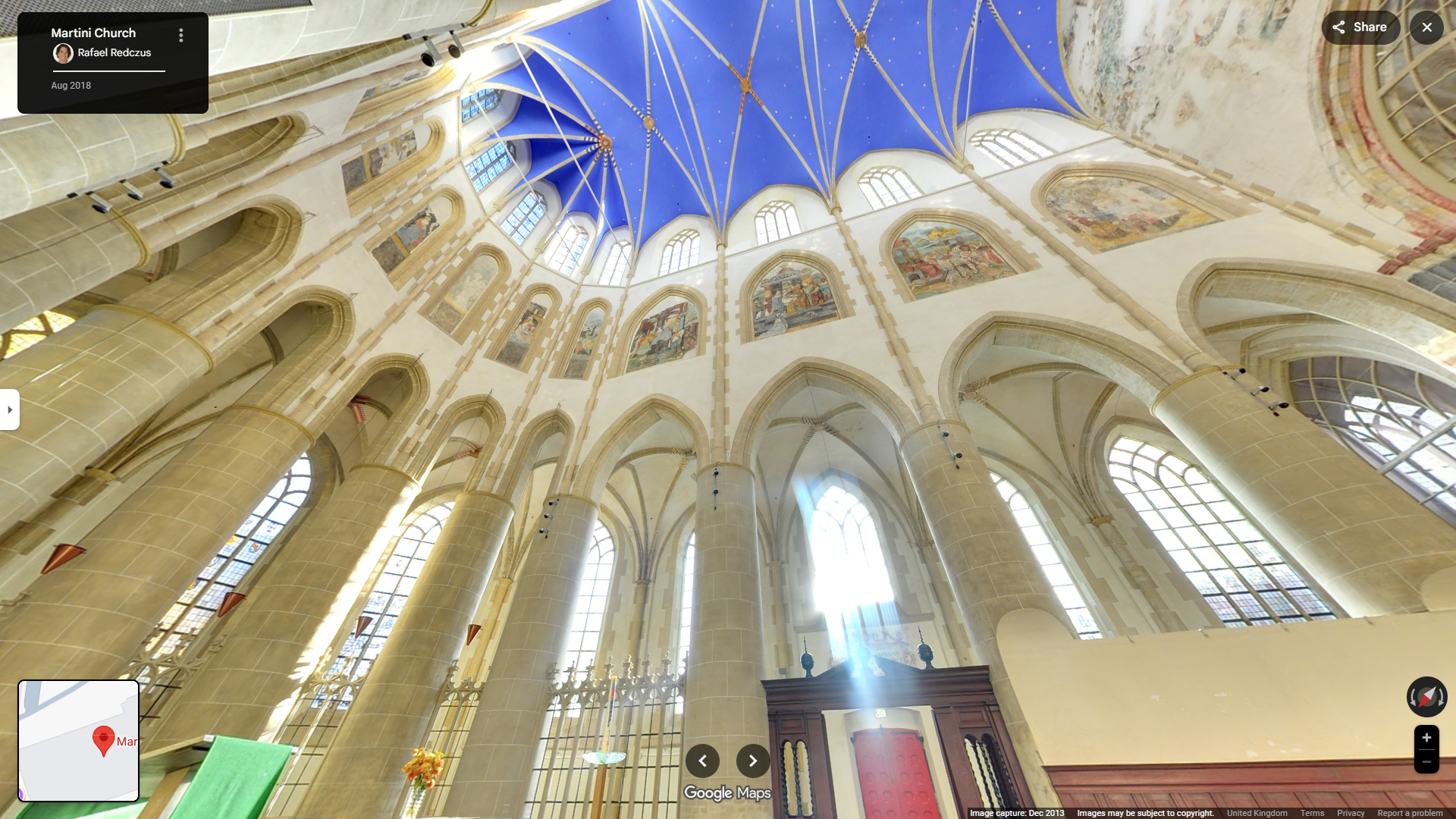
The east arm, built in the first quarter of the fifteenth century, has an extremely plain elevation with stout columns in the traditional Low Countries Gothic manner with a now-blocked second-storey false-gallery openings with moulded arches, and a small clerestory on top. The ambulatory is just vaults to an outer wall under a lean-to roofspace: like Deventer and Haarlem it has no chapels whatsoever. The second storey was bricked-up at some point toward the middle of the sixteenth century,70 and in them scenes from the New Testament painted a secco on plaster: they were only discovered in 1923.71 The ensemble was an extraordinary commission for their time, and draw on wide sources across German and Italian prints.72
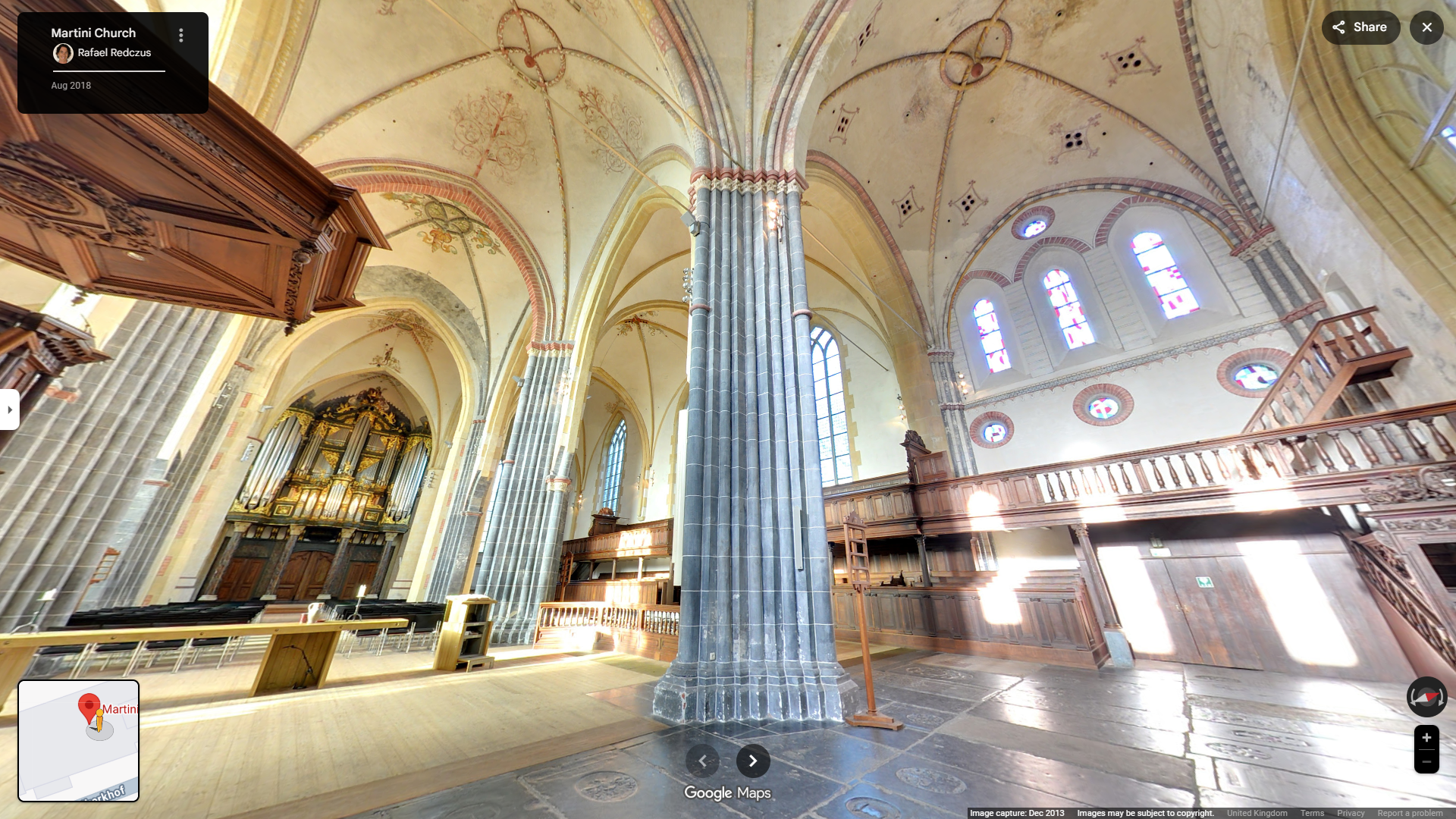
The nave retains the transept walls and domical high vaults of the crossing and two further bays of the thirteenth-century Romanesque basilica, but with the elevations smashed through to create a hall-church. After the west tower collapsed in 1468, and then the nave was extended by two bays, with a pair of stout Low-Countries columns bridging the gap between the remaining fabric and the west wall.
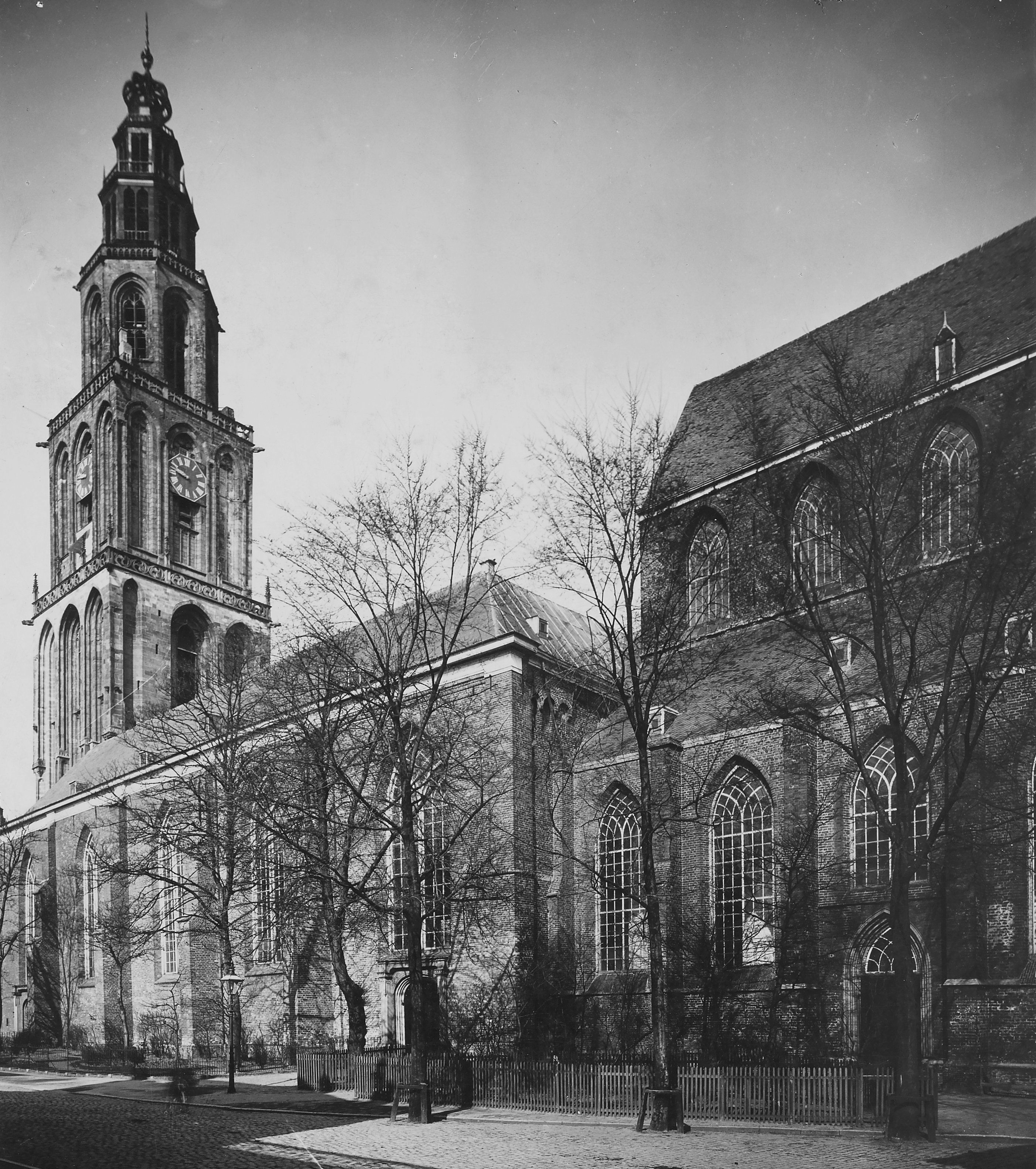
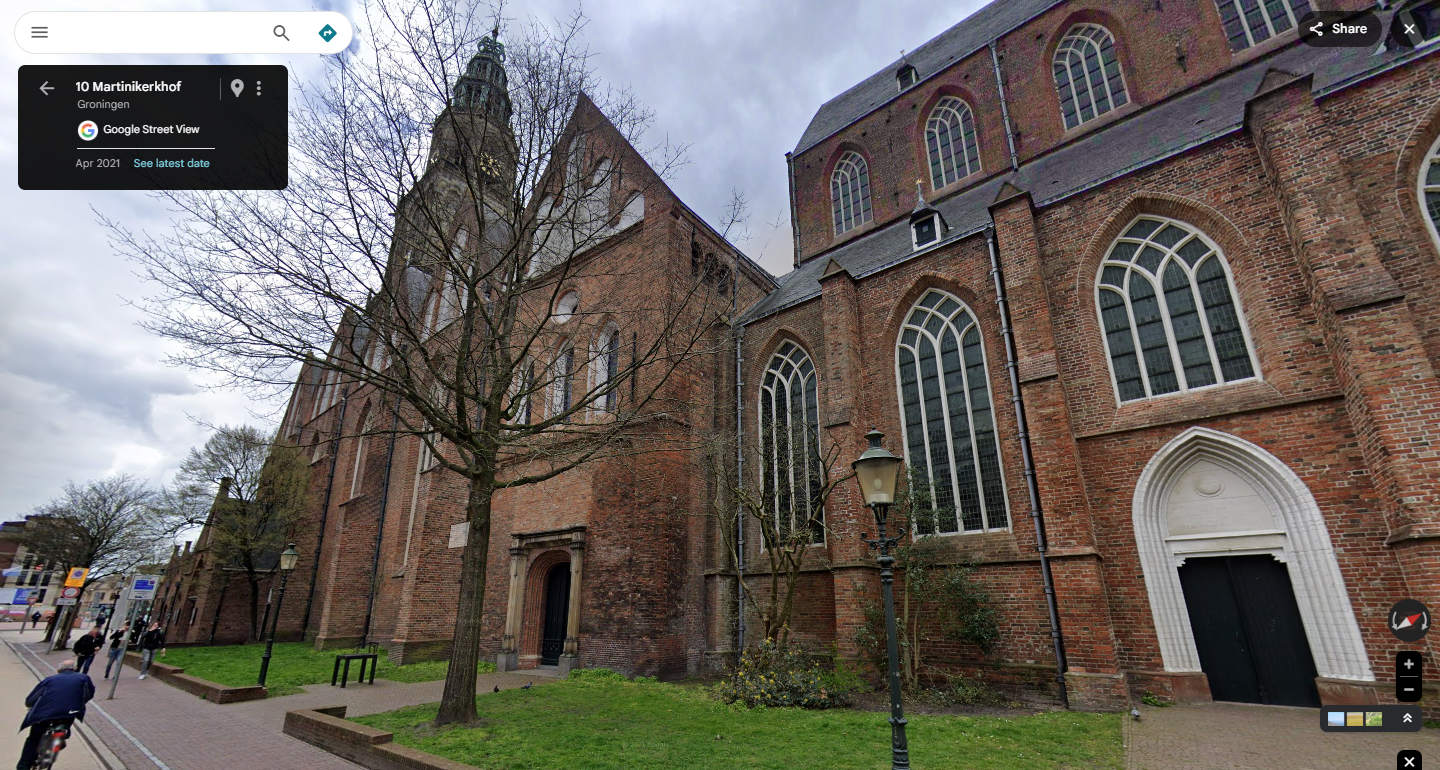
The landmark Martinitoren was completed by 1481, is of three square stages topped with a small octagon carrying a spire: a very squashed and reduced emulation of Utrecht Cathedral. It is also called d’Olle Grieze (the old grey one) as it is, unlike the rest of the church and indeed much of Groningen, dressed in sandstone rather than of brick. It was dangerously erring further out of plumb and was rescued from 1936-48 by excavating its cracking foundations and encasing them in a reinforced concrete collar. A drastic restoration from 1962-75 reinstated the transverse gables of the hall nave that had been removed in 1688, replaced the cast iron tracery with imitations in stone and inserted Romanesque-style fenestration into the original thirteenth-century transept walls, as you can see below. Although notice the three original apertures with corbelled arches in the east transept wall.
Leeuwarden, St Vitus (Oldehove)
Parish church, zeven-getijdencollege recorded 1534
Diocese suppressed 1580. Church demolished 1595.
Photogrammetry capture of the Oldehovetoren, over archaeology of the demolished church of St Vitus it was meant to adjoin
Again, as the church was not collegiate,73 a chapter was to be provided from Mariëngaarde Premonstratensian Abbey a little under seven miles to the north, the abbot serving as dean.74 The first bishop was Remi Drieux, a professor of civil law at Leuven and member of Great Council of Mechelen. He never took possession of the see, and was translated to Bruges in 1569. His successor Cuneris Petri did take up residence and attempted to enforce the Council of Trent via visitations, but met with strong resistance from Calvinists, and ended in 1578 up being held prisoner by the Stadtholder of Friesland and Groningen George, Count of Renneberg at Harlingen on the coast 15 miles west as part of his last efforts to placate the rebels.75 He died in Cologne in 1580 and it subsequently the diocese of Leeuwarden was suppressed.
Whatever the short-lived Leeuwarden Cathedral consisted of was largely demolished, after the Protestant triumph freed up the more centrally-placed Dominican Church as the new Grote Kerk of the town. All that survives today of the church is its unfinished west tower, named Oldehove after the neighbourhood defined the artificial turf mound, or terpdorp, first built around the first century AD. However, excavations in 1968-9 revealed the development of the building. The church of St Vitus is first documented in 1148, and that era is represented by a 40-metre long Romanesque plan of an unaisled building with a long apsed east arm and transepts with apsidal chapels expanded, first with a westwerk and then a larger choir around the transepts. These were completely superseded by an aisled church with ambulatory in the fifteenth century. The earliest view of 1533 shows a seemingly under-construction nave connected to an ambulatoried choir, while Braun and Hogenberg’s map of 1580 shows the nave attached to a higher choir.76 Johan Sem’s map just over two decades later shows only the outer walls standing, as the interior of the church continues as a graveyard.
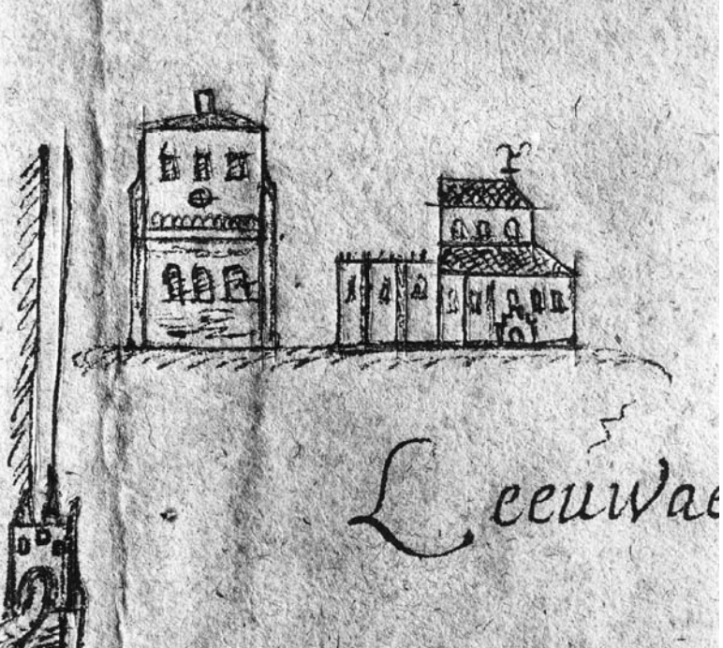
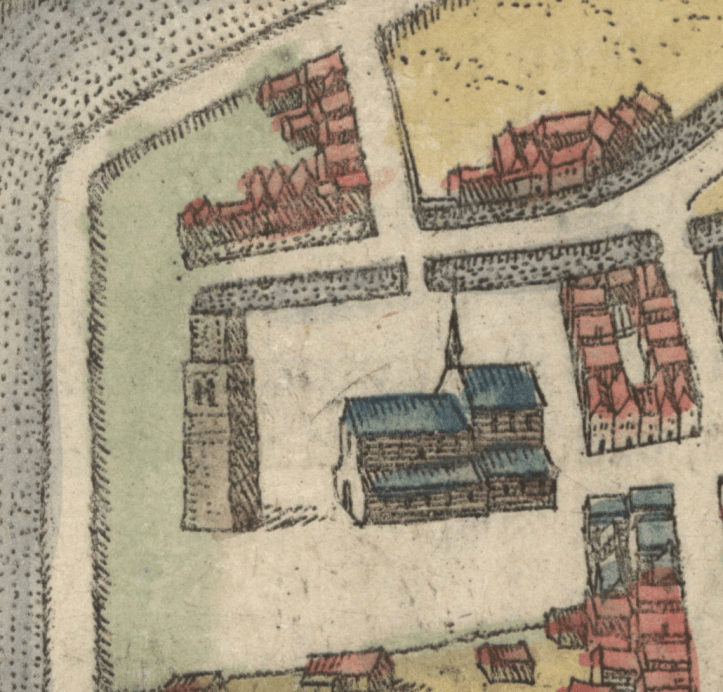
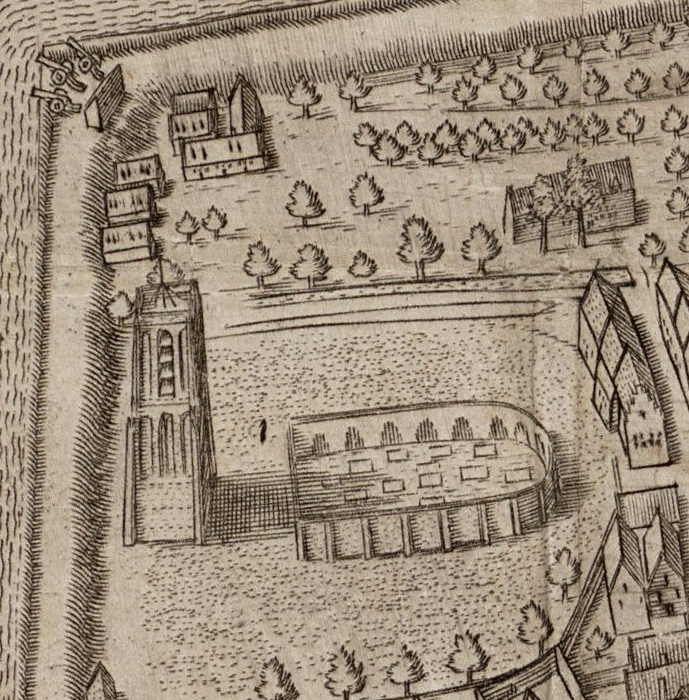
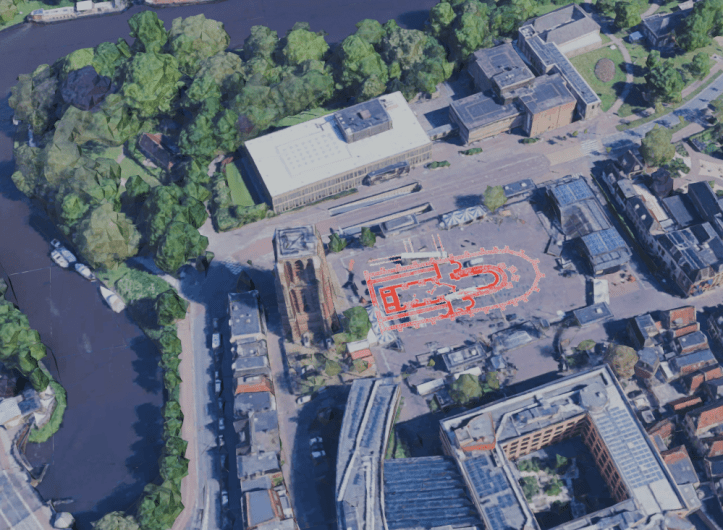
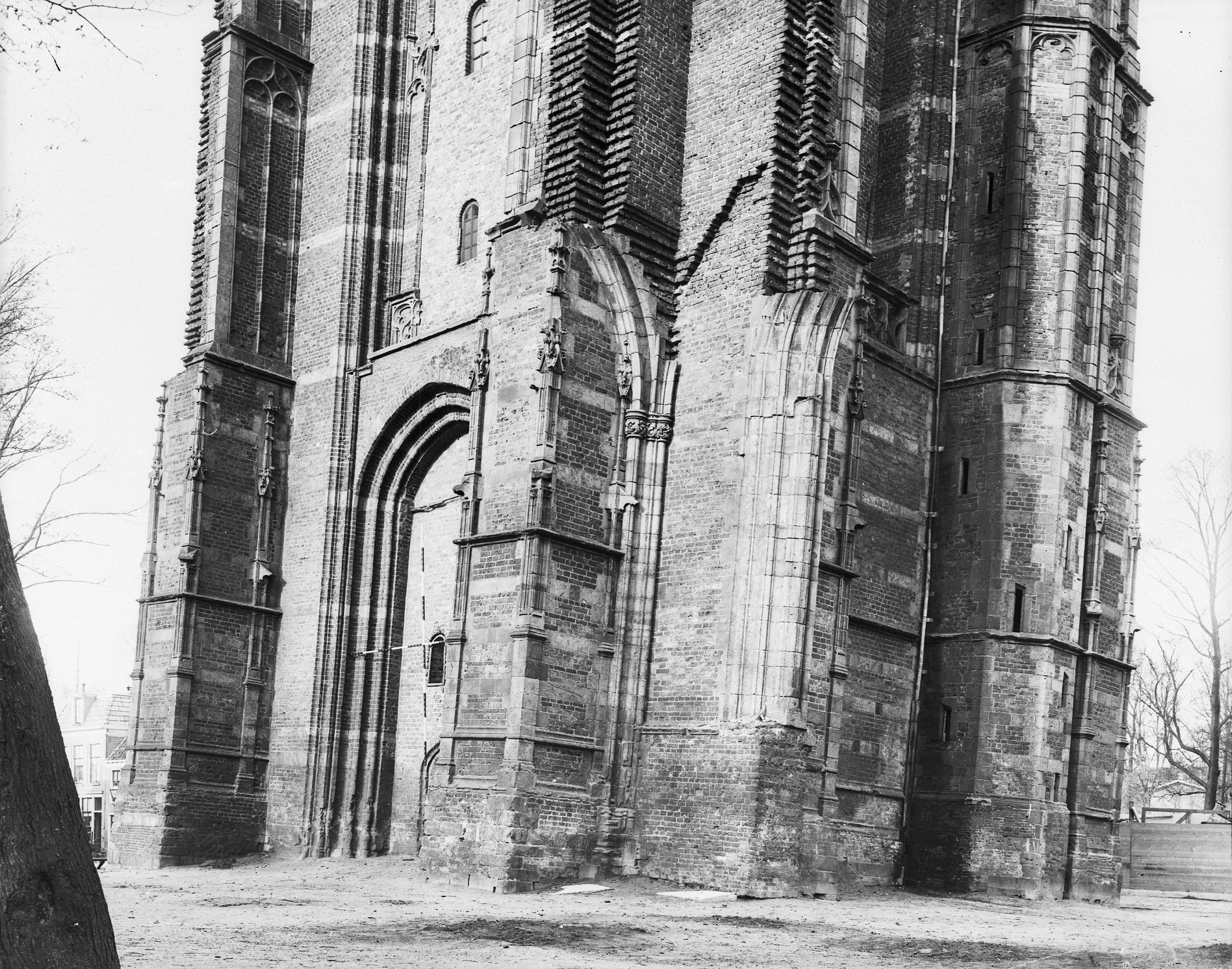
Photograph taken by P. Kramer, dated 1 June 1907, before the first major restoration.
Rijksdienst voor het Cultureel Erfgoed: [1] [2]
The tower resulted from the new confidence as the confirmation of the town as capital of Friesland in 1504. The build is documented as taking place under the master masons Jacob van Aken (Aachen, Germany) from 1529. Subsidence – essentially because the masons didn’t realise they were building on the edge of an artificial mound – was initially attempted to be corrected by building the upper storey at an angle (like the belfry stage of the campanile of Pisa Cathedral). The tower was clearly intended to join the church (there is toothed masonry on the east side, as well as west window jambs and capitals with springers for aisle vaults) but it ended up so hopelessly out of plumb the project was abandoned in 1532 to become a free-standing tower. With the demolition of the church in 1595-6, many of the openings were bricked up with demolition material to help shore it up. It seems from early maps that part of the Gothic church walls survived enclosing a graveyard, but they had gone by 1706. The Oldehovetoren has gone through many restorations to stabilise its structure – including iron ties, concreting the foundations and reconstructing the masonry. In the twentieth century there was major interventions in 1910-3,77 1972-4 and 1997. In the slideshow below you can compare how much has changed – major masonry replacement (note the arches), changes to the fenestration in blocked aperatures, and new placement of pattresses (wall tie plates).
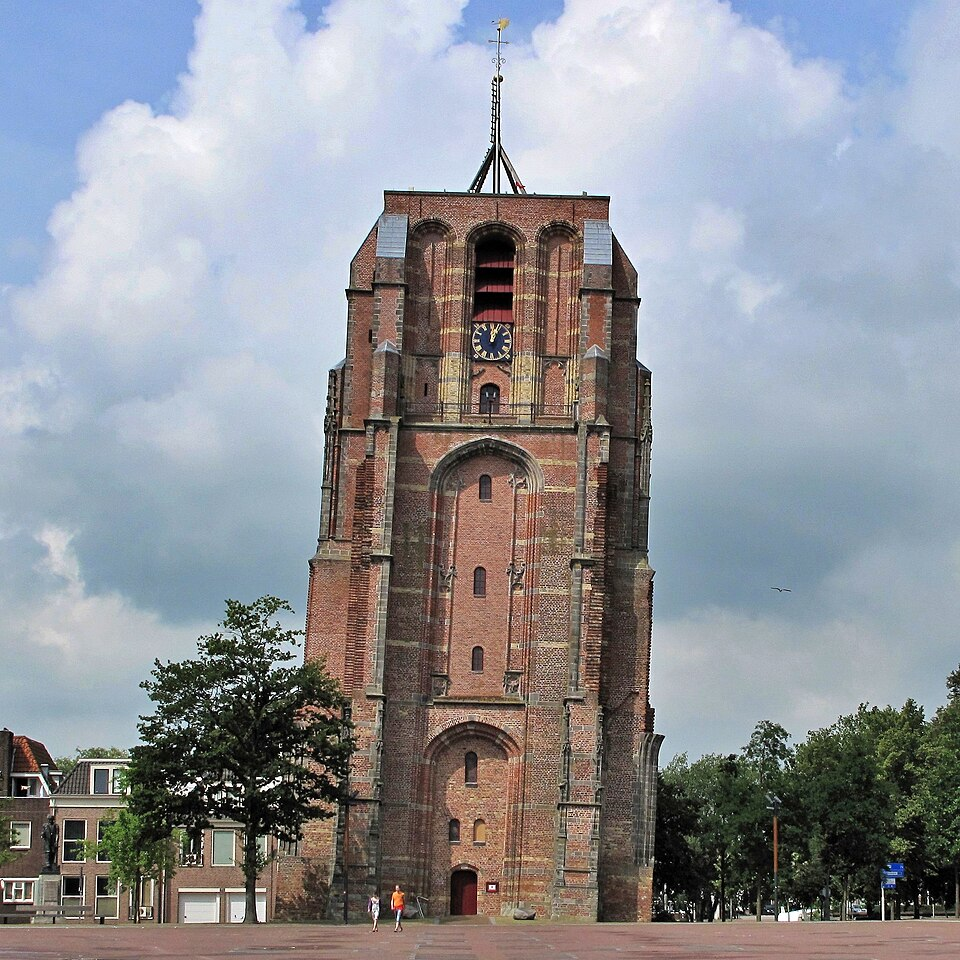
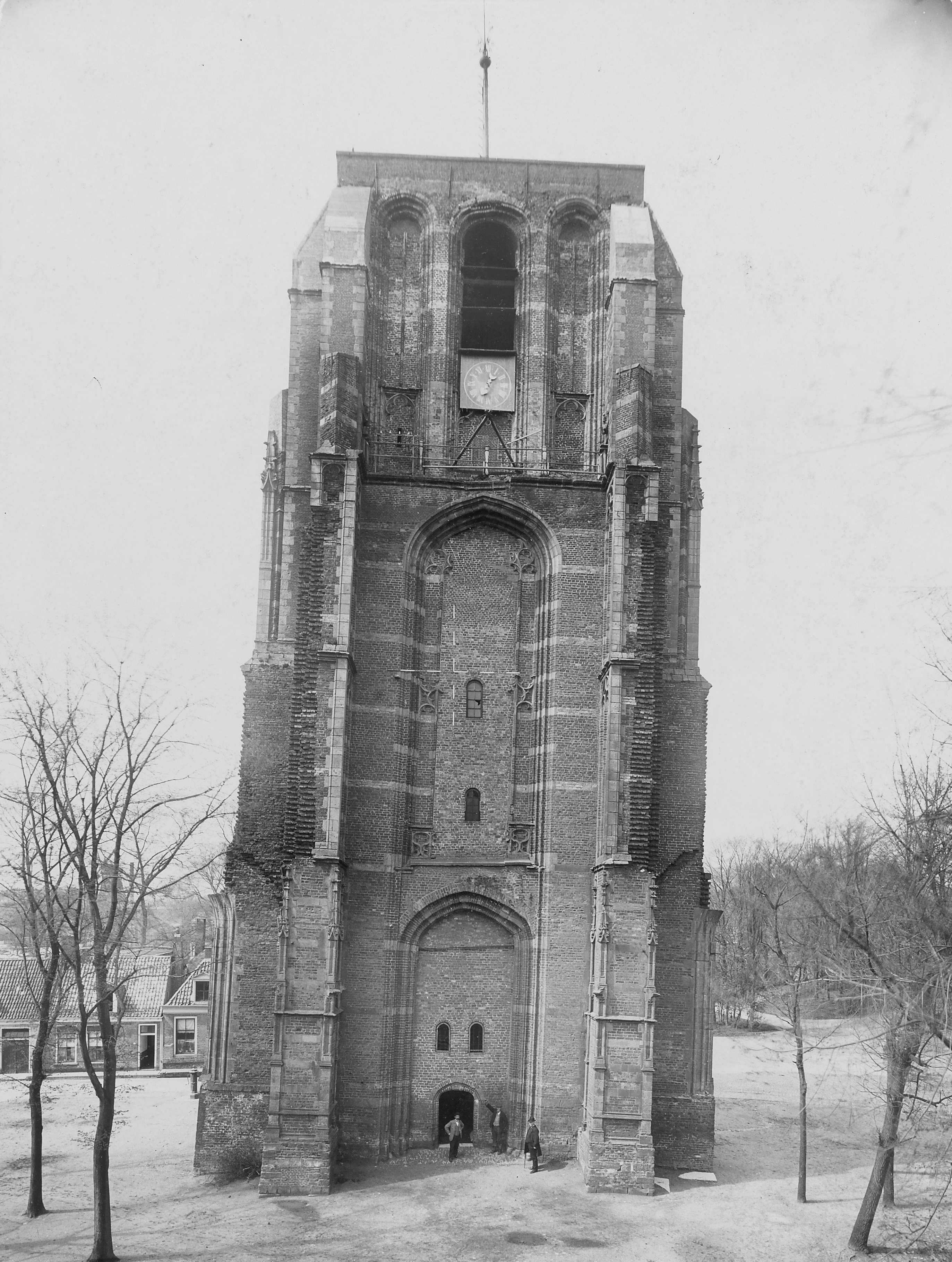
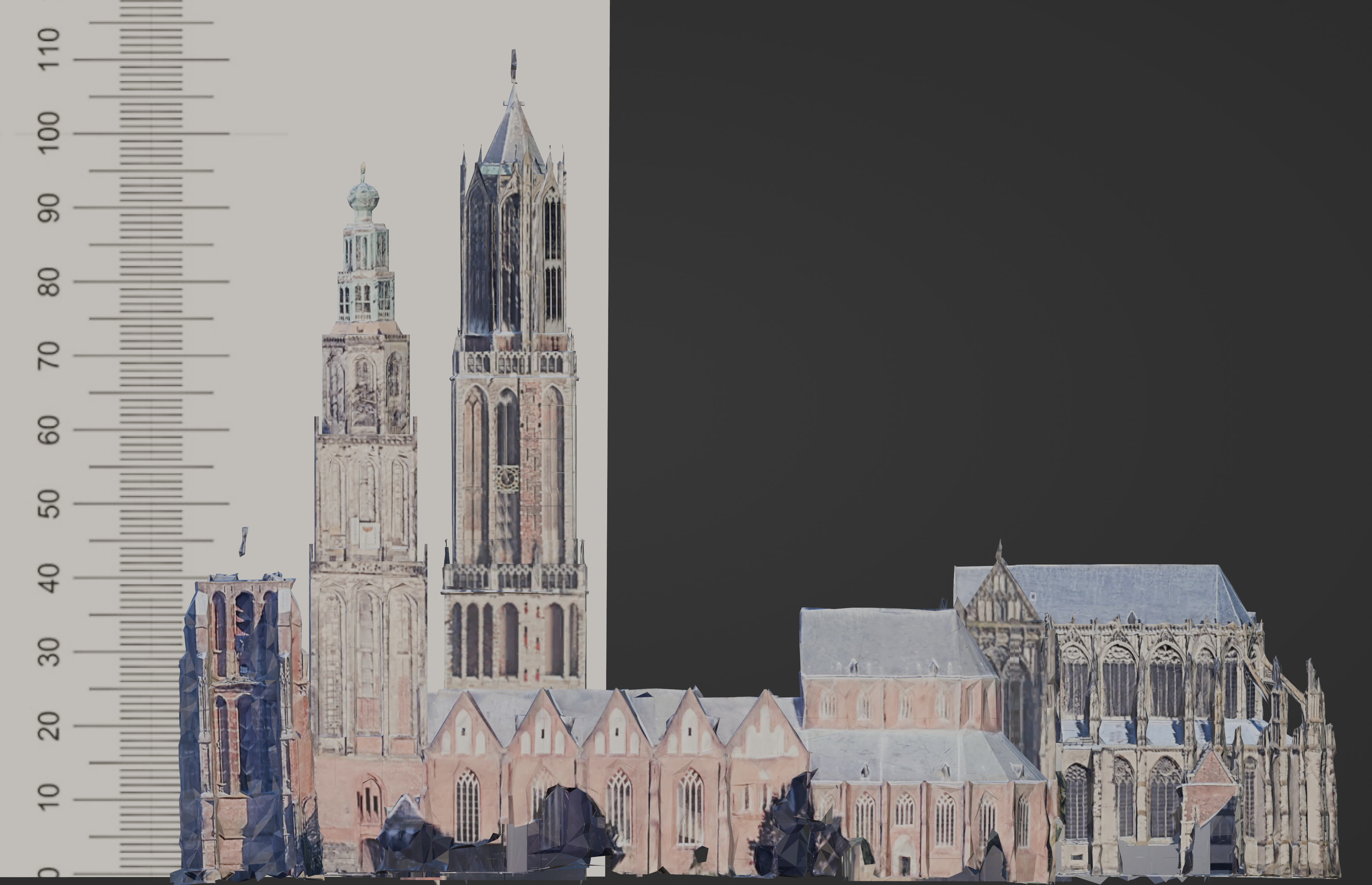
Many myths persist about the Oldehovetoren. Aside from the ever-present Dutch legend that it was built on salted ox-hides,78 there is a tendency to exaggerate its intended height: either that it was meant to surpass that of Groningen, or even its diocesan church at Utrecht. A simple comparison of the dimensions show the latter is an utter impossibility, and it was never intended to be on the scale of the prodigy Brabant towers like Antwerp and Mechelen. Like a certain campanile in the Italian states again, the wonkiness of Oldehovetoren has somewhat eclipsed its design, which with its careful use of brick, yellow sandstone banding and dark sandstone dressings is arguably more aesthetically accomplished than the Martinitoren over at Groningen.
It clearly wasn’t meant to be excessively high, but was the start of clearly a very fancy building campaign that sadly ended up in the trash for not just for the excessive settlement but for a multitude of reasons (a bit like the religious reorganisation of the Spanish Netherlands, eh?!?).
Middelburg, St Peter (Noordmonsterkerk)
Parish church elevated to collegiate in 1311
Diocese suppressed 1603. Church demolished 1833-4
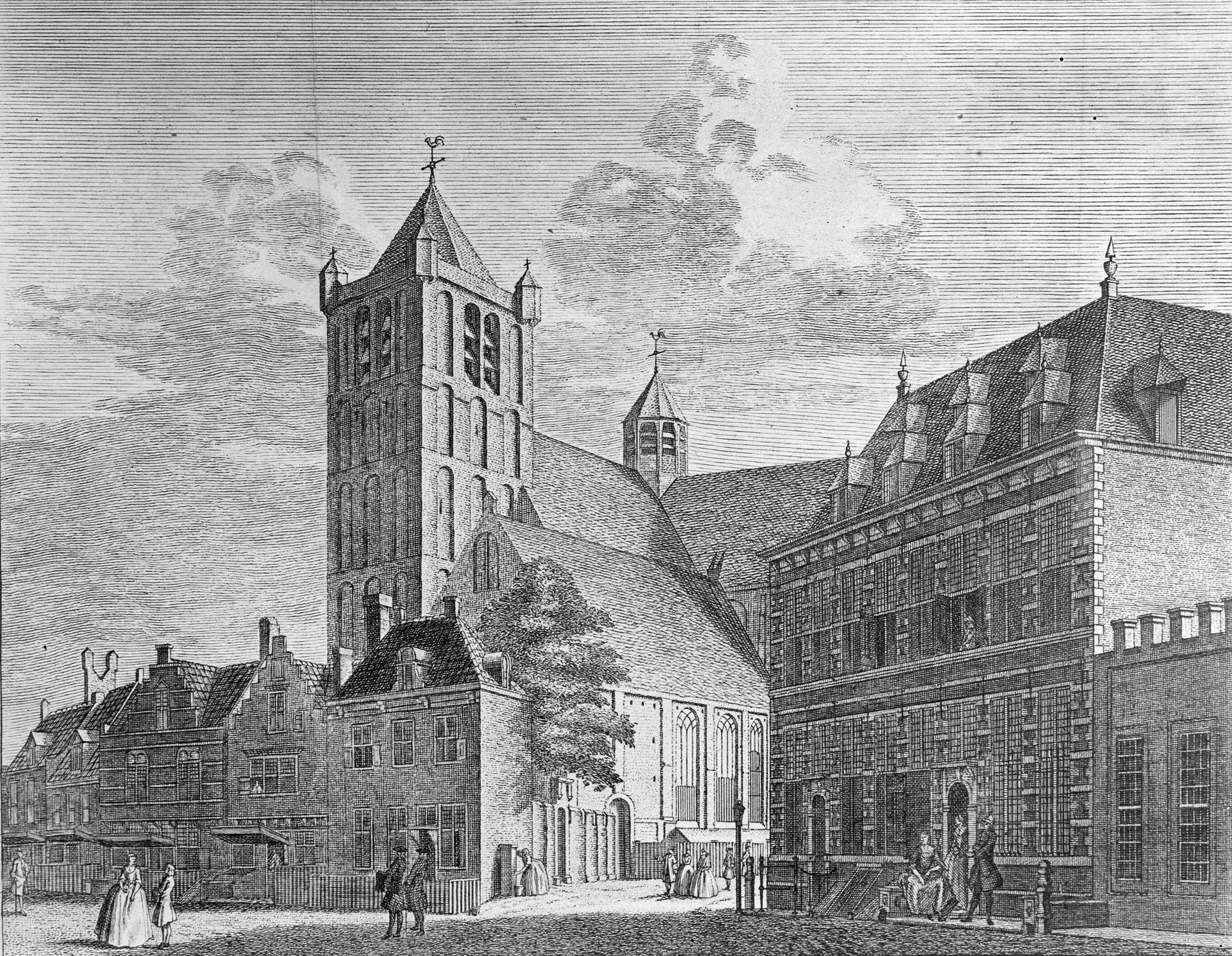
Drawn by Cornelis Pronk 1743, engraved by Jan Caspar Philips, published by Issak Tirion.
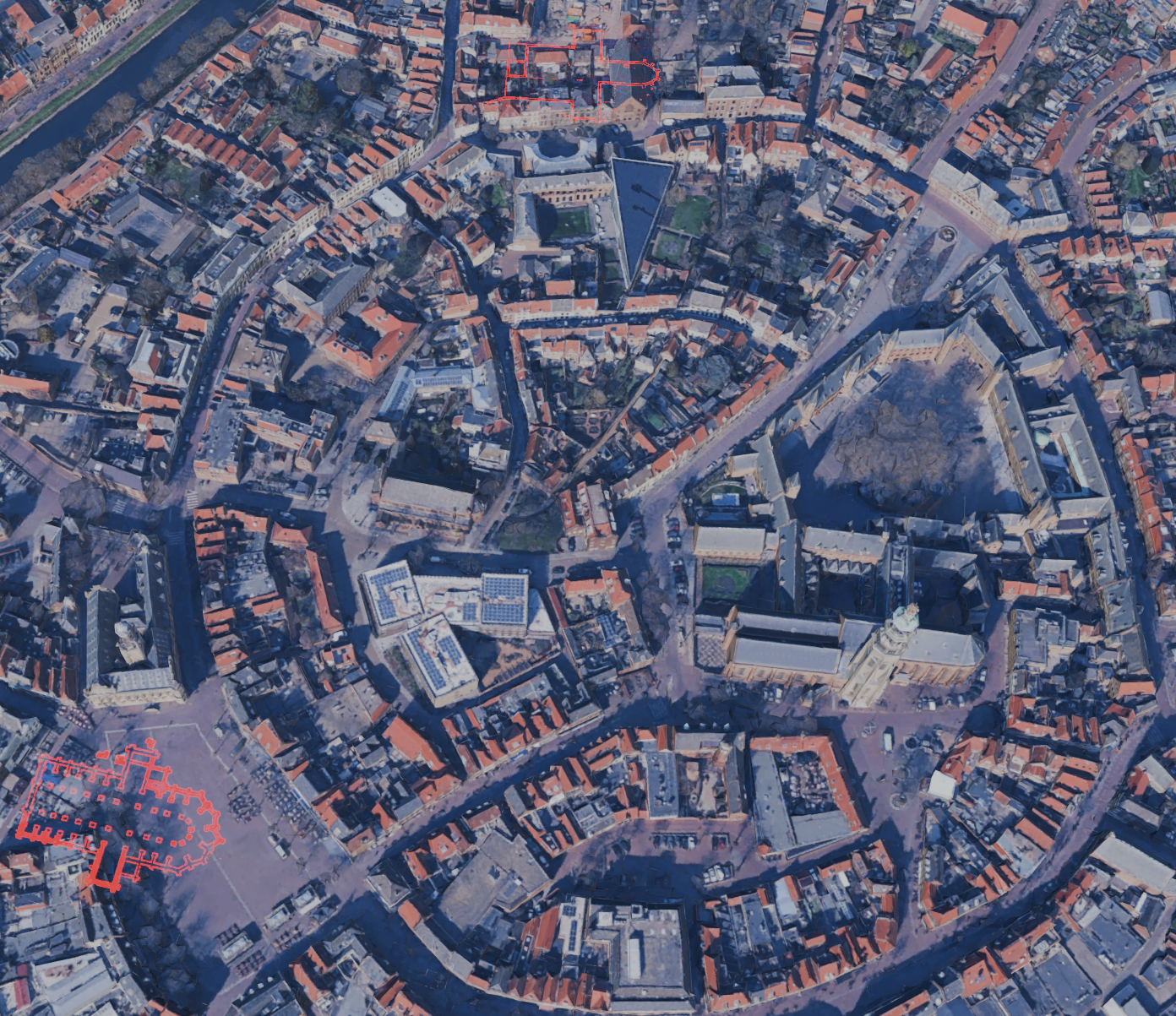
To conclude with, another odd consisting of not one, but two collegiate parish churches that have been totally demolished: and it was actually the smaller one that was the cathedral. The first parochial church was the Westmonsterkerk dedicated to St Peter, which was located where the grote markt is now. The open site means it has been excavated and we can see it was ultimately a large building – 68 m long in all – with an ambulatory with radiating chapels, projecting transepts, and a nave with outer chapels.79 It was raised to collegiate in 1479 with twelve canons by Mary, Duchess of Burgundy and her husband, Emperor Maximillian I. It suffered from violent storms including one at the beginning of 1559, perhaps why it was passed over as cathedral of the capital of the county (now province) of Zeeland. In 1575, following the town’s capture from the Spanish, the city government decided to sell the Westmonsterkerk for materials. Mason Pieter Pietersz paid £1,800, with the organs, pulpit, pews and bells sold separately, and in 1577 two pavers from Ghent were contracted for £107, 19 s. to pave the new market square, with £1, 13 s., 10 d. paid for completion the following year.80
The church which did become a cathedral after 1559 was the Noordmonsterkerk dedicated to St Peter, which in its final form was slightly smaller, at around 66 m in length, and lacking an ambulatory. It had been a former chapel held by the Counts of Zeeland, and raised to collegiate in 1311 by William I, Count of Hainaut.81 The Abbot of the Premonstratensian Abbey in centre of Middelburg was appointed the first bishop, however he died in 1573, during the siege by the Geuzen army which eventually led to the end of Catholicism in the town in February 1574 with the departure of the Spanish garrison and the Catholic clergy. The Catholic Church kept appointing bishops until the translation of Bishop Karel-Filips de Rodoan to Bruges in 1603,82 when the diocese was suppressed. The Augustinian Abbey in the centre of Middelburg, the nave of which had served parochially in the later Middle Ages to the town as the Nieuwe Kerk, became sufficient for the population after the canons were ejected.
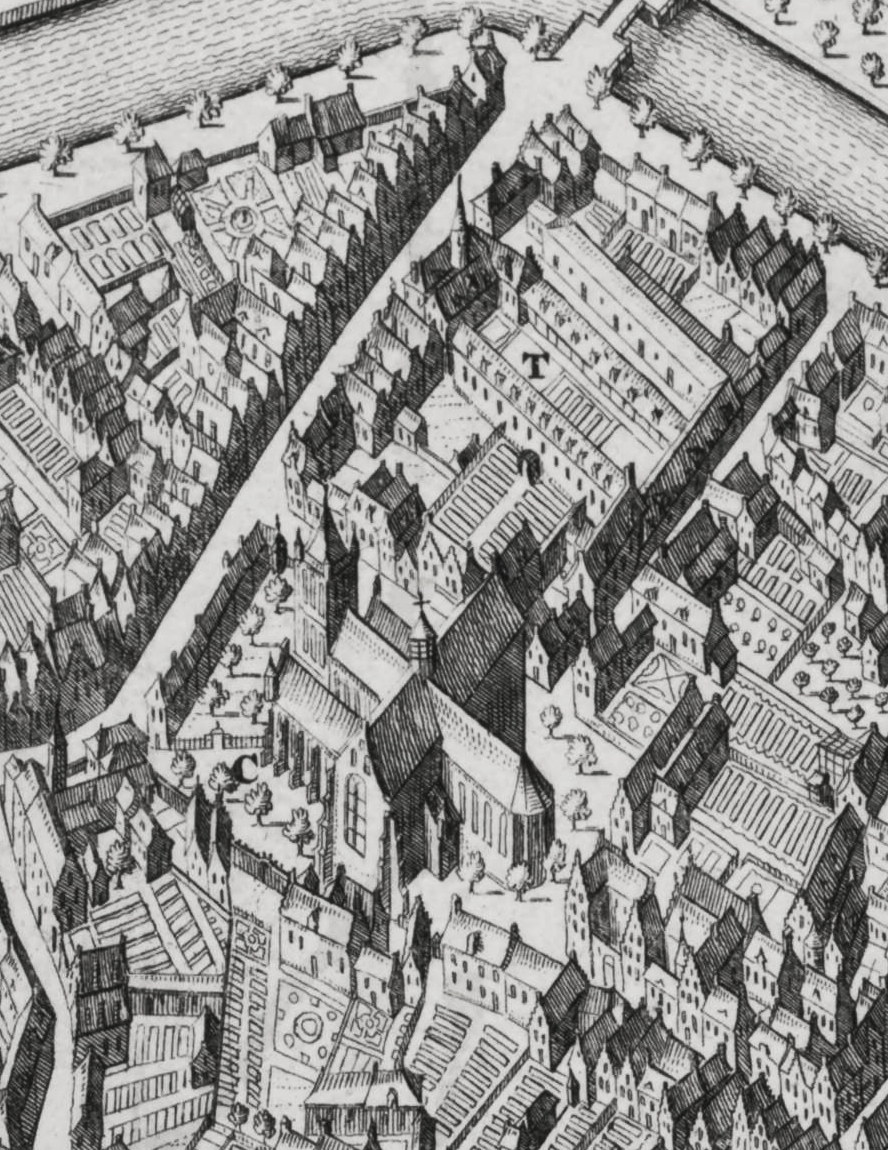
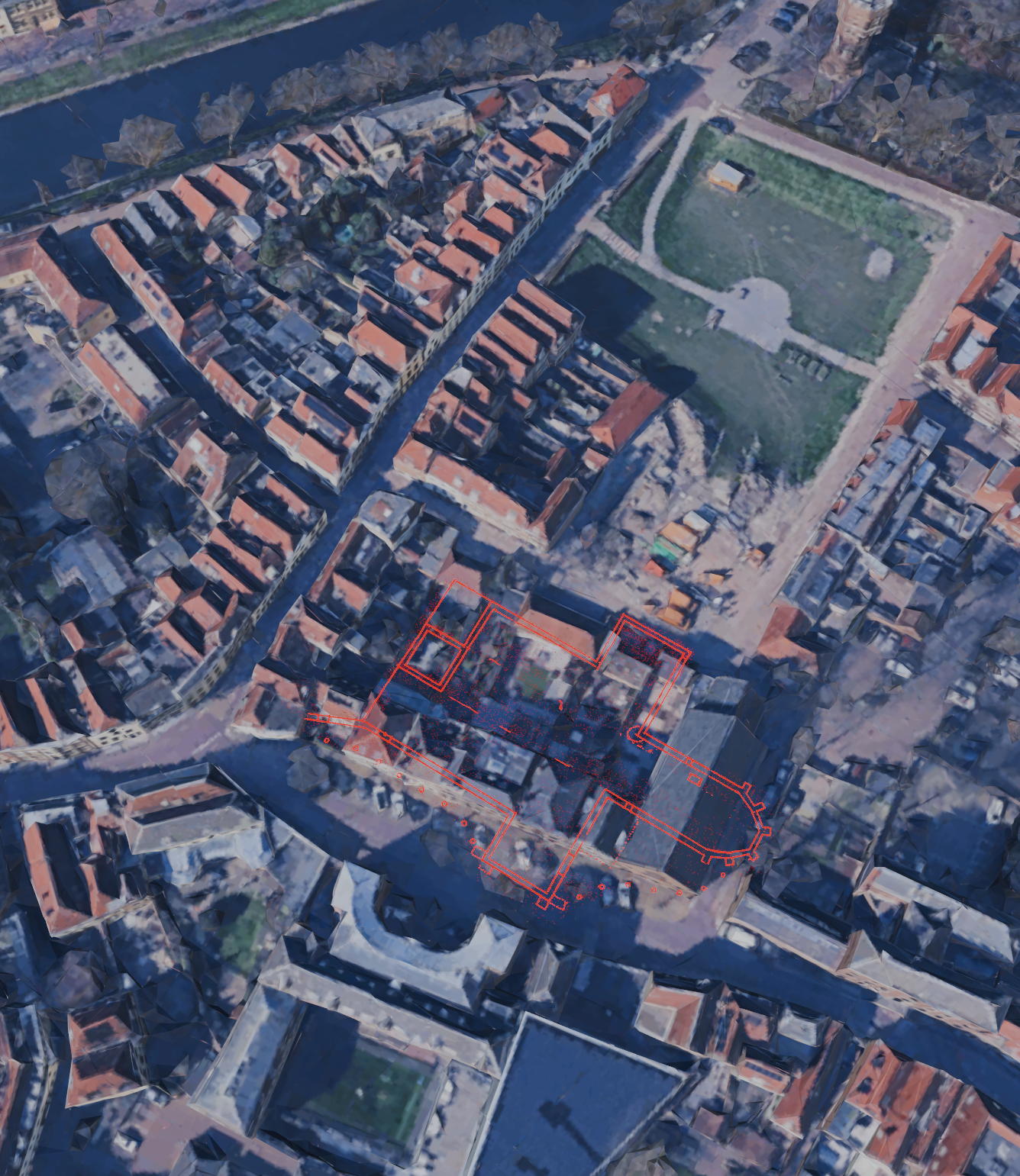
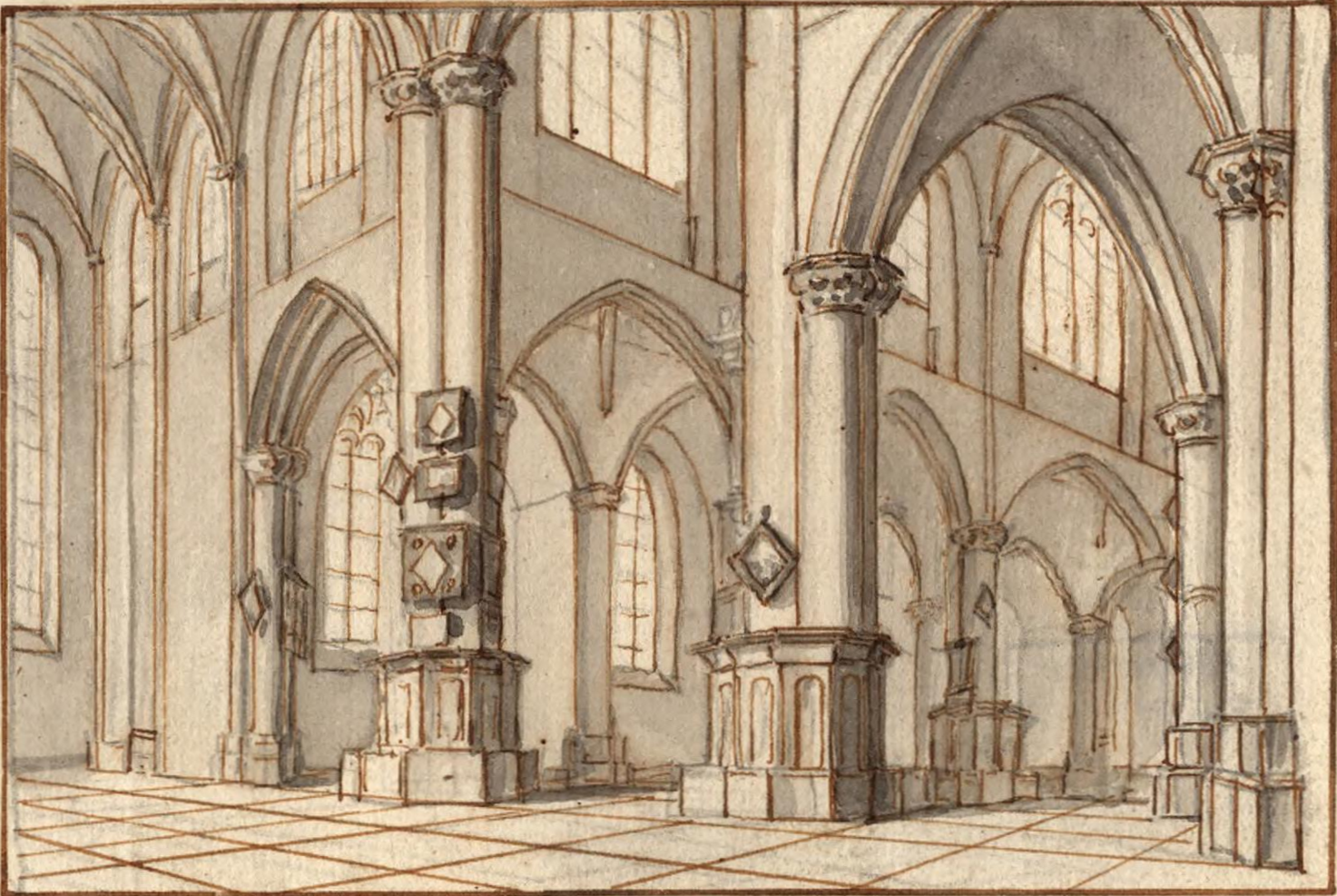
Ink on paper, by Daniel de Blieck, c.1660-5
Koninklijk Zeeuwsch Genootschap der Wetenschappen, ZI-II-2641.
The former cathedral, by then known in distinction as the Oude Kerk, seems to have never recovered from when it was used for garrisoning soldiers to guard against the 1809 British expedition known as the Walcheren Campaign in Napoleonic Wars, and was only used for burials from then until it was sold for demolition materials to contractor and hydraulic engineer Dirk Dronkers for 19,300 guilders in 1833.83 The empty plot was left as open land until it was built over in the 1890s.84 Its site, which as far I can tell has never been investigated, is now covered by buildings, including the 1930-1 Hofpleinkerk at the east end, a minimalist brick building, which ceased use as a Protestant Church in 2019.85 Since the former cathedral church building survived until the 1830s, we do have a fair few depictions of it, if not properly measured architectural surveys. We can see it had an unaisled choir with a five-sided polygonal apse (as at the east arm of Middelburg Augustinian church now known as the Koorkerk) with late Gothic tracery. The nave and transept had typical Low Countries cylindrical columns with vegetative capitals, and a clerestory with an interior dropped sill below, and outer chapels off the south aisle.86 It had a sizeable west tower, articulated as five stories, with the second to fourth stories having three blind arches to each face, and the fifth storey having four arches with the inner two open for the belfry.
Quite honestly, it’s clearly not the biggest loss on this list (even in the town, the Westmonsterkerk was clearly much more splendid), but you can see a timeline where it limped on as the Oude Kerk and now was a thriving arts venue.
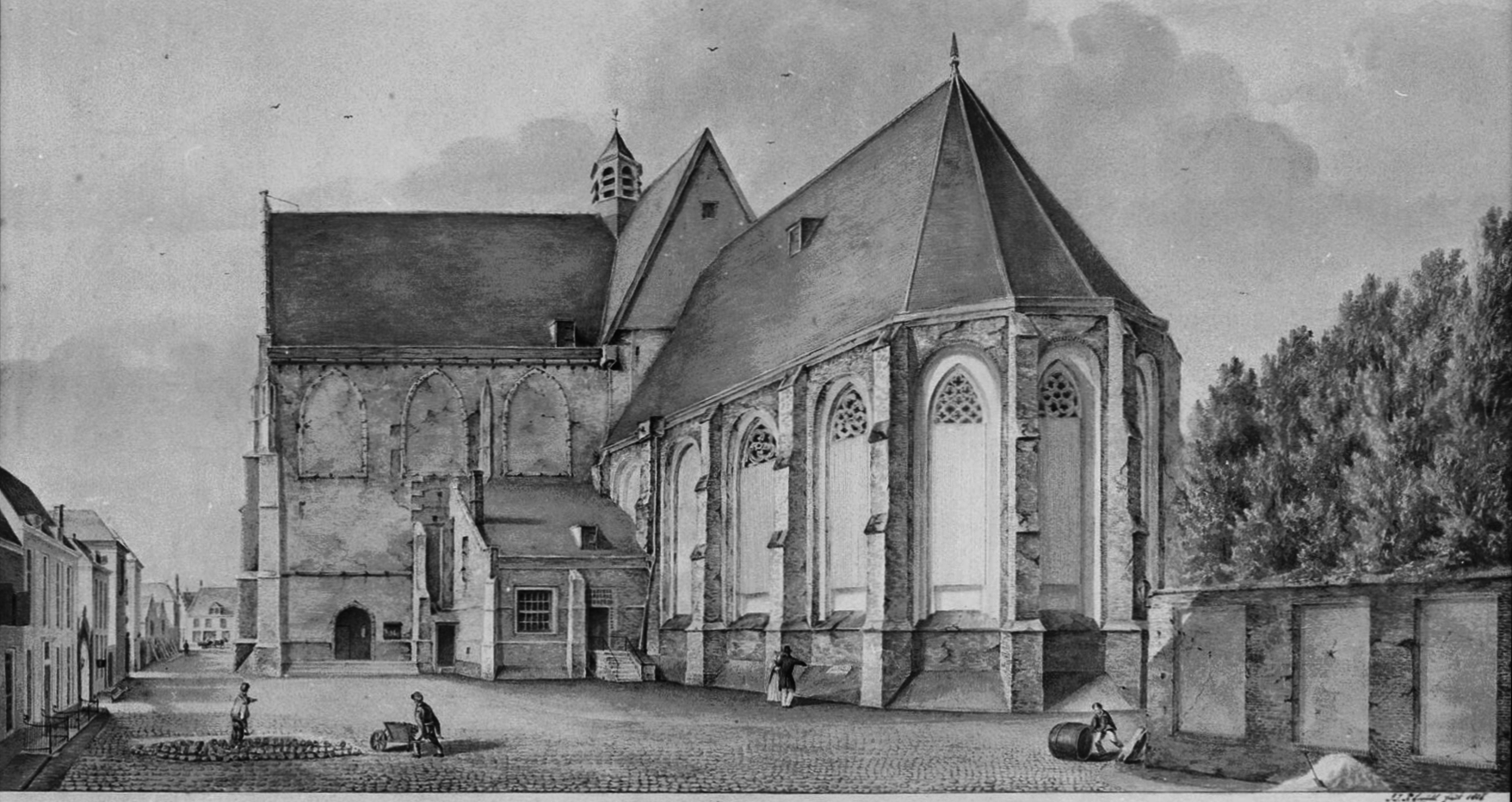
Signed print (?1826)
Image adapted from a photograph taken 1972, Rijksdienst voor het Cultureel Erfgoed
So there you go, a rag-tag bunch of 14 cathedrals that perform(ed) architecturally to very different degrees as representing the authority of the bishop within carefully constructed administrative structures of their dioceses. I hope this was interesting to someone: while preparing it my WordPress.com account finally went over its free storage limit and rather than try to have a clear-out I upgraded to a paid plan for more space. This does at least let me use my domain properly though. And I am quite taken with WordPress.com now because how of easily it lets me create the…
Footnotes
- Much as is defining “Low Countries”. The term “Netherlands” has the same literal meaning, but I mean it here to be all the parts in the northern coastal angle between Germany and France that were not part of the Kingdom of France in the Middle Ages, which includes parts of the modern states of Belgium and France as well as the modern country of the Netherlands.
My summary of the diocesan reorganisation project largely comes via L.J. Rogier, Geschiedenis van het katholicisme in Noord-Nederland in de 16e en de 17e eeuw, 3 Vols, (Urbi et orbi,1947), Vol. 1, pp.201-406, but also from findings from subsequent publication and work that stands central to modern scholarship on the episode: Michel Dierickx S.J., De oprichting der nieuwe bisdommen in de Nederlanden onder Filips II (1559-1570) (Uitgeverij Het Spectrum, 1950) and subsequently Documents inédits sur l’èrection des nouveaux diocèses aux Pays-Bas: Vol. 1, “Des premiers projets sous Charles-Quint à la promulgation des bulles de circonsriptions et de dotation”, 1960; Vol. 2, “De la promulgation des bulles de circonscription et de dotation à la désincorporation des abbayes brabançonnes (août 1561 – juillet 1564)” 1961; Vol. 3, “De la désincorporation des abbayes brabançonnes à l’installation du dernier des dix-huit évêques (juillet 1564 – fin 1570)” 1962, which I cannot get hold of, hence going through the following reviews:
Maurice van Durme in Revue Belge de Philologie et d’Histoire 30:1-2 (1952), pp.355-9
J. Godard in Revue Historique, T. 228, Fasc. 2 (1962), pp. 473-474.
P. H. Ramsey in The English Historical Review, Vol. 77, No. 303 (Apr. 1962), pp. 368-70
Gabriel Le Bras in Revue historique de droit français et étranger, 4th Ser., Vol. 41 (1963), pp. 115-6
Claude Malbranke in Revue de Nord, Vol. 45, No. 177 (Jan.-Mar. 1963), pp. 132-3
Claude Malbranke in Revue du Nord, Vol. 45, No. 178 (Apr.-Jun. 1963), pp. 257-8
Basil Hall, The Journal of Ecclesiastical History, Vol. 14 , Iss. 2 (Oct. 1963), pp. 232-3
P. H. Ramsey in The English Historical Review, Vol. 79, No. 310 (Jan. 1964), pp. 166-7
H. A. Enno van Gelder in Tijdschrift voor geschiedenis, Vol. 77 (1964), p.501-2.
The English wikipedia page is pretty solid and I’ve also used the Dutch one. There is much more recent scholarship beyond this, which can be seen cited in the summary of the episcopal reorganisation in Els Agten, The Catholic Church and the Dutch Bible: From the Council of Trent to the Jansenist Controversy (1564–1733), Brill’s Series in Church History, Vol. 80 (Brill, 2020), pp.12-5, https://doi.org/10.1163/9789004420229_003. ↩︎ - Also the Prince-Bishop of Liège held ecclesiastical territory there, along with small parts of the dioceses of Osnabrück, Münster, Tournai and Cologne, as can be seen in the maps. ↩︎
- A. Graafhuis, “Bulla super universas 12 mei 1559” Maandblad van Oud Utrecht 32: (1959), pp. 38-49, p.41 ↩︎
- Graafhuis, 1959, p.41. The first proposal in 1522 concerned splitting Utrecht with Leiden, in 1529 Middelburg is also included in the Netherlands, with Brussels alongside Ypres, Ghent and Bruges in the southern Low Countries, L.J. Rogier, Vol. 1, p.208.
The impressive gothic great church of St Michael and St Gudule in Brussels, new east arm begun in 1226 (but built so slowly it was rather out-of-date when it was finished) was not made a cathedral until 1961 when it was made a joint seat with Mechelen. ↩︎ - Rogier 1947, Vol. 1, pp.238-9. Sonnius was actually keen to have Leuven, the only university in the Low Countries, as the seat of one of two archdioceses, but it eventually did not even receive a bishop’s seat. Gert Gielis, “Viri docti et periti rerum divinarum: Leuven Theologians, Ecclesiastical Reform and the ‘Episcopal Turn’ in the Early Modern Low Countries” in Louvain, Belgium, And Beyond: Studies In Religious History In Honour Of Leo Kenis eds Mathijs Lamberigts and Ward De Pril (Peeters, 2018), pp.26-7, 37. ↩︎
- Rogier 1947, Vol. 1, p.213; Graafhuis 1959, p.42. ↩︎
- For the Carafa War, Michael J. Levin, Agents of Empire: Spanish Ambassadors in Sixteenth-Century Italy (Cornell UP, 2005), pp.65-6 https://www.jstor.org/stable/10.7591/j.ctv2n7gvc.6 and James D. Tracy, Holland under Habsburg Rule, 1506–1566: The Formation of a Body Politic (University of California Press, 1990), pp.176-7 and Rogier 1947, Vol. 1, p.209.
↩︎ - Rogier 1947, Vol. 1, pp.246; Graafhuise 1959, p.43. ↩︎
- The name “Super universas”, sounds rather cosmic, but simply comes from the opening words of the 1559 Bull “Super universas orbis ecclesias…” which means “over all the world’s churches…”. You can read the whole thing in Gisbert Brom and A. H. L. Hensen, Romeinsche Bronnen Voor Den Kerkelijk-Staatkundigen Toestand Der Nederlanden in de 16de Eeuw. Rijks Geschiedkundige Publicatiën 42 (Martinus Nijhoff 1922), pp.69-74. ↩︎
- Ramsay Apr. 1962, p.369. It is interesting to note this sum would seem to be a third less than the 15,000 Italian crowns which his father gifted to the to-be Cathedral of St Bavo in 1550 (see below). Italian gold coins used for large international transactions generally had the same fineness and weight of bullion (3.53/3.54 grams) so it would seem parity in units can be reasonably assumed. Peter Spufford, Money and its use in medieval Europe (Cambridge UP, 1988), pp.177-8. ↩︎
- Hall Oct. 1963, pp. 232; Gelder 1964, p.501-2. ↩︎
- Ramsay Jan 1964, p.167, Hans Cools, “Bishops in the Habsburg Netherlands on the Eve of the Catholic Renewal, 1515–59”, Episcopal Reform and Politics in Early Modern Europe, ed. Jennifer Mara DeSilva (Truman State UP, 2012), p.47. Although Sonnius was an inquisitor against heresy, the idea the new dioceses would be used to launch a Spanish-scale Inquisition were unfounded, van Durme 1952, p.357. ↩︎
- J. Godard 1962, pp. 473-474; Le Bras p. 116. The final bishop to take up his seat was Deventer, 30 November 1570, Rogier 1947, Vol. 1, p.317; Van Durme 1952, p.358. ↩︎
- Gielis 2018, pp.37-8. Even Granvelle had studied at Leuven, but not exclusively or to doctoral level. The exceptions seem to be in Tournai archdiocese who were alumni of Paris: at Namur, Antoine Havet was prior of the Dominican house at Arras and had a doctorate from the College of the Sorbonne, Biographie Nationale de Belgique (1881-5), Vol. 8, pp.801-3, and at Saint-Omer Gérard de Haméricourt, the Abbot of St Bertin, had studied at Collége de Boncourt. Henri de Laplane, Les Abbes de Saint-Bertin (Fleury-Lemaire, 1855), Vol.2, p.106. ↩︎
- Cools 2012, pp.46-62 ↩︎
- van Durme 1952, pp.357-8. ↩︎
- The Tour Octogonale is clearly a two-storey sacristy/treasury that was built at the same time as the Gothic east arm, and like the slightly earlier build at the Collegiate Church of Ripon (West Yorkshire), used archaising stylistic features. As assessed recently in Lesley Milner, Secret Spaces: Sacred Treasuries in England 1066-1320 (Brill, 2024), pp.121-127, https://doi.org/10.1163/9789004695634_009. ↩︎
- Michalis Olympios, “The Romanesque as Relic: Architecture and Institutional Memory at the Collegiate Church of Saint-Omer”, Journal of the Society of Architectural Historians, Vol. 77, No. 1 (Mar., 2018), pp.14-15, https://doi.org/10.1525/jsah.2018.77.1.10. Olympios plausibly suggests that the apsidole was carefully retained as representative of the high altar of St Audomarus’s Merovingian church. ↩︎
- M.J. de Pas, Congrès archéologique de France: 99e Session Tenue a Amiens en 1936 (Société française d’archéologie: 1937), p.485 ↩︎
- M.J. de Pas 1937, p.480. ↩︎
- The Wikipedia Commons upload of the Albums de Cröy Namur Cathedral leaf cites the exhibition catalogue, D. Misonne, Abbayes et collégiales entre Sambre et Meuse: VIIe – XXe siècle (Crédit Communal de Belgique, 1987) p.80. I cannot find who owns it: the best collection I could find of the Albums de Cröy online was 14 bindings at the Austrian National Library, but I looked for Namur in vain. There are some cool abbey churches there that no longer exist though! ↩︎
- I was hoping to find a drawing of his showing Saint-Omer, but he seems not to have visited. Instead here is his depiction of the also fully-Gothic St Martin, Ypres, which we look at below. ↩︎
- Antoine Leroi, Histoire de Notre-Dame de Boulogne (Le Roy-Mabulle, Boulogne-sur-Mer/Techner, Paris, 1839), pp.185-8 ↩︎
- Just as well. A Romanesque crypt survives underneath, but I struggled to find any good sources about the archaeology of the abbey church. And as for the replacement built over the site 1827-66 – that I’ve never encountered until now – it is genuinely one of the ugliest churches I’ve ever seen pictures of. I hope by burying this flippantly rude assessment in a footnote, no one will shout at me about it. ↩︎
- Nicolaas Van Nieuwland, appointed to Haarlem, had been appointed as an auxiliary bishop of Utrecht and titular bishop of Hebron (Patriarchate of Jerusalem) in 1541, Rogier 1947, p.283. ↩︎
- A basic overview of the chronology can be found in Annales du XIIe Congrés Archéologique & Historique: Malines – 1897 (Féderation Archéologique & Historique de Belgique, 1897), pp.160-4. Also overviews in Jan Esther, “Le Brabant” in Architecture Gothique en Belgique, Buyle et al. (Editions Racine, 1997), pp.87-8 and Christopher Wilson, The Gothic Cathedral (Thames and Hudson, 1992 rev. 2000), pp.237-8. ↩︎
- Jean d’Oisy is primarily documented as magister operis from 1357 at Notre-Dame-au-Lac in Tienen. Esther in Buyle et al. 1997 pp.84-5. Establishing Jean’s exact role in the creation of Brabantine Gothic is a rather fraught one I won’t wade into. ↩︎
- The drawing is at the Archives de l’État à Mons, inventoried as Documents précieux 4. Merlijn Hurx “Collaboration and Competition: Master Masons and Painters in the Production of Architectural Designs in the Low Countries in the 16th Century”, Architectural Histories 11:1 (2023), https://doi.org/10.16995/ah.9179. ↩︎
- Wilson 1992 rev. 2000, p.245; for an overview of the Keldermans dynasty see Esther in Buyle et al. pp.100-2. ↩︎
- The Basilica of La Sagrada Família, Barcelona, begun 1882 under the designs of Antoni Gaudí, is to be completed in 2026 with a height of 172.5 m, but due to the safety margin regarding once-in-a-century earthquake events and other factors, from 2014 the build for the central tower relied on prestressed panels of reinforced concrete. See ARUP [link], [archive] ↩︎
- Part of an undercroft was also begun and some of a brick support can from the gardens to the south-east of the cathedral. An overview of the project and its large bibliography can be found at Inventaris Onroerend Erfgoed. For the three-dimensional realisation of the scheme, see Kasper Dupré, ““PLVS OVLTRE”: De reconstructie van een laatgotische droom in Antwerpen”, BA Dissertation, KU Leuven, 2019-20. ↩︎
- I suppose I ought to make a video out of this some day: Spacefleet Ecclesiastica: Cathedrals of the Iberian Peninsula. ↩︎
- Also importantly at one of the earliest mature Gothic buildings in the Empire: the Liebfrauenkirche, Trier, begun c.1227, although here the plan goes towards the centrally-planned design of the building so it is difficult to fit it into basilican-type ideas. The Benedictine Abbey church of Saint-Michel-en-Thiérache has been suggested but it seems unlikely it is the prototype. Go dive into Paul Frankl rev. Paul Crossley, Gothic Architecture (Yale UP, 2000), p.329 fn.57, you massive nerd bothering to read this footnote. It is also to my eternal annoyance that my bus to Braine never turned up during my North-East France trip last decade, but thankfully I had the option of train to get to my booked hotel in Soissons. I had it all planned out! I should have been to Braine!! Although not sure whether it would have been open anyway. ↩︎
- These dates are from the 1928 reprint of T.S. Bumpus (see below), p.vii, I’m not able to get into WW1 history to confirm quite how the town and church got pulverised. ↩︎
- “When Ypres was visited in the summer of 1908 the facade of this transept was undergoing restoration — although one had taken place about fifty years previously — and was too much enveloped in scaffolding to allow of a satisfactory survey being taken of it”, Thomas Francis Bumpus, The Cathedrals and Churches of Belgium (T. W. Laurie, 1909), p.121. pp.118-29 is a good assessment of the building a few years before it was destroyed. ↩︎
- “Wederopbouw getuigend voor Coomans’ eenheid-van-stijl-principen: onder meer ruime toepassing van natuursteen voor structurele onderdelen en parement, uniformeren van kapitelen in middenbeuk, onnauwkeurige reconstructie van blinde nissen, voornamelijk in de zuidelijke transeptarm, en eerder willekeurige houding ten opzichte van de 19de-eeuwse restauraties.” Inventaris Onroerend Erfgoed, which also provides an in-depth overview of the chronology for the construction, restoration, and rebuild. ↩︎
- This spire disappears in seventeenth-century maps due to a fire in the tower 2 September 1603, “as the result of a bad storm”. Reference in Hendrik Vanden Abeele, “What late medieval chant manuscripts do to a present-day performer of plainchant”, doctoral thesis (University of Leiden, 2014), p.152. ↩︎
- Mémoires sur la ville de Gand, par le chevalier Charles-Louis Diericx, Vol. 2, 1815, p.30 ↩︎
- Tim Tatton-Brown “The Building History of the Lady Chapels” in Westminster Abbey: The Lady Chapel of Henry VII, ed. T. Tatton-Brown and R. Mortimer, (Boydell & Brewer, 2003), pp.192-3. ↩︎
- Steven Gunn et al., War, State, and Society in England and the Netherlands 1477-1559, Oxford UP, 2007, p.ix ↩︎
- It was extremely difficult to find archaeological plans of the site online, other than isolated plans of the Carolingian rotunda. I eventually found an overview plan reproduced in Jan Moens, “De archeologie van leren schoeisel in de
middeleeuwen en nieuwe tijden in Vlaanderen. Een chronologische, technische en typologische studie. Analyse en interpretatie”, Ph.D. dissertation, Vrije Universiteit Brussel/Universiteit Gent, 2018-2019, p.115, and punched the air. ↩︎ - Joseph Mertens, “Quelques édifices religieux a plan central découverts récemment en Belgique”, Archaeologia Belgica 73 (1963), pp.146-149. ↩︎
- Antoon Viaene, “Bij een honderdvijftigste verjaring. Het einde van een kathedraal: De Sint-Donaaskerk te Brugge verkocht en afgebroken”, Biekorf 50 (1949), pp.169-180. The absolutely enormous amount of 4 million francs bid for the cathedral site for its raw materials by meester-timmerman (essentially city contractor) Dominique Maeyens will be to do with the collapse of fiat currency in the French Revolutionary state and basically wheelbarrow-full-of-paper-notes stuff as far as I understand. ↩︎
- Inventaris Onroerend Erfgoed. ↩︎
- “Deze ‘verborgen parel’ in Brugge ontdek je voortaan alleen nog met erkende gids: “Sommige bezoekers stalen zelfs stenen uit de muur””, Het Laatste Nieuws, 20 April 2023 [direct link] [archive] . ↩︎
- A detailed interpretation of the construction history can be found in C.J.A.C. Peeters, De Sint Janskathedraal te ‘s-Hertogenbosch (Staatsuitgeverij/Rijksdienst voor de Monumentenzorg,1964), pp.385-99. ↩︎
- This is an argument forwarded in Wilson 1992 rev. 2000, pp.242-3, and has been largely accepted since. ↩︎
- Formerly owned by Roermond notary and keen antiquarian collector Charles Gullion (1811-73), and perhaps commissioned by him: Gerard Venner, “De historische belangstelling van Charles Guillon“, Publications De La Société Historique Et Archéologique Dans Le Limbourg 155 (2020), p.161-5. Guillon also owned the archives of the chapter, going back to before it was converted into a cathedral, p.180. ↩︎
- Certified copy of 1906, RCE – Gebouwd 203.746. ↩︎
- Via https://aezel.eu/ontdekken/geografie/minuutplans-grondgebruik ↩︎
- Via map of the development of Roermond 1842-2015, https://aezel.eu/ontdekken/geografie/tijdlijn-kadaster. First appears tax year 1899 so presumably built the year before. ↩︎
- Gerard van der Schrier and Rob Groenland, “A reconstruction of 1 August 1674 thunderstorms over the Low Countries”, Natural Hazards and Earth System Sciences 17 (2017), pp.157-70. https://doi.org/10.5194/nhess-17-157-2017 ↩︎
- Oft-given collegiate establishment dates of 1474 and 1479 are actually when the City of Haarlem granted the getijdencollege the revenues of excises on beer and corn, and right on grazing respectively. Eric Jas, Piety and Polyphony in Sixteenth-Century Holland: The Choirbooks of St Peter’s Church, Leiden (Boydell and Brewer 2019), p.23. https://doi.org/10.1017/9781787443198.003 ↩︎
- Jas 2019 pp.5-6. Although there are eight canonical hours (Matins, Lauds, Prime, Terce, Sext, None, Vespers, Compline), the secular clergy tended to run Matins and Lauds together as one, and seven sounded more mystical, basically. ↩︎
- For Haarlem specifically, see Jas 2019, pp.21-5 ↩︎
- Rogier 1947, Vol. 1, p.222. ↩︎
- Herman J. Selderhuis and Peter Nissen, “The Sixteenth Century” in Handbook of Dutch Church History, ed. H.J. Selderhuis (Vandenhoeck & Ruprecht GmbH & Co. KG, 2014), p.196 ↩︎
- Rogier 1947, Vol. 1, pp.283-5. ↩︎
- Ingeborg Worm, “Saint Bavo [Grote Kerk] (Haarlem)”, Grove Art Online (2003) https://doi.org/10.1093/oao/9781884446054.013.90000373327
There are a number of precedents in Belgian Gothic for ambulatories with no chapels: St Leonard, Zoutleeuw (c.1231-); St Materne, Walcourt (c.1235-) and Notre-Dame-de-Pamele, Oudenaarde, 1234 (dated by external brass inscription), Architecture Gothique en Belgique, Buyle et al. (Editions Racine, 1997), pp.38, pp.52-3. It seems appropriate that the later Protestant Netherlands took these “chapel-less” east ends up, but of course when they were initially built, they were filled with altars as any Catholic ambulatory was. ↩︎ - A.J. van Egmond 2019, p.223 ↩︎
- Literally, I went through all of R. Stenvert et al., Monumenten in Nederland: Noord-Holland (Rijksdienst voor de Monumentenzorg/Zeist Waanders Uitgevers, 2006) and R. Stenvert et al., Monumenten in Nederland: Zuid-Holland (Rijksdienst voor de Monumentenzorg/Zeist Waanders Uitgevers, 2004). I know what a Holland is. ↩︎
- Worm 2003. ↩︎
- This post-choir build chronology is essentially from R. Stenvert et al., Monumenten in Nederland: Noord-Holland (Rijksdienst voor de Monumentenzorg/Zeist Waanders Uitgevers, 2006), pp.313-5. ↩︎
- Eric Fernie, Romanesque Architecture: The First Style of the European Age (Yale UP, 2014), p.76. ↩︎
- For an interpretation of the dating of the Gothic works, see R. Stenvert et al., Monumenten in Nederland: Overijssel (Rijksdienst voor de Monumentenzorg/Zeist Waanders Uitgevers, 1998), pp.99-100. ↩︎
- Photographs from above the roofspace, if you’re excited by the sort of thing, can be seen courtesy of the Rijksdienst voor het Cultureel Erfgoed ↩︎
- The Mariakerk was secularised under the Calvinists after 1578. The main vessel survives as an unroofed courtyard between the bricked-up arcades, with the south aisle mezzanined at an early date. ↩︎
- St Joseph’s site is now occupied by the library of Rijksuniversiteit Groningen, opposite its neo-Dutch Renaissance Academy Building (Academiegebouw) of 1906-9. ↩︎
- Rogier 1947, Vol 1, p.226 ↩︎
- You can actually see the different-coloured bricks on this photograph inside the lean-to roofspace. ↩︎
- Some initial publications after the discovery available online: Elisabeth Neurdenburg, “De Muurschilderingen in net Koor van de Martinikerk te Groningen”, Oudheidkundig Jaarboek, Bulletein van den Koninklijke Nederlandse Oudheidkundige Bond 3rd Ser., 4 (1924), pp.241-254; Cornelis Hendrikus van Rhijn, De Muurschilderingen in de Martinikerk te Groningen (Evern B. van der Kamp, ?1925). ↩︎
- Although it is tempting to relate these to its brief role as the Catholic Cathedral beginning in 1559, most datings tend to place them in the 1530s or 40s. See Kees van der Ploeg, “Mural Painting in Medieval Frisian Churches”, CODART.nl (March 2022) [link] [archive] ↩︎
- There is a single mention of a zeven-getijdencollege in 1534. Jas 2019, p.41. ↩︎
- Rogier 1947, Vol. 1, p.227. ↩︎
- Jacob de Jong, “Cunerus Petri” in Nieuw Nederlandsch biografisch woordenboek Vol. 5, 1921, pp.122-4. ↩︎
- This hand-coloured printing from 1616, Bibloteka Narodowa, ZZK 0.261. ↩︎
- The use of fat, non-hydraulic lime mortar in this restoration was criticised by rocks and rock products specialist Alfred Broadhead Searle in The Building News, 26 June 1914 ↩︎
- An overview of the persistent ox skins (ossehuiden/taurinis cutibus) myth can be found in Peeters 1964, pp.51-3. Despite the many consolidating excavations around the foundations of church towers in the Netherlands in modern times to secure their structure, not a shred of archaeological evidence has been found for the use of ox hides below building footings. ↩︎
- First excavated in 1943 when the market was reconstructed after bombing, and again during redevelopment in 1998, with further archaeology of the site of the nave and cemetery in 2010 due to a building demolition. Most recent archaeological report, G.M.H. Benerink, Archeologische Begeleiding en Archeologische Opgraving Bouwlocatie
Markt 65, Middelburg, Gemeente Middelburg (SOB Research, 2010). The “monster” in these churches’ names relates to “monastery”, in the same way as minster/munster. ↩︎ - Frederik Nagtglas, De Algemeene Kerkeraad der Nederduitsch-Hervormde Gemeente te Middleburg van 1574-1860, (Altorffer 1860), pp.30-1. ↩︎
- Nagtglas 1860, p.31. ↩︎
- Rogier 1947, Vol. 1, pp.313-4. ↩︎
- Nagtglas 1860, p.33. The amount Dronkers paid is something like £1,600 British sterling: using the 11.95:1 rate cited in Tate, The Modern Cambist (Royal Exchange, 1861) pp.33-4. ↩︎
- The mansions on the north side of Hofplein 9-11 are dated c.1895 in R. Stenvert et al., Monumenten in Nederland: Zeeland (Rijksdienst voor de Monumentenzorg/Zeist Waanders Uitgevers, 2003), pp.178-9. Although not uploaded at a good resolution to read the plot label certainly, you can make out the former church site marked as “terrein” in 1860 and 1873 maps. The 1818 cadastral map can be found here in this study. The measured plan can be found on Wikimedia Commons as attributed as being held by the Zeeland Society (Zeeuws Genootschap) and dated to 1814, although unfortunately I cannot find another source to confirm. The notes regarding rasterwerk (latticing) of the walls and churchyard and its height seem to point to it being a sketch regarding assessment of chattel before site disposal rather than antiquarian recording. ↩︎
- Nieuwe Kerkgemeente Middelburg website, 29 May 2019 [archive] ↩︎
- The question of whether it was vaulted is an irksome one. They are clearly there in the watercolour, but Daniel de Blieck’s sketchbook, which was presumably the in-situ reference, has no vaults in the nave, aisles or transepts, Rijksdienst voor het Cultureel Erfgoed. The truss roof of the nave looks like it’s meant to be over a vault though, also advised by the the capitals and hoods over the nave clerestory, so perhaps Daniel was combining information from a visit above the vaults in this sketch. The south aisle however, looks like it is supposed to have a genuine open timber roof. ↩︎
 Stained Glass Attitudes


.jpg)

You must be logged in to post a comment.